Green Hydrogen: India’s Green Hydrogen Push

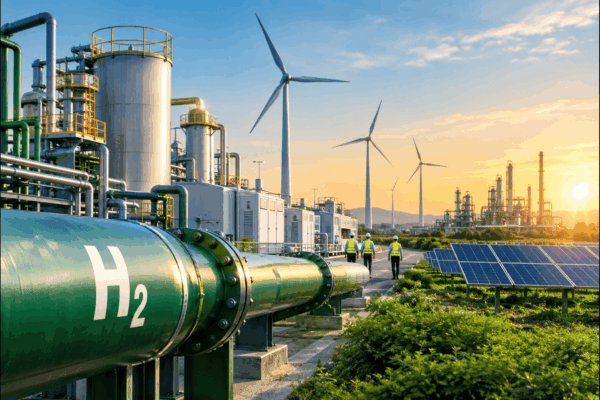
India’s Green Hydrogen Mission has moved beyond the stage of announcing ambitions. The policy architecture is now translating into electrolyser manufacturing capacity, production awards, green-ammonia tenders, refinery offtake and pilot projects. Yet the numbers also reveal the harder part of the transition: turning awarded capacity into operating plants at competitive cost, with reliable renewable power, adequate water, safe hydrogen handling and bankable long-term demand. EPC World explores
The National Green Hydrogen Mission, approved in January 2023 with an initial outlay of ₹19,744 crore, targets at least 5 million tonnes per annum (MMT) of green hydrogen production by 2030. It also envisages around 125 GW of associated renewable-energy capacity, more than ₹8 lakh crore of investment, over 6 lakh jobs and avoidance of about 50 MMT of CO₂ emissions annually.
The transition from policy to projects, however, is where India’s hydrogen story will ultimately be tested.
As of February 2026, around 8,000 tonnes per annum of green hydrogen production capacity had been commissioned. Against this, projects representing 8.62 lakh tonnes per annum had been awarded under the Mission’s production incentive programme. Separately, 15 companies had been awarded incentives for 3,000 MW per annum of domestic electrolyser manufacturing capacity.
That gap between capacity awarded and capacity operating is not necessarily a sign of failure. It is the normal but difficult middle stage of building a new industrial ecosystem. It is also where engineering, financing, infrastructure, offtake and regulation begin to interact.
From Mission to Market
The architecture of the National Green Hydrogen Mission is deliberately broader than simply subsidising hydrogen production.
At its centre is the Strategic Interventions for Green Hydrogen Transition (SIGHT) programme, which supports both electrolyser manufacturing and green hydrogen production. The Mission’s initial SIGHT allocation is ₹17,490 crore, within the overall Mission outlay.
The policy framework also attempts to address one of hydrogen’s biggest problems: a producer can build a plant, but without a buyer willing to pay for green hydrogen, the project may not reach financial closure.
This is why demand aggregation has become an important part of India’s approach. Green-ammonia procurement has emerged as one of the first sizeable demand-creation mechanisms. Competitive bidding has resulted in discovered prices for the production and supply of 7.24 lakh tonnes per annum of green ammonia to 13 fertiliser units. Green hydrogen procurement has also been taken up for the refinery sector.
The significance goes beyond individual contracts. Fertiliser production and petroleum refining already consume large quantities of hydrogen or hydrogen-derived products. Replacing existing fossil-based hydrogen with green hydrogen therefore provides a more immediate market than trying to create an entirely new hydrogen-consuming industry.
India’s existing annual hydrogen consumption is around 5 MMT, with petroleum refining and ammonia production accounting for about 99% of that demand.
The first phase of India’s hydrogen economy, therefore, is likely to be less about hydrogen-powered cars and more about decarbonising industries that already use hydrogen.
The Enabling Layer
The Mission has also attempted to reduce some of the structural costs of green hydrogen.
Projects using renewable energy for green hydrogen and green ammonia have been provided an exemption from interstate transmission-system charges for projects commissioned by the prescribed deadline, with the benefit extending for 25 years from commissioning. Other measures include renewable-energy banking, open-access facilitation and connectivity provisions.
These measures matter because electricity is the largest single cost component of green hydrogen.
Government-linked assessments indicate that renewable electricity can account for roughly 50–70% of green hydrogen production cost. Recent Indian competitive-bidding outcomes have put discovered green-hydrogen supply prices in the vicinity of ₹387–397 per kg for specified refinery supplies, including GST.
The economics consequently depend on more than the price of an electrolyser. They depend on the cost and availability of renewable electricity, transmission, electrolyser utilisation, water treatment, compression, storage, land, financing and the distance between production and consumption.
That is why hydrogen projects are increasingly being conceived as integrated energy-and-industrial systems, rather than standalone electrolysers.
The Engineering Reality
At its simplest, green hydrogen is produced by passing electricity through water in an electrolyser, splitting water into hydrogen and oxygen.
At project scale, however, the system is much more complicated.
A commercial plant requires renewable power, power-conditioning equipment, electrolyser stacks, water treatment, cooling, gas separation and purification, hydrogen compression, storage, safety systems, controls and downstream connections. If the hydrogen is converted into ammonia, another major process train is added.
The engineering challenge is therefore not simply to manufacture an electrolyser. It is to make the entire balance of plant operate reliably and economically.
Government-linked project assessments have used an electricity consumption assumption of around 53 kWh per kg of green hydrogen, with electrolyser utilisation and renewable-energy capacity factors becoming critical determinants of output.
This brings India’s renewable-energy profile directly into the hydrogen equation.
The Intermittency Problem
Electrolysers prefer stable operating conditions. Solar and wind power do not naturally provide them.
A solar-powered electrolyser can face significant variation between daylight and night. Wind generation fluctuates with weather conditions. Running an electrolyser at low utilisation increases the cost of each kilogram of hydrogen because capital-intensive equipment is being used for fewer operating hours.
One solution is to oversize renewable generation relative to the electrolyser. Another is to combine solar and wind, add energy storage, use grid electricity where permitted under the green-hydrogen rules, or design flexible electrolyser operations.
Each solution changes the economics.
The engineering objective is therefore to optimise the complete system rather than maximise the size of any one component.
Water: Small National Number, Local Engineering Issue
Water is another frequently discussed challenge.
The chemical requirement is relatively modest: roughly 9 litres of purified water are required theoretically for each kilogram of hydrogen. Actual water demand is higher because treatment, cooling and other plant processes have to be considered. A government-linked assessment notes that actual consumption can range from approximately 59 to 95 litres per kg of hydrogen when purification and cooling requirements are included.
At the national level, this does not make green hydrogen India’s largest water consumer. But national averages can conceal local constraints.
A hydrogen project located in a water-stressed industrial region may face a very different situation from a coastal project that can use desalinated seawater.
This makes project location a strategic engineering decision. Renewable-energy availability, water availability, transmission access, industrial demand and logistics all have to be considered together.
Electrolysers: Building an Indian Supply Chain
The Mission is also attempting to prevent India’s hydrogen expansion from becoming dependent on imported equipment.
The government has awarded incentives supporting 3 GW per annum of electrolyser manufacturing capacity across 15 companies.
The technology landscape includes alkaline, PEM and other electrolyser technologies, each with different characteristics in terms of operating flexibility, materials, efficiency, cost and supply chains.
But manufacturing capacity on paper is only the beginning.
The industry must establish dependable domestic supply chains for stacks, membranes, catalysts, electrodes, power electronics, compressors, control systems and specialised materials. It must also develop testing and certification capabilities and demonstrate performance over long operating periods.
This is particularly important because the global electrolyser market itself is still undergoing rapid technological and commercial change.
Hydrogen is Difficult to Handle
Producing hydrogen is only half the engineering problem.
Hydrogen has a very low molecular weight and high volumetric energy density only when compressed or converted into another carrier. This creates challenges in compression, storage and transportation.
High-pressure hydrogen systems require specialised equipment and careful control of leakage, ventilation and ignition risks. Hydrogen can also interact with certain metals, creating the possibility of hydrogen embrittlement. India’s hydrogen standards framework specifically includes standards dealing with hydrogen generators, pressure systems, storage, transportation and embrittlement-related material issues.
Safety therefore cannot be treated as an end-of-pipeline compliance issue. It has to be designed into the plant from the beginning.
Detection systems, ventilation, pressure relief, separation distances, materials selection, emergency shutdown systems and operating procedures all become part of the engineering package.
Green Ammonia Changes the Equation
For India, hydrogen derivatives may become more important than transporting pure hydrogen over long distances.
Ammonia is already produced and consumed at industrial scale, has established handling infrastructure and can serve as a hydrogen carrier. That makes green ammonia particularly relevant for fertiliser production and international trade.
The government’s decision in February 2026 to notify Green Ammonia and Green Methanol Standards represents another step towards creating a common definition of what qualifies as a green derivative. The green-ammonia standard sets a maximum lifecycle-related non-biogenic emissions threshold of 0.38 kg CO₂-equivalent per kg of ammonia, covering hydrogen production, ammonia synthesis, purification, compression and onsite storage.
For exporters, such certification becomes increasingly important. International buyers will not simply ask whether hydrogen is called “green”; they will increasingly ask how its emissions were measured and verified.
India’s Green Hydrogen Certification Scheme, launched in 2025, is intended to establish that measurement, monitoring, reporting, verification and certification framework.
Ports, Hubs and Hydrogen Valleys
The next phase will require infrastructure beyond individual plants.
The Mission’s approach includes Green Hydrogen Hubs and Hydrogen Valley Innovation Clusters, bringing production, storage, transportation and end-use closer together.
Three major ports—Kandla, Paradip and Tuticorin—have been designated as Green Hydrogen Hubs.
This reflects a broader principle: hydrogen economics improve when multiple parts of the value chain are co-located.
A coastal industrial cluster could combine renewable electricity, electrolysis, desalination, ammonia synthesis, storage and port infrastructure. Instead of transporting hydrogen itself, the project could ship ammonia or another hydrogen derivative.
For India, this could be particularly important for exports.
Where India Stands in the Global Hydrogen Economy
The global hydrogen economy is simultaneously expanding and being forced to become more realistic.
Global hydrogen demand surpassed 100 million tonnes in 2025, but almost all of it remained concentrated in traditional applications such as refining, ammonia and industrial processes. Low-emissions hydrogen production reached close to 1 million tonnes, still only a small fraction of total global production.
Global electrolysis capacity exceeded 4 GW in 2025, approximately doubling during the year. China accounted for nearly three-quarters of new installations, reinforcing its position as the world’s largest electrolyser market and manufacturing base.
The global project pipeline, however, has become more cautious. Announced low-emissions hydrogen production for 2030 has fallen as projects have been delayed or cancelled, while projects that have actually reached investment decisions remain a much smaller subset of the headline pipeline.
This is an important context for India.
The global hydrogen race is no longer simply about who announced the biggest target. It is increasingly about who can convert policy support into bankable projects, operating assets and dependable customers.
India has several structural advantages: a large domestic industrial hydrogen market, rapidly expanding renewable-energy capacity, an established chemicals and refining sector, port infrastructure, manufacturing ambitions and a policy framework specifically designed around green hydrogen.
But it also faces familiar challenges: high capital costs, renewable-power integration, infrastructure gaps, water availability at specific locations, technology learning curves and the need for predictable long-term demand.
The Policy-to-Project Test
The numbers tell the story clearly.
India has created a policy target of 5 MMT per year by 2030. It has awarded 8.62 lakh tonnes per year of production capacity, supported 3 GW per year of electrolyser manufacturing, aggregated 7.24 lakh tonnes per year of green-ammonia demand, and begun commissioning actual green-hydrogen plants.
The next challenge is execution.
An award must become financial closure. Financial closure must become engineering, procurement and construction. Construction must become commissioning. Commissioning must become stable operations. Stable operations must demonstrate the contracted cost and emissions performance. And the customer must continue buying the product.
That chain is what will determine whether India’s hydrogen ambitions become an industrial reality.
The government has also continued adding implementation mechanisms. In 2026, the Ministry of New and Renewable Energy published a model service agreement for “Electrolyser as a Service”, while continuing programmes for skilling, Hydrogen Valley clusters and innovative hydrogen applications.
Such measures indicate that the policy conversation is gradually moving from whether India should build a hydrogen economy to how the ecosystem can operate efficiently at scale.
Beyond 2030
India’s 5 MMT target should therefore be viewed as a production milestone, not the final destination.
The larger opportunity lies in creating a complete hydrogen value chain—from renewable power and electrolysers to hydrogen derivatives, industrial consumption, logistics, certification and exports.
The Mission itself has identified the possibility of expanding production towards 10 MMT annually, particularly if export markets develop.
But the international experience is already demonstrating that hydrogen does not scale merely because governments announce targets.
The winners of the next phase will be those that can solve the less visible problems: utilisation rates, electricity contracts, water treatment, equipment reliability, financing, offtake security, storage, safety, certification and logistics.
For India, the Green Hydrogen Mission has provided the policy foundation. The production awards and industrial tenders have created the first commercial bridge.
The real test now moves from the policy document to the project site.
And on that ground, green hydrogen is no longer simply an energy-policy proposition. It is becoming a test of India’s ability to integrate renewable energy, heavy engineering, industrial demand, infrastructure, finance and global trade into one new industrial system.