
Smart Construction Equipment: Engineering the Intelligent Edge

From smarter fleets to cleaner operations, technology is changing how equipment works, how it is managed and where the next wave of industry growth will come from. As connected systems, automation and intelligent controls move deeper into construction sites, they are turning machines into data-driven assets—reshaping productivity, efficiency and the competitive landscape
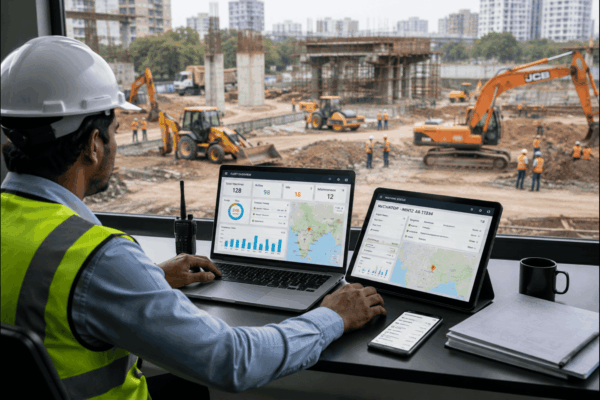
A construction site is becoming more than a place where machines move earth, lift materials and build structures—it is increasingly becoming a connected, data-driven workplace. Equipment that once operated largely on mechanical intelligence is now being equipped with sensors, telematics, digital controls and automated systems that can monitor performance, anticipate maintenance needs and provide real-time insights. The result is a fundamental shift in how machines are operated, managed and measured, bringing intelligence closer to the heart of construction activity.
The value proposition of construction equipment is being rewritten as intelligence becomes an increasingly important part of machine performance. Across project sites, the focus is shifting from how much a machine can do to how efficiently it can work, how accurately its performance can be tracked and how effectively downtime can be prevented. Connected technologies, telematics, sensors, machine-control systems and digital monitoring are consequently moving higher on the priority list for equipment manufacturers, fleet owners and contractors.
This technology-led transition is opening a new competitive dimension for India’s construction equipment market. Smart features are enabling businesses to extract greater productivity from existing fleets, optimise fuel and maintenance costs, improve equipment utilisation and gain better visibility over operations. As infrastructure projects become larger, timelines tighter and cost pressures more pronounced, the ability to combine machine capability with actionable data is emerging as a key differentiator—and is likely to influence the next wave of product development, investment and competition across the industry.
Beyond Volumes
The opportunity in India’s construction equipment market is increasingly being shaped by the sheer scale and diversity of construction activity. Roads and highways continue to generate demand for earthmoving and road-building machinery, while urban development, industrial projects, mining, logistics infrastructure and large public works are creating requirements across a much wider equipment base. This broadening demand is giving manufacturers room to expand beyond conventional high-volume categories and develop machines suited to more specialised applications.
The numbers underline the strength of this opportunity. Construction equipment sales reached 1,40,191 units in FY25, compared with 1,35,650 units in FY24, according to ICEMA (Indian Construction Equipment Manufacturers Association). While the year-on-year increase moderated to 3.3%, the industry is operating on a significantly larger volume base than it was a few years ago. Domestic sales accounted for 1,26,961 units, while exports reached 13,230 units, pointing towards a market that is simultaneously deepening at home and gaining greater international relevance.
In its recent annual meet the industry organization stated that the India’s construction equipment industry is targeting to move up the ladder to become the second-largest market globally by 2030–from the current third position– with the sector projected to expand from around $10 billion currently to $14.76 billion by 2030.
We expect that by 2030 we should be very close to around 250,000 units. Today we are the third-largest construction equipment market in the world. We expect to move to the second-largest by 2030,” said Deepak Shetty, ICEMA President and JCB India CEO and Managing Director during the ICEMA annual meet.
Earthmoving equipment remains the largest demand pool, contributing around 71% of total industry sales in FY25. The segment sold 99,159 units, with backhoe loaders and crawler excavators accounting for a substantial share. Its dominance is closely connected to the wide range of applications these machines serve—from excavation and site preparation to roadwork, mining and general infrastructure construction. As project execution becomes more equipment-intensive, the emphasis is also shifting towards machines that can deliver higher utilisation rather than simply higher capacity.
The growth story is becoming more diversified in material handling. Cranes, telehandlers and related lifting solutions are finding greater application as projects involve heavier components, tighter sites and increasingly complex material movement requirements. The segment had already recorded a 61% rise in sales during FY24, reaching 18,684 units. Its trajectory reflects a wider change in construction practices, where efficient movement of materials is becoming an important part of overall project productivity.
Concrete equipment is being supported by the continuing expansion of urban and transport infrastructure. The segment recorded 14,034 units in FY24, a 19% increase over the previous year. The requirement is no longer limited to simply producing or transporting concrete; consistency, speed of placement and the ability to maintain output across large projects are becoming increasingly important considerations. This creates a natural opening for equipment with greater automation, monitoring and process control.
The road-building segment, although considerably smaller in volumes than earthmoving, remains strategically important. Sales reached 6,571 units in FY24, following 40% growth. Demand for pavers, compactors, milling machines and allied equipment is likely to remain closely tied to the pace and composition of road development. At the same time, the segment offers manufacturers an opportunity to introduce more precision-oriented technologies that can improve construction quality and reduce material and operational losses.
Looking onto the scenario, Vivek Hajela, Executive Vice-President and Head of Construction and Mining Machinery Business, Larsen & Toubro expressed recently while addressing the media that, “The pace of road awards improved towards to the end of the financial year. In the first eight months the appointed awards was only about 2,000 km, and between November and March an additional 5,000 km of awards happened.”
What makes the market particularly interesting is that the next stage of expansion may not be defined purely by rising unit sales. With equipment fleets becoming larger and project economics coming under greater scrutiny, buyers are increasingly looking at the total value generated by a machine over its operating life. Fuel consumption, utilisation, maintenance intervals, uptime, operator performance and resale value are consequently gaining importance.
This is where smart technology can alter the competitive equation. A machine capable of communicating its operating condition, identifying performance deviations, supporting preventive maintenance or helping an operator work more accurately can deliver value well beyond its basic mechanical function. For India’s construction equipment industry, therefore, the larger market opportunity lies not only in putting more machines on sites, but in making every machine more productive, measurable and connected.
The e-Advantage
As construction projects become larger and geographically dispersed, contractors are dealing with growing fleets, tighter execution schedules, rising fuel and maintenance expenses and an increasing shortage of skilled operators. Smart technologies can address several of these pressures simultaneously by bringing greater visibility into machine performance and converting equipment-generated data into actionable information.
The scope for adoption is particularly wide because construction equipment operates in demanding environments where even small improvements in utilisation can have a measurable impact on project economics. Telematics can provide fleet owners with a real-time view of machine location, operating hours, fuel consumption, idle time and utilisation. Sensors and onboard systems can monitor critical parameters and alert users when performance moves outside normal limits. Instead of waiting for a machine to fail, maintenance teams can increasingly plan interventions around actual equipment condition, reducing unexpected stoppages and improving asset availability.
Machine-control and automation technologies can take this advantage further. Equipment fitted with positioning systems, digital grade control and automated functions can help operators achieve greater accuracy with fewer manual adjustments. On road projects, for instance, technology can support more consistent grading, paving and compaction, while on excavation sites it can assist with achieving specified depths and profiles. The value extends beyond precision: reducing rework and material wastage can directly influence project timelines and costs.
Another major opportunity lies in operator assistance. Construction sites often bring together operators with different levels of experience, while the availability of highly skilled manpower remains a concern. Intelligent assistance systems can provide alerts, operating guidance and automated controls that help reduce the dependence on individual operator judgement for certain tasks. This does not eliminate the role of the operator; rather, it can allow the operator to focus more effectively on machine movement, site conditions and overall task execution.
Smart connectivity is also creating a new relationship between OEMs and equipment owners. With connected machines, manufacturers can remain engaged with equipment after it leaves the factory. Usage data can support remote diagnostics, service planning, warranty management and product improvement. Over time, this opens possibilities for more responsive after-sales models, uptime-based services and predictive maintenance packages, transforming equipment ownership from a transaction into a continuing service relationship.
The penetration of these technologies, however, will depend on how clearly their economic value can be demonstrated. Large contractors and organised fleet operators may have the resources to adopt sophisticated digital platforms, but smaller contractors remain more sensitive to upfront costs, connectivity limitations and technology complexity. The industry therefore needs solutions that are scalable, intuitive and capable of delivering measurable benefits without requiring major changes to existing workflows.
The real potential of smart construction equipment will emerge when individual technologies begin working as part of a connected ecosystem. A machine that can monitor itself, communicate with a fleet platform, support its operator and alert a service team before a failure occurs is more than a digitally enhanced machine—it becomes an active contributor to project management. As this transition gathers pace, smart technology could help the sector extract more productivity from every machine, greater predictability from every project and more value from every hour of equipment operation.
Smart Machines, Lower Footprints
Every litre of fuel saved and every unnecessary hour of machine operation avoided can add up to a significant environmental gain across a large construction fleet. This is where smart technology is beginning to make its mark. Telematics and connected monitoring can track fuel consumption, engine performance, idle time and machine utilisation, giving operators and fleet managers the visibility needed to curb inefficient operating practices and reduce avoidable fuel burn and emissions.
The sustainability advantage also extends to how machines are maintained and deployed. Predictive diagnostics can flag potential problems before they turn into breakdowns, helping equipment operate more efficiently while reducing emergency service visits, premature component replacement and downtime. Intelligent fleet management can further match machines to actual workloads, preventing unnecessary operation and making better use of energy and resources.
Smart technology is also helping prepare construction sites for the low-emission equipment of tomorrow. As electric and hybrid machines enter more applications, connected systems can help monitor battery health, energy consumption, charging patterns and machine performance. The combination of electrification with digital intelligence could therefore move the industry beyond simply replacing conventional powertrains—towards equipment that is cleaner, quieter, more efficient and smarter by design.
Turning Industry Pressures into Opportunities
The road ahead for construction equipment is not without friction. High acquisition costs, financing constraints, uneven technology adoption, shortage of skilled operators, fragmented after-sales networks and the need for reliable digital connectivity continue to influence purchasing and deployment decisions. For manufacturers and fleet owners, the challenge is no longer limited to building more capable machines; it is about making advanced technologies commercially viable, easier to operate and relevant across different scales of construction activity.
Industry stakeholders are increasingly responding by turning these constraints into areas for innovation. Equipment manufacturers are investing in localisation, connected machines, automation, alternative powertrains and technology-led after-sales support, while contractors and fleet operators are placing greater emphasis on lifecycle costs, equipment utilisation and productivity rather than the initial purchase price alone. Training and skilling initiatives are also gaining importance as smarter equipment changes the skill sets required on construction sites. The convergence of these efforts is gradually creating an ecosystem where technology adoption can become an enabler of efficiency rather than another layer of complexity.
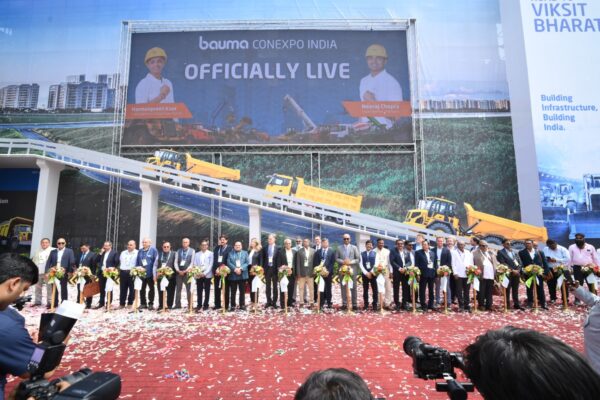
Against this backdrop, bauma CONEXPO INDIA arrives at an important juncture for the industry. By bringing equipment manufacturers, technology providers, component suppliers, contractors and other construction stakeholders onto a common platform, the exhibition provides an avenue to showcase emerging technologies, explore partnerships and identify solutions to evolving project requirements. More importantly, such industry platforms can accelerate the exchange of ideas around smart equipment, sustainable technologies, automation and digitalisation. As the sector moves towards its next phase of growth, the expo presents an opportunity not merely to display what the industry can build today, but to shape what construction equipment in India can become tomorrow.
Tags