Commercial Vehicle: From Road Freight to Connected Fleets

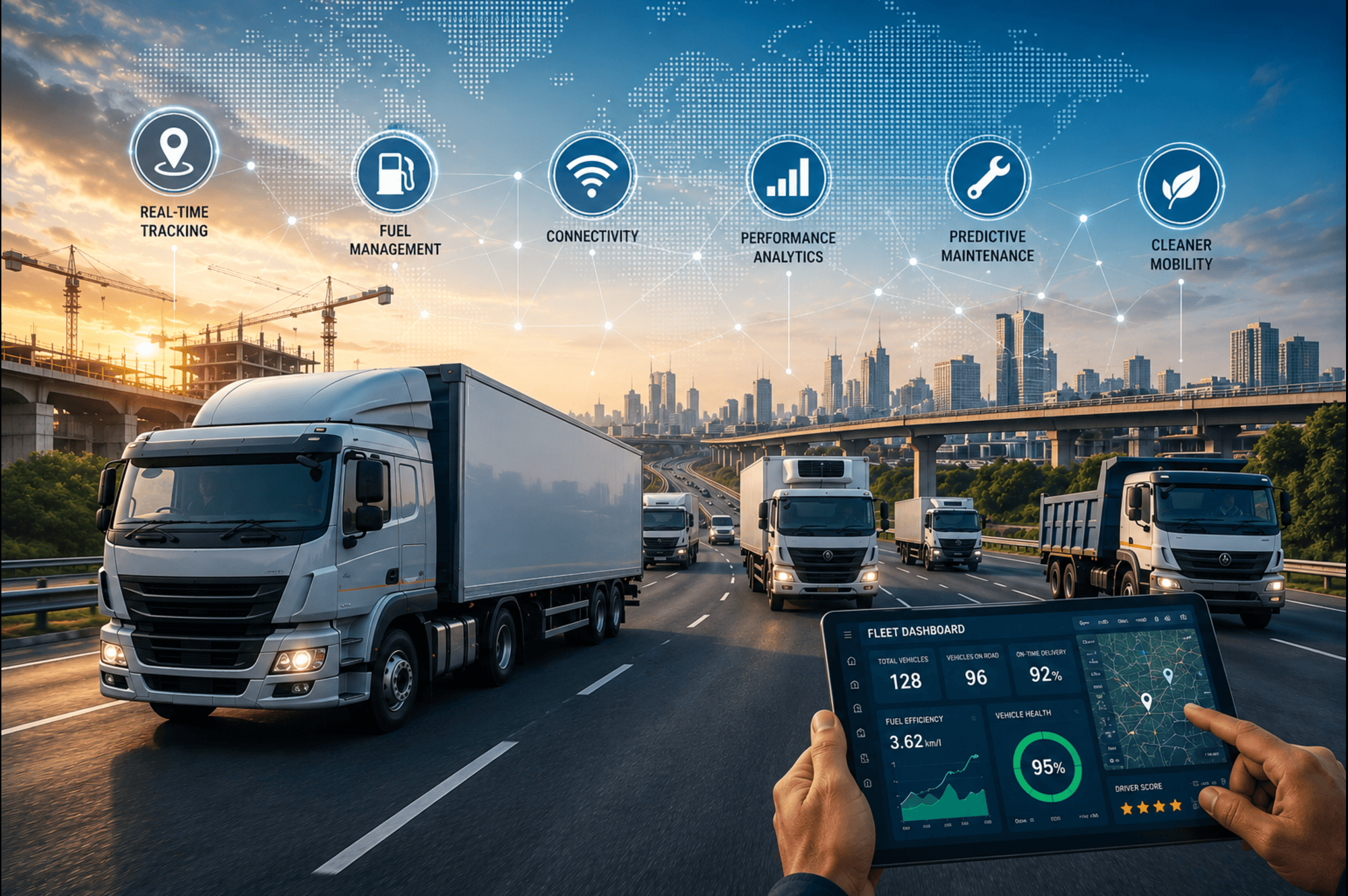
Beyond sales growth, India’s M&HCV sector is entering a new phase shaped by smarter trucks, connected fleets and cleaner mobility. Rising demand from freight, construction and infrastructure is accelerating the shift towards greater efficiency, uptime and productivity
India’s medium and heavy commercial vehicle (M&HCV) segment is on a roll, driven by growing freight movement and sustained activity across infrastructure, construction, mining, manufacturing and logistics. The expansion of highways and expressways, industrial corridors, warehousing and logistics facilities, along with continued investment in real estate and infrastructure projects, is creating demand for a wide range of medium and heavy-duty trucks. As economic activity expands and supply chains become increasingly organised, the need for efficient movement of raw materials, machinery and finished goods is strengthening the role of M&HCVs across diverse applications. The government’s increasing focus on infrastructure creation, multimodal connectivity and logistics efficiency is further strengthening this momentum. Continued investment in roads, freight corridors, ports and industrial infrastructure is not only expanding the country’s physical network but also increasing the movement of goods across regions, creating a favourable environment for commercial vehicle demand. Against this backdrop, M&HCV manufacturers are stepping up their efforts to capture emerging opportunities, strengthening product portfolios, introducing new technologies and expanding their customer-support networks. The focus is increasingly on delivering greater productivity, efficiency and uptime across diverse freight and heavy-duty applications.
Market Movers: Uptick & Momentum
The strong momentum in the M&HCV segment is also reflected in the recent sales performance of leading manufacturers. Tata Motors reported a 33 per cent year-on-year increase in domestic commercial vehicle sales to 36,619 units in August 2026, compared with 27,481 units in the corresponding period last year. Within its portfolio, heavy commercial vehicle (HCV) truck sales increased 42 per cent year-on-year to 10,612 units, while intermediate, light and medium commercial vehicle (I&LCV) truck sales grew 20 per cent to 6,859 units. Ashok Leyland recorded an even stronger performance in the heavy-duty segment. The company reported total sales of 21,038 units in August 2026, up 38 per cent year-on-year. Its domestic medium and heavy commercial vehicle (M&HCV) sales increased to 12,408 units from 7,991 units in the year-ago period, registering a 55 per cent growth. The performance highlights the continuing demand from infrastructure, construction, mining and freight applications, where heavy-duty vehicles remain critical to moving materials and goods.
VE Commercial Vehicles (VECV) also posted growth during the period, with total vehicle sales rising 17.7 per cent to 8,434 units from 7,167 units in August 2025. Eicher-branded trucks and buses accounted for 8,162 units, compared with 6,924 units in the corresponding period last year, representing 17.9 per cent growth. In the domestic market, Eicher-branded trucks and buses recorded sales of 7,584 units, up 19.8 per cent from 6,331 units a year earlier. Mahindra’s Trucks and Buses business, which includes Mahindra Truck & Bus and SML Mahindra, also reported strong growth. Its overall sales of vehicles above 3.5 tonnes, including exports, increased 47 per cent year-on-year to 2,495 units in August 2026. Within the business, cargo vehicle sales rose 55 per cent to 1,532 units, while Mahindra Truck & Bus alone recorded a 56 per cent increase in cargo vehicle sales to 1,040 units. The company attributed the broader truck and bus segment’s performance to higher infrastructure spending, rising freight demand and replacement demand.
The growth is not confined to the established heavy-truck manufacturers. Force Motors also recorded strong commercial vehicle sales, while Daimler India Commercial Vehicles (BharatBenz) continues to be an important player in the heavy-duty truck market. Industry retail-registration data for August also shows the presence of other emerging players, including electric commercial vehicle manufacturers, indicating that the commercial vehicle landscape is gradually becoming more diverse. Taken together, the performance of leading manufacturers points to sustained momentum in India’s commercial vehicle market. Infrastructure spending, freight movement, construction and mining activity, replacement demand and growing logistics requirements are supporting volumes, while manufacturers are simultaneously responding with new products and technologies aimed at improving productivity, fuel efficiency, uptime and total cost of ownership.
Driving the Next Wave
Sensing the changing requirements of India’s freight and logistics market, commercial vehicle manufacturers are strengthening their M&HCV portfolios with products focused on productivity, fuel efficiency, uptime, safety and application-specific performance, backed by IoT, telematics, connected vehicle technology and digital fleet-management solutions. Mahindra Truck and Bus has introduced the new-generation BLAZO i-TRK, bringing AI-enabled iFuelSmart technology, a 320 hp mPOWER engine, iMAXX 2.0 connected technology and a 48-hour uptime guarantee to the heavy-duty segment. The truck is positioned around the broader objective of improving profitability for fleet operators by combining fuel-saving technologies with predictive diagnostics, vehicle intelligence, driver-behaviour monitoring and service-management capabilities.
Ashok Leyland has strengthened its heavy-duty portfolio with the reintroduction of its TAURUS and HIPPO trucks on the AVTR modular platform, targeting demanding applications across construction, infrastructure, mining and long-haul transportation. The focus is on higher productivity, uptime, fuel efficiency and driver comfort, reflecting the growing demand for application-specific trucks that can deliver better operating economics. The company has also expanded its AVTR range with air-suspension models designed to offer payload and productivity advantages for heavy-duty operations. Tata Motors, meanwhile, has expanded its next-generation truck portfolio across the 7–55 tonne range, covering its Prima, Signa and Ultra platforms as well as electric offerings, with improvements in safety, payload, fuel efficiency, driver comfort and connected fleet operations. Together, these launches indicate a clear shift towards trucks that are not merely designed to carry higher loads but are engineered to deliver greater utilisation, lower downtime and better total cost of ownership.
The transition is also extending beyond conventional diesel-powered M&HCVs. Blue Energy Motors has developed electric heavy-duty trucks with battery-swapping technology, while also building its LNG truck portfolio for long-haul freight. GreenLine Mobility Solutions is taking the alternative-fuel proposition further through the commercial deployment of LNG and electric trucks for freight operations. Its approach combines LNG for longer-distance, high-utilisation routes with electric trucks for shorter-haul applications, supported by charging and battery-swapping infrastructure. BharatBenz, meanwhile, continues to offer a broad 9–55 tonne truck portfolio, with its products incorporating connected-vehicle capabilities alongside technologies aimed at improving fuel efficiency, safety, reliability and maintenance costs. These developments point to an M&HCV market that is gradually moving from conventional truck procurement towards a more integrated model centred on connected vehicles, intelligent fleet operations, cleaner powertrains, application-specific engineering and lifecycle economics.
Expanding Footprint: Strengthening Reach
The M&HCV industry’s expansion is extending beyond new products, with manufacturers strengthening their physical and digital presence to reach customers closer to key freight corridors, industrial clusters, construction hubs and emerging markets. For fleet operators, particularly those running heavy-duty vehicles over long distances, the availability of dealerships, service facilities, spare parts and technical support can have a direct bearing on vehicle uptime and operating economics. As a result, OEMs are increasingly treating their sales and after-sales networks as an integral part of the commercial vehicle proposition. Daimler India Commercial Vehicles (DICV), the maker of BharatBenz trucks and buses, has recently inaugurated a new BharatBenz dealership in Uluberia, Howrah, West Bengal, strengthening its presence along the NH-16 freight corridor. The 100,000 sq ft, 16-bay 3S facility includes 12 service bays, four accident-repair bays and three Mobile Reach Vans, and is designed to service more than 500 vehicles a month. With the addition of the Howrah facility, BharatBenz’s network in West Bengal has expanded to 14 touchpoints, while DICV is also planning a dedicated Parts Logistics Centre for eastern India to improve parts availability and reduce delivery lead times.
Ashok Leyland, meanwhile, has been pursuing an aggressive expansion of its customer-facing network. The company has opened a new dealership in Rourkela, strengthening its presence in Odisha, and has inaugurated two dealership outlets in Assam to expand its reach in Northeast India. It has also outlined plans to add 30 new touchpoints in Western India to its existing network of 150 touchpoints in the region. The expansion is aimed at improving service accessibility and reducing the distance customers need to travel for support, with the company looking to strengthen coverage across a region characterised by industrial activity, logistics movement and infrastructure development. The company is also looking beyond the traditional new-vehicle sales channel. Ashok Leyland’s partnership with Shriram Automall is aimed at creating a more organised and transparent ecosystem for certified pre-owned commercial vehicles, covering areas such as vehicle exchange, remarketing, disposal and inspection. For fleet operators, a stronger used-vehicle market can improve the liquidity and resale value of existing assets while making it easier to upgrade to newer, more efficient vehicles. This becomes particularly relevant as India’s commercial vehicle fleet gradually moves towards newer emission, safety and technology standards.
VE Commercial Vehicles (VECV) is also expanding its customer interface through Eicher Trucks & Buses. The company has been building a dedicated, born-digital dealership network for its Pro X range, with new 3S facilities coming up in locations such as Jaipur, Meerut, Thanjavur and Chhatrapati Sambhaji Nagar. These dealerships are designed around an omni-channel retail experience, while integrating sales, service and uptime support. Their locations along major highways and freight routes underline the increasing importance of proximity and faster service response in commercial vehicle operations. Eicher’s wider network now spans more than 600 dealerships and 1,250-plus touchpoints, supported by more than 1.86 lakh connected vehicles. The expansion of the ecosystem is also taking place through skills development and financial support. Training technicians in advanced commercial vehicle technologies is becoming increasingly important as trucks incorporate more electronics, telematics, automated systems and alternative powertrains. At the same time, OEMs are strengthening financing options to make vehicle acquisition easier for fleet operators. Ashok Leyland has entered into financing partnerships with banks including UCO Bank and Rajasthan Gramin Bank, while Tata Motors has partnered with UCO Bank to expand commercial vehicle financing solutions across the country. Such initiatives can help improve access to organised finance, particularly for small and medium fleet operators, who form a significant part of India’s road-freight ecosystem. The growing footprint is therefore not simply about adding more dealerships. It reflects a broader shift towards an integrated ownership ecosystem in which manufacturers compete on the strength of their service reach, parts availability, financing, vehicle exchange, technician capability and digital support alongside the truck itself. As M&HCV utilisation rises and fleet owners become increasingly focused on total cost of ownership, uptime and asset productivity, the ability to provide support throughout the vehicle lifecycle is likely to become an increasingly important differentiator.
Challenges: Balancing Growth with Operating Realities
Despite the strong growth outlook, the M&HCV segment continues to face several operational and economic headwinds. High acquisition costs, rising fuel and input prices and pressure on fleet margins remain key concerns. As trucks become more sophisticated, fleet operators must balance higher upfront investments in connectivity, safety and advanced powertrains with fuel savings, productivity gains and lower total cost of ownership.
Driver availability and skill development also remain challenges, particularly as modern trucks incorporate automated transmissions, connected systems and advanced safety features. At the same time, the transition to electric and alternative-fuel M&HCVs requires greater investment in charging, battery-swapping and LNG refuelling infrastructure. Higher vehicle costs and concerns around range, utilisation and residual values could influence adoption, particularly in long-haul applications. Uptime and after-sales support are equally important for heavy-duty operators. Limited access to trained technicians, diagnostic capabilities and spare parts can result in costly downtime, particularly on long-distance routes. As technology and regulatory requirements continue to evolve, manufacturers and fleet operators will also need to invest in skills, infrastructure and fleet modernisation. The challenge, therefore, is not simply adopting new technology, but making it reliable, accessible and commercially viable across diverse M&HCV applications.
Government Policies & Initiatives
Government policies are playing an important role in shaping the next phase of India’s M&HCV market, with the focus extending from road infrastructure and fleet modernisation to vehicle safety, emissions and cleaner mobility. The continued expansion of highways, expressways, freight corridors and logistics infrastructure is supporting freight movement and creating demand for higher-capacity commercial vehicles. At the same time, fleet-modernisation measures are encouraging operators to replace older, less-efficient vehicles with newer models that offer better fuel efficiency, lower emissions and improved safety. The government’s PARIVARTAN scheme for Delhi-NCR, aimed at accelerating the replacement of older trucks and buses with BS-VI and electric vehicles, is one such initiative. The scheme provides incentives for scrapping eligible older vehicles and purchasing newer ones, while also offering tax concessions. Such programmes can help create a more structured replacement cycle for commercial vehicles and improve fleet efficiency. Meanwhile, upcoming safety requirements, including electronic stability control and advanced emergency braking systems for trucks, are expected to push manufacturers towards higher levels of active safety and vehicle intelligence. The policy focus is also expanding towards alternative fuels and electrification. Support for electric mobility, development of charging infrastructure and efforts to promote cleaner fuels such as LNG are gradually creating the ecosystem required for lower-emission freight transport. However, the effectiveness of these initiatives will depend on the availability of adequate infrastructure, financing and viable operating models for fleet owners. For the M&HCV sector, policy support therefore needs to evolve alongside technology and market requirements, ensuring that the transition towards safer, cleaner and more efficient freight mobility remains commercially sustainable.
The Road Ahead: Smarter, Cleaner, Stronger
India’s M&HCV segment is entering a phase in which growth will increasingly be measured not just by the number of trucks sold, but by the productivity, uptime and efficiency they deliver. Rising freight movement, infrastructure development, fleet replacement and expanding logistics activity are creating a favourable demand environment, while manufacturers are responding with application-specific products, connected technologies and cleaner powertrain options. The road ahead, however, will require more than new trucks. Stronger service networks, skilled drivers and technicians, financing support, charging and refuelling infrastructure and a supportive regulatory framework will be essential to unlock the full potential of the segment. As AI, IoT, telematics, electrification and alternative fuels become more deeply integrated into commercial vehicles, the M&HCV is evolving from a conventional transport asset into an increasingly connected, intelligent and productivity-focused machine. The manufacturers and fleet operators that can balance technology, total cost of ownership and operational reliability are likely to shape the next chapter of India’s heavy-duty road-freight story.
Tags