The Engineer Still Signs the Drawing, While the Machine Does the Heavy Lifting

by Arjun KJ, Deputy Manager, Structures, U-Sphere
Every structural design office is quietly wrestling with the same two problems. Most won’t say them out loud on a project call, but they shape every deadline we hit or miss. The first is a skilled labour shortage that is only getting worse. In India, 82% of employers report difficulty filling roles, with engineering among the scarcest skills, according to ManpowerGroup’s 2026 Talent Shortage Survey. The engineers who can look at a framing plan and feel where it will fail, the detailers who can take a model to Level of Development (LOD) 500 without a hundred Request for Information (RFIs), that generation is retiring faster than the industry is replacing it. The learning curve is brutal. It takes years before a junior can be trusted alone with a moment frame or a foundation under uplift, so projects bottleneck on a handful of experienced people, and everyone waits.
The second is that the apprenticeship model those experts came up through is changing. For decades this profession ran on a simple bargain. Engineers spent their early years grinding through repetitive, unglamorous work, redrawing sections, checking take-offs by hand and marking up prints, slowly developing their judgement. Those entering the industry today did not sign up for that grind. Priorities have shifted towards lifestyle and quicker outcomes, away from the long slog that used to forge a senior engineer. Most firms treat these as HR problems. In reality, they are workflow problems.
Amplifying Engineers, Not Replacing Them
The answer is not simply to hire more juniors. It is to amplify the people who can already do the work. AI works best as a genuine partner in the technical loop that drives analysis and documentation, rather than a chatbot outside the engineering process. The principle is simple. The AI does the mechanical heavy lifting. The machine provides speed and consistency, while the engineer provides judgement and accountability.
That distinction changes the equation. One senior engineer can cover ground that once needed a team of juniors handling repetitive work, while retaining responsibility for every engineering decision that matters.
What It Actually Looks Like on A Project
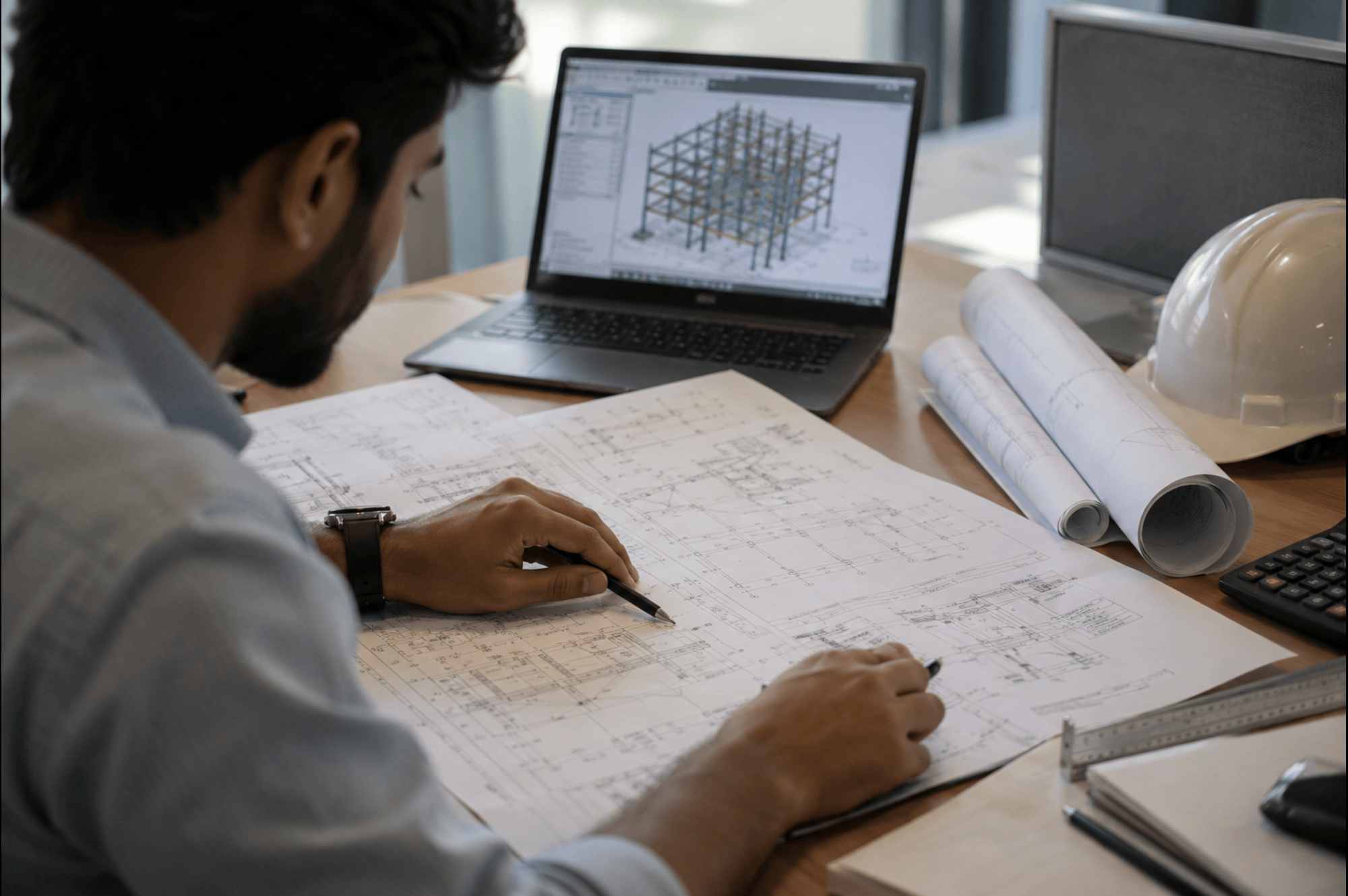
Instead of hand-building a Structural Analysis and Design (STAAD) model node by node, engineers can describe the structure once, generate the geometry, sections, supports, load cases, combinations and diaphragms programmatically, then run the analysis and parse the results automatically. A change that once took hours now takes minutes.
The same workflow makes it possible to explore multiple structural schemes instead of defending the first workable one. Alternative bracing arrangements, column systems and framing concepts can be designed to code and compared on tonnage and drift, giving clients informed choices rather than assumptions driven by time constraints.
The benefits extend beyond modelling. Changes to an analysis model can stay synchronised with digital twins, drawings and quantities, while design reports, Bill of Quantities (BOQs) and layouts are generated from a common source of truth, reducing inconsistencies across documentation.
This is the part that matters most. Automation means checking more, not less. People assume it means cutting corners, but the opposite is true. Because AI handles the grunt work, engineers have more time to verify everything, every member passing code, storey drift within limits, base shear reconciling with the seismic definition and statics balancing on every load case. Reading the model’s own drift output can catch a subtle instability in a hung stair landing that a rushed manual review might miss.
How AI Reaches the Tools
The real value emerges when AI works directly with the software engineers already use. Technologies such as the Model Context Protocol (MCP) let AI interact with analysis and Building Information Modelling (BIM) applications through a common interface. Instead of copying values between tools, instructions and results move both ways while geometry, loads, combinations, drawings and quantities stay coordinated as the design evolves. The engineer still sets the intent and signs off on the result. MCP simply makes the workflow more connected.
A New Role for the Engineer
For clients, the obvious benefit is faster turnaround. The bigger advantage is accuracy that compounds over time. Changes can be reverified automatically, design options evaluated in hours instead of weeks, and drawings, reports and BOQs are far more likely to stay aligned.
For the profession, the implications run deeper. Delivery capacity no longer depends entirely on expanding teams or waiting years for juniors to become fully productive. Experienced engineers can scale their judgement while machines absorb the repetitive work.
The firms that win the next decade will not be the ones with the most Computer-Aided Design (CAD) seats or the cheapest drafting. They will be the ones that understand the right division of labour between engineer and machine.
The technology is impressive. But the drawing still carries an engineer’s stamp, an engineer’s name and an engineer’s responsibility.