Data Centres and the Future of Energy: A New Opportunity for India

by Devansh Shah, Director, Mecpower Solutions
India’s digital economy is approaching a state in which access to consistent power will be equally vital to access to computing infrastructure. As technologies like cloud computing, artificial intelligence and digital services develop, data centres are turning into a crucial element of the country’s infrastructure. The evolution of this sector opens up wide opportunities for India. On the other hand, this raises the issue of how to supply the necessary energy for such development in a sustainable, efficient, and reliable way?
Data centres differ from most traditional commercial structures in terms of being in operation 24 hours a day, thus a power failure may disrupt their operations considerably. Therefore, reliability is one of the key factors in their design, rather than just a feature of advantage. In addition, growing electricity needs, cooling needs, and sustainability goals are changing the approach to energy management in data centres.
Lack of Just Power Availability
Historically, energy infrastructure has primarily concerned itself with merely ensuring sufficient supply of power as per demand. However for data centres simply securing capacity is not enough. Power quality, redundancy, fixed costs and supply continuity need to be factored together.
What this means is that the energy planning needs to start very early in the project life cycle. The site’s location, connection to the grid, electrical systems, backup resources, and strategies for future development must be evaluated as part of an interconnected decision-making process.
As always, the difficulties increase in magnitude as facilities expand. An energy strategy that may have worked for a small data centre does not need to remain adequate when computing demands change.
The Significance of Renewable Energy and Storage
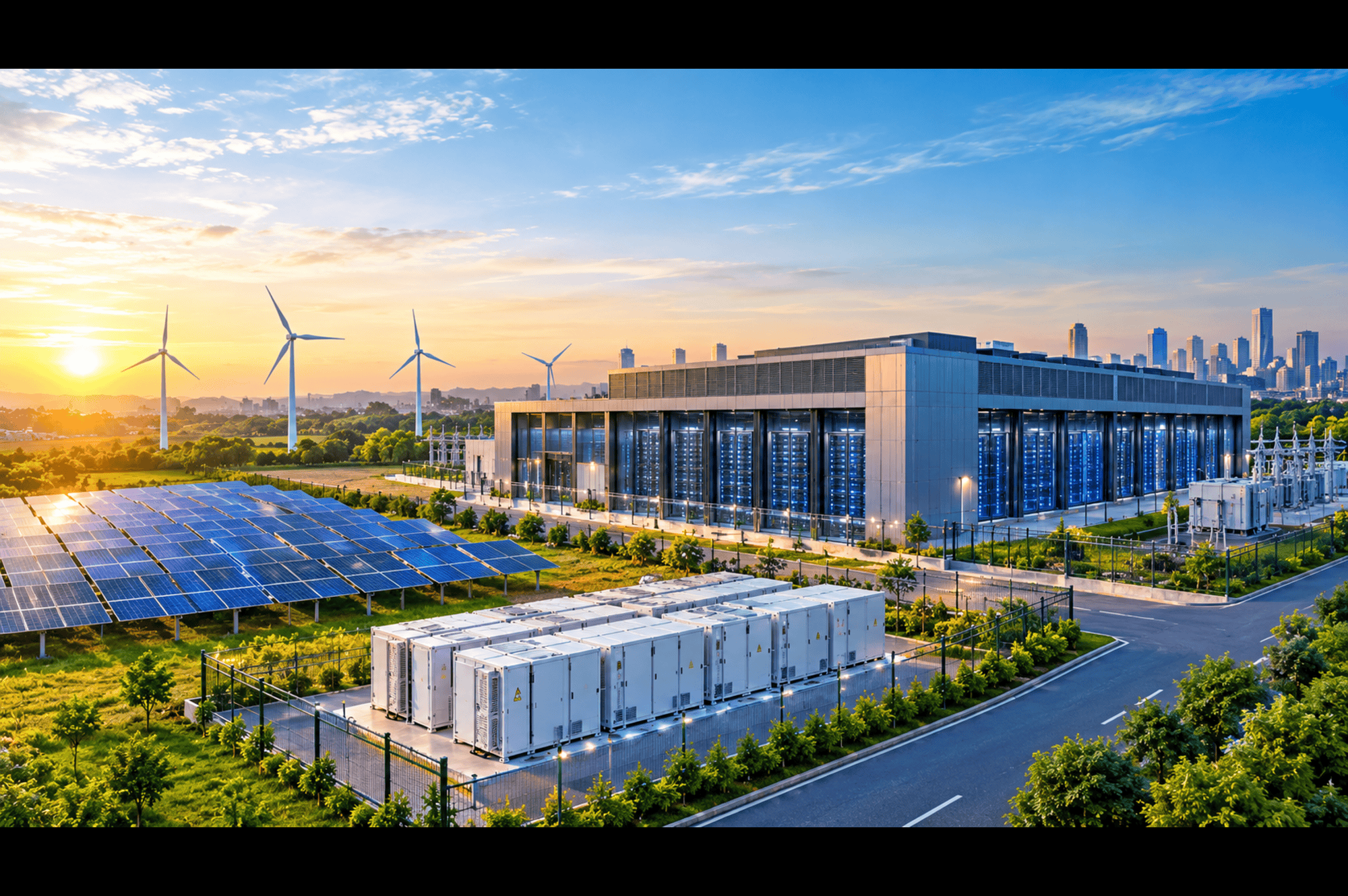
The increase in usage of renewable energy signifies a great chance to tackle the increasing demand for electricity and control the future costs of energy. The growth of renewable energy such as solar and wind in India represents a solid advancement in the progress of renewable energy utilization.
Nevertheless, the renewable energy production does not always coincide with the power demand as the solar energy is produced during the day while the need for electricity in the data centre is constant. Moreover, the wind generation is subject to weather conditions. As this leads to the need for further investments into energy production it is important to have the strategy of energy supply planned beforehand.
The use of Battery Energy Storage Systems (BESS) enables users to tackle this issue as with the help of batteries one can collect energy during its generation and use it when needed. BESS devices are usually used for peak demand management and for using energy during peak hours.
The standard backup systems are not applicable for all cases of storage, since their efficiency depends on several elements such as backup time period, type of load, grid state, economics, and required level of reliability of the system. An optimal combination of different sources may include grid power, renewables, batteries, and various backup systems.
Design For Performance, Not Just Capacity
One of the most critical things is that energy infrastructure needs to be designed around the application. Data centers differ in load characteristics, redundancy requirements and expansion timelines. Their energy systems therefore require engineering rather than a standardized approach.
That includes the assessment of an electrical design, the selection of the size of the battery, the need for power conversion, the management of the energy, and the coordination between the power sources. The monitoring and control systems will help to get insight into the demand pattern.
The lifecycle performance of an energy system is also a worthy consideration. First cost is only one component, as are losses, maintenance, equipment degradation, replacement and operational performance.
Developers and operators should be looking to build an energy system that can deliver consistent performance throughout the lifecycle of the facility and not just meet initial capacity requirements.
A Window of Opportunity for India’s Energy Ecosystem
The growth of data centers could create opportunities in various parts of India’s energy sector, including in renewable energy, battery manufacturing, electrical equipment, system integration and intelligent energy management.
This will require coordinated efforts from data center developers, utilities, renewable energy firms, storage companies, and policy makers, including grid extension and connectivity to cater to the new demand and establishment of regulations for reliable power sourcing and renewable energy and storage integration.
India also has the potential to build domestic capacity in these areas, as the needs for data centers are getting more and more complex. It will be crucial to have skills in energy storage, power electronics, systems integration, and lifecycle management.
The future of data centers will eventually transcend computing capability and digital infrastructure. Energy will continue to be a key aspect of their reliability, operations, and sustainability.
For India, the opportunity is not only to build more data centers. It is to build the energy infrastructure to support them efficiently and reliably over the long term. Those that get this link early will be better placed to build the infrastructure that can evolve as digital demand and the energy landscape change.