
Why Data Sharing and Cloud Are Gaining Momentum in India’s Construction Sector

by Harsh Pareek, Vice President – Direct Sales, Asia-Pacific, Trimble
India’s construction sector is going through a paradigm shift, with the real estate market expected to reach $82.5 billion by 2028 at a CAGR of 10.6% and is set to become the world’s 3rd largest construction market by as early as 2030.
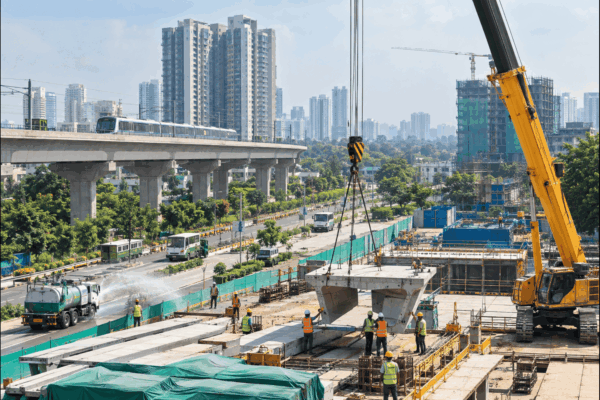
The scale of ambition is staggering, whether it is the rapid development of expressways, metro corridors, or even smart cities, to accommodate the demand generated by the migration of population to cities. The pipeline of projects is enormous, but the progress is held back by information that is fragmented, and reliance is placed on outdated technologies.
Infrastructure delays are typically blamed on capital constraints, but an issue hiding in plain sight is the flow of information between stakeholders. Gaps widen when communication between contractors and architects is delayed, project data is updated days later, and procurement decisions are made without proper data available. The effect of this ultimately is a delayed project, cost overruns, and inefficiency.
In practice, this looks less like a technology upgrade and more like a different way of working. When an architect updates a drawing on a common data environment, the site engineer in another city sees the revision the same morning instead of weeks later. Clash detection catches conflicts between structural and MEP systems inside the model, before steel is cut or concrete poured. Quantity changes flow automatically into procurement, so material orders reflect what the project actually needs today, not what it needed last quarter. The technology is unremarkable on its own; what changes is that every stakeholder is working from the same version of the truth at the same time.
Cloud technology now puts project information, the blueprints, drawings and specifications, into the hands of construction teams instantly even on a smartphone ensuring decisions are made considering all data points.
The government has also laid down the blueprint with “PM Gati Shakti” initiative, designed to ensure integrated planning and coordinated execution of infrastructure projects. The platform is built to overhaul the disconnect in decision-making by providing over 200 data layers across various ministries into a single digital platform. As of February 2026, 352 projects have been evaluated under the scheme, with 167 under implementation. This is data sharing delivering efficiency at scale through a single source of truth that ministries can plan around.
Traction is also being observed in the private sector, where Indian businesses are investing 28% of business expenditure in new technologies, putting India ahead of markets such as Japan and Singapore in the digitization of the construction sector. Driving much of this shift is cloud-based Building Information Modelling (BIM), a collaborative process that lets multiple stakeholders plan, design, and construct a structure within a single 3D model. In the deployment of BIM, India leads with a market share of 55% as of 2025, enabling teams to save time, reduce costs, and eliminate rework.
BIM enables a project team in Mumbai to share its live model with an engineering team in Hyderabad and a procurement team in Delhi while updating in real time. The Nagpur Metro Rail, with 20 major contractors working across different systems, posed serious coordination risks and the threat of cost and time overruns. To avoid the complexities that the project posed, BIM 5D was implemented to deliver consistent quality, on-time completion and a 10% saving over the estimated project cost.
Bangalore International Airport extended BIM to Terminal 2’s entire lifecycle, from design and fabrication through to operations and maintenance; showing the same toolset can deliver value well beyond the construction phase.
That momentum, however, is uneven. BIM licences and the hardware to run them remain out of reach for most small and mid-sized contractors, who still execute a significant share of construction work in India. Trained BIM modellers are scarce, and on many sites, intermittent connectivity still makes “real-time” collaboration aspirational rather than actual. There are also legitimate concerns around data security and ownership, particularly on government projects, where it is not always clear who controls the model once a contractor exits. These are real frictions, and they explain why adoption, while accelerating, is concentrated at the top end of the market rather than spread across it.
There is also a deeper, less-discussed obstacle: the contracts themselves. Indian construction contracts are still largely structured around adversarial risk allocation, where each party has a commercial incentive to control information rather than share it. A common data environment can sit on top of that structure, but it cannot rewrite it. Until tendering frameworks reward collaborative delivery, and until liability is allocated in a way that doesn’t punish the party who flags a problem early, BIM and cloud platforms will keep being deployed inside the same adversarial dynamics they were designed to dissolve. Technology is the easier half of the transformation. The harder half is contractual.
For a sector that carries so much of India’s economic weight, and where trillion-rupee projects shape the nation’s future, data sharing and cloud computing are no longer optional upgrades. They are the foundation on which projects will be delivered at the speed and quality the country now demands.
Tags