Case Study: JMT Untangles a Long-congested River Crossing with 3D Modeling and a Digital Twin

Bentley Applications Helped to Deliver Models with a High Level of Detail and Keep Numerous Stakeholders Informed
Traffic Above the Rappahannock
Some roadways are notorious for congestion—such as the span of I-95 crossing the Rappahannock River in Northern Virginia. Aside from the frustrations of sitting in traffic, the clogged area raises environmental concerns due to idling vehicles as well as potential supply chain implications related to the serious congestion. “Described as two of the busiest interchanges in the region, there have been many attempts to improve the river crossing, but they failed to materialize due to political, environmental, or historical considerations,” said Garth Donahue, director of JMT’s Design Center of Excellence.
To address the problem, the Fredericksburg Area Metropolitan Planning Organization started to investigate potential solutions on the local traffic grid, rather than on I-95 itself. Soon, they determined that local traffic could gain additional travel access between Route 17 and Route 3, avoiding that area of I-95, though it would require the construction of new bridges over the Rappahannock River. Johnson, Mirmiran & Thompson (JMT), a firm offering a full array of planning, design, and construction services, was named lead designer for the USD 114.7 million first phase of the project.
Balancing Four New Bridges
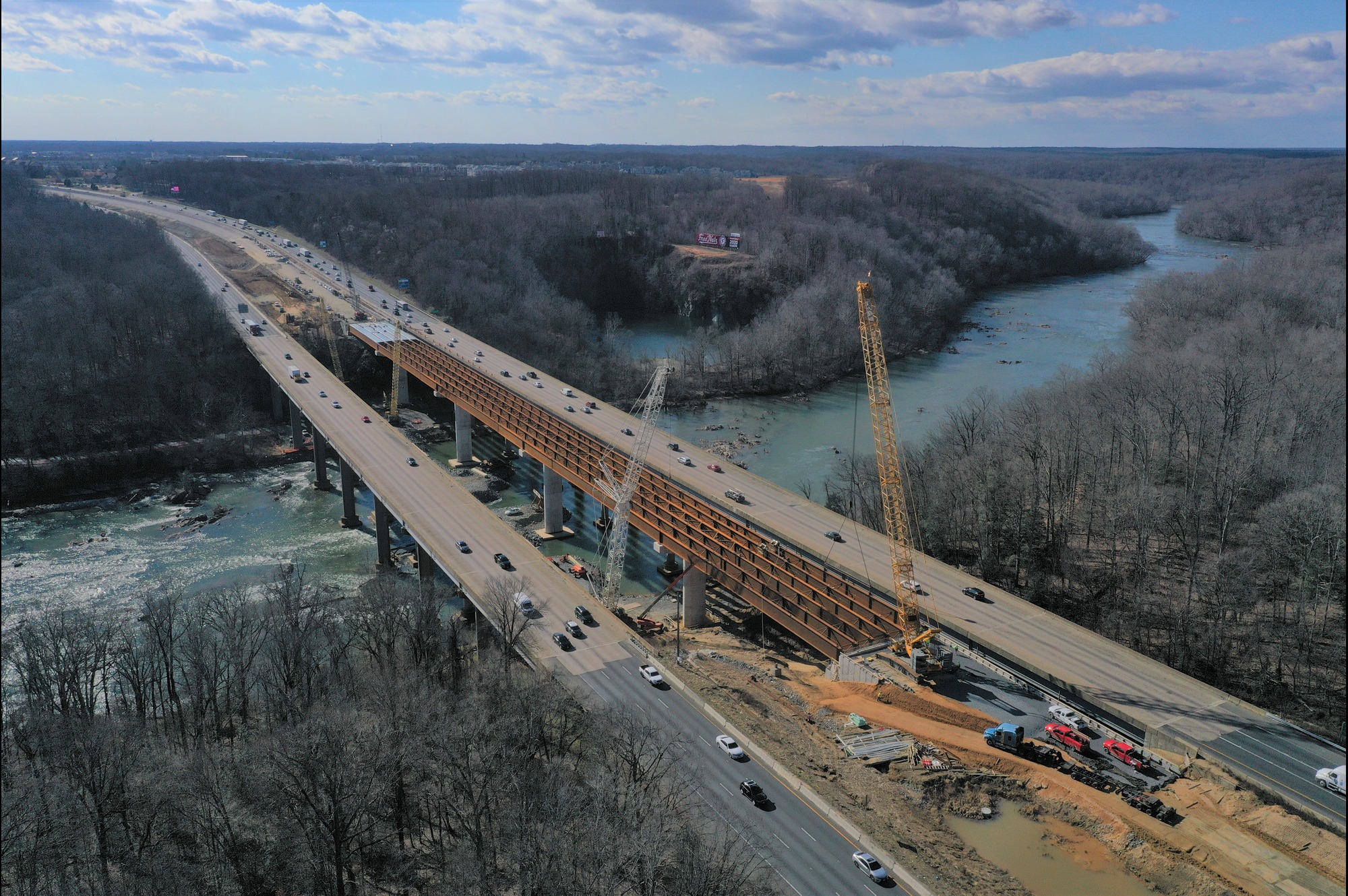
Accommodating the local traffic meant building six miles of three new southbound lanes. These lanes were added to I-95’s existing median, and existing southbound lanes were converted to a collector-distributor road between Routes 3 and 17. All told, this plan required building four new bridges—a 1,200-foot-long, 100-foot-high bridge over the river for the new general-purpose lanes in the median, a bridge over Route 17 for the general-purpose lanes, and two replacement bridges for the existing I-95 Route 17 crossings.
Since many previous attempts to improve the roadway fell short due to stakeholder concerns, JMT wanted to coordinate with many agencies, including the Virgina Department of Transportation (VDOT), the U S Environmental Protection Agency, the U S Army Corps of Engineers, and numerous state and local agencies, as well as the public. “The public involvement included a series of Pardon Our Dust public meetings that occur at each major switch in traffic during construction to inform citizens what to expect and how to navigate the construction work zones and a mixed reality outreach experience and allowed citizens to experience the bridge,” said Donahue. Though the design was complex, JMT had to keep traffic flowing in both directions during construction. Finally, this project was one of the first in Virginia that required a BIM execution plan with level of detail requirements. JMT needed robust digital design capabilities to meet both the requirements and the deadline.
Connecting Stakeholders with a Digital Twin
JMT determined that Bentley Open applications would allow them to model project assets at the very high level of detail required. And, with OpenRoads Designer and Bentley Descartes, they could take advantage of scalable terrain meshes to produce accurate representations of ground conditions. Once the roadways and bridges were fully modeled, JMT created digital twins in the iTwin Platform, then shared them to stakeholders through ProjectWise. “This allowed for project teams and stakeholders to view the models in a web portal versus having to have the design products installed,” said Donahue.
But JMT did not stop there. They imported the complete digital twin into Bentley LumenRT and created an animated experience through the model to demonstrate the product phasing for stakeholders. These videos were also shown during various public and private events. “For one such event, JMT utilized OpenCities to create an interactive web portal for users to experience the project,” said Donahue. “Users were able to interact with the model itself, view the animations created for the project, and experience the project using augmented reality utilizing the iTwin model.”
Improved Communications for Better Delivery
By utilizing Bentley applications, JMT was able to meet the deadline, as well as deliver a digital twin of the site with the required high level of detail. Sharing data and models via ProjectWise greatly improved collaboration between team members, even those working in other areas. Since Bentley applications are interoperable with many third-party applications, JMT retained their preferred workflows while enhancing delivery. Plus, the added capabilities helped them determine how to minimize the impact on traffic. “The advanced modeling capabilities, built-in analysis, and simulation tools of Bentley applications allowed our engineers to efficiently assess the management of traffic, performance, safety, and sustainability of the proposed roadway designs to help identify potential issues early in the design process thus saving time and resources,” said Donahue.
The digital twin of the project became a centerpiece of engagement with stakeholders. “JMT was not only able to assure the success of the construction within the criteria of the stakeholder groups, but also created an immersive experience of the design,” Donahue said. This immersive experience allowed viewers to learn about the construction project, get up-to date information about progress, and see what the completed roadway would look like. Other digital assets included a virtual public meeting, built on JMT’s VirtualSpaces platform, that led the viewer through the aspects of the project including animations of the proposed work zones and changes in traffic patterns. This virtual meeting, using Bentley assets, attracted three times the number of participants than the physical meeting. Ample buy-in from the community helped the project move forward to completion within the deadline. With the success of the first phase, JMT moved on to the second phase of the project, which added three more bridges in the area at a cost of USD 111.9 million.
Tags