LiDAR-Driven MLFF System Goes Live on National Highways

Manoharpur in Rajasthan, and Hyderabad in Telangana are among the first live locations in India to implement barrier-less Multi-Lane Free Flow (MLFF) tolling infrastructure on National Highways. The deployment is powered by LiDAR-based real-time vehicle detection and classification, marking a significant step toward no-stop tolling infrastructure. The deployment is being enabled through a partnership between the National Highways Authority of India (NHAI) and Cron AI’s senseEDGE platform.
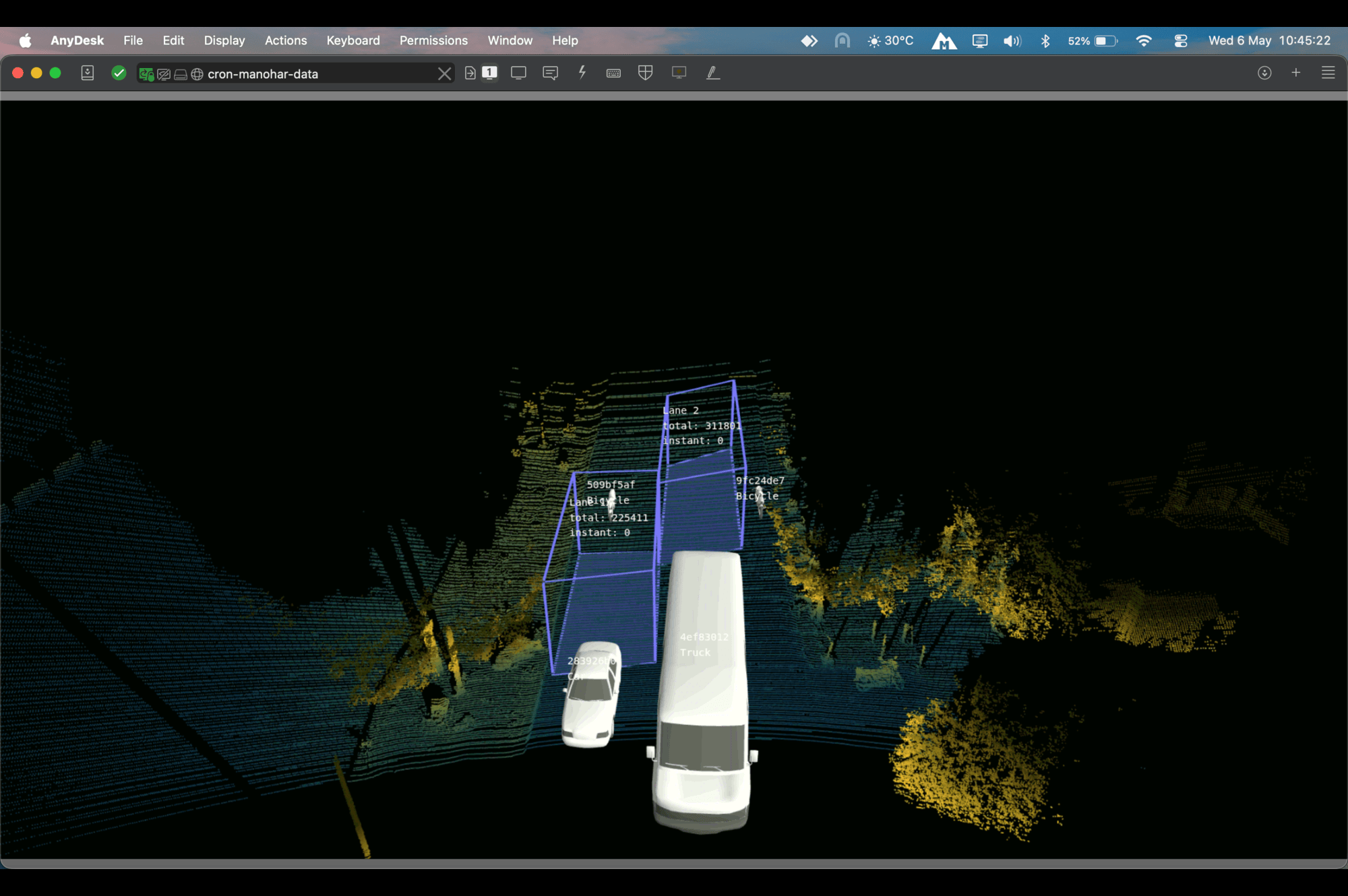
As part of the rollout, Cron AI’s proprietary senseEDGE platform has been deployed across MLFF gantries, where it detects, and classifies vehicles in real time as they move under the tolling infrastructure, without requiring them to stop at a toll plaza. The system assigns a unique tracking ID, captures number plates via ANPR, and determines vehicle class from axle count and dimensions. The platform is architected to support FASTag-linked RFID as part of the full tolling stack. The system is specifically designed to handle complex Indian traffic conditions, including inconsistent lane discipline and frequent vehicle overlap (occlusion). The deployment is expected to reduce queueing, traffic jams, idling and stop-start movement at tolling points, helping improve traffic flow and supporting better fuel efficiency and lower emissions on some of India’s busiest highway corridors.
At the core of the deployment is Cron AI’s senseEDGE platform, which combines edge AI, and 3D perception to give tolling infrastructure a real-time understanding of traffic, including edge-case scenarios such as wrong-way driving and lane-level anomalies. In an MLFF environment, where vehicles continue moving instead of slowing down at a plaza, the system must be able to identify the vehicle, classify it correctly and trigger the right tolling action instantly. Cron AI’s technology is designed for this operating environment, including conditions involving poor visibility, overlapping vehicles, glare, darkness and fast-changing traffic.
“India is moving from tolling as a checkpoint to tolling as an invisible layer of national infrastructure. That shift requires the road itself to become intelligent — able to identify every vehicle, classify it correctly, and trigger the right action instantly, regardless of speed or conditions. That is what senseEDGE is built to do, and what is now live on some of India’s busiest corridors,” said Tushar Chhabra, Founder and CEO, Cron AI.
At current deployment levels in the Manoharpur and Hyderabad, the system is capable of processing an estimated 30,000 to 35,000 vehicles per day under full highway conditions. This ability to handle high-throughput traffic without requiring vehicles to slow down is central to the scalability of MLFF infrastructure across India’s expanding highway network.
A senior official from NHAI said, “As India continues to modernize its highway infrastructure, MLFF tolling represents an important step toward improving throughput, reducing congestion at tolling points and creating a more seamless experience for road users. Technologies that enable accurate real-time vehicle detection and classification will be critical to this transition, particularly in traffic environments as dense and diverse as India’s. Deployments such as these will help strengthen the technological backbone required for the next generation of tolling infrastructure.”
As India’s National Highway network has expanded from 91,287 km in 2013–14 to 1,46,204 km as of March 2025, the need for infrastructure that can keep traffic moving efficiently across a much larger road network has grown in parallel. The Government of India has mandated the transition of over 1,100 toll plazas to Multi-Lane Free Flow systems, signalling a nationwide shift toward barrier-less tolling. With FASTag already reaching around 98% penetration and over 8 crore users, the next phase of tolling modernization lies in enabling vehicles to be identified and processed while in motion. NHAI has described MLFF as a barrier-less tolling system designed to reduce congestion and travel time at fee plazas, underscoring the need for technologies that can make no-stop tolling reliable at scale.
Tags