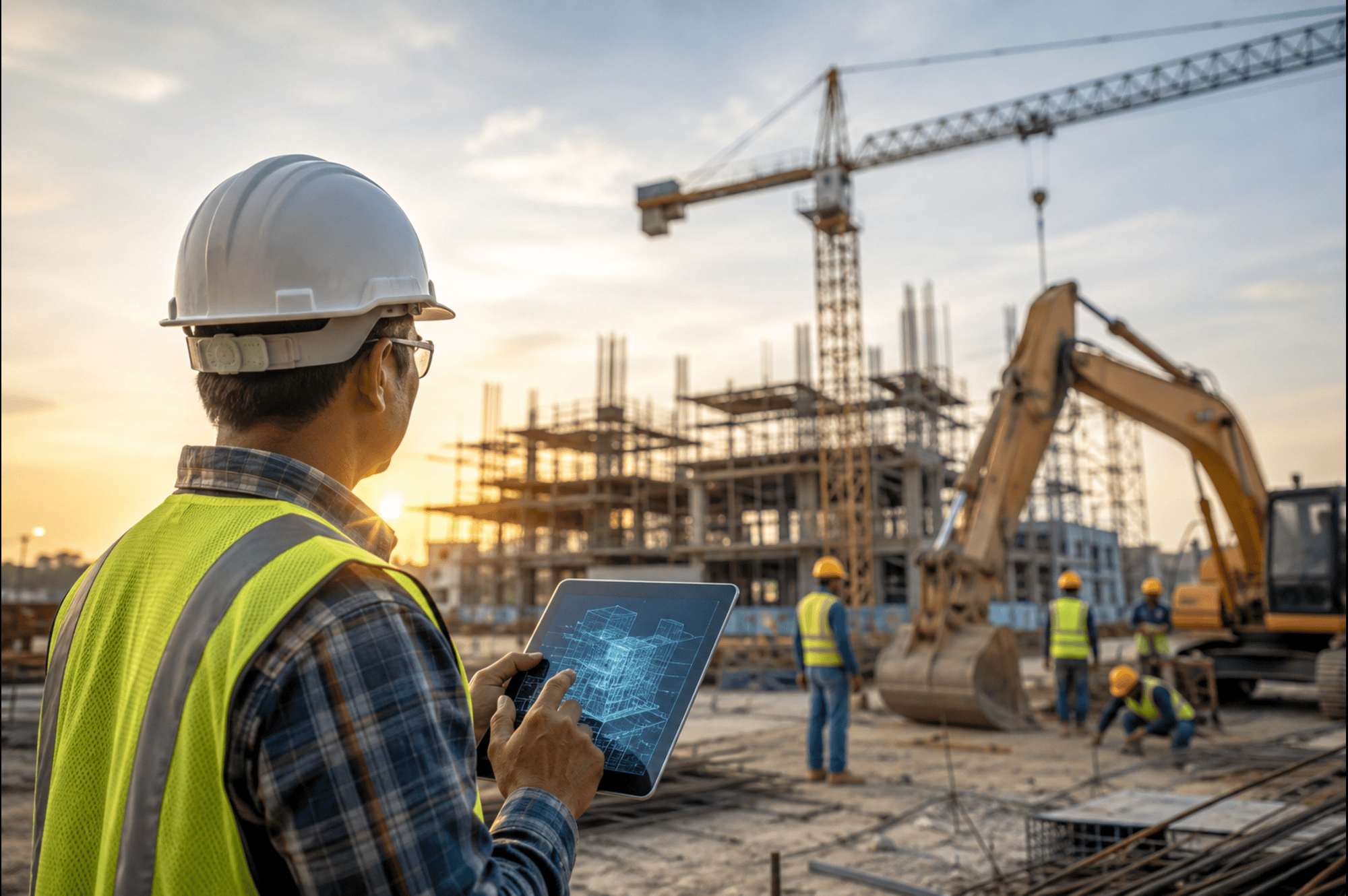
The Human Side of Digital: Empowering Construction Workers Through Smart Technology

by Harsh Pareek, Vice President, Direct Sales, Asia-Pacific, Trimble
Smart technologies are transforming construction not by replacing workers, but by empowering them with safer, more efficient, and data-driven tools. As labour shortages intensify, digital innovation is enhancing productivity, preserving expertise, and putting people at the centre of construction’s future
Construction productivity has grown by roughly 1% a year for the past two decades, compared with 2.8% for the broader world economy. That gap, laid out in McKinsey’s research on construction productivity, has usually told as a story about inefficiency, fragmented supply chains, low IT spending, projects that run over budget and over schedule. It has rarely told as a story about people. But every one of those inefficiencies eventually lands on a worker, in the form of a longer shift, a repeated task or a deadline that gets harder to hit as fewer skilled hands are available to hit it. The most useful way to think about smart construction technology is not as a fix for the industry’s numbers. It is as a way of giving the people doing the work a fairer shot at doing it well.
That framing matters because the pressure on the workforce itself is intensifying. Deloitte’s 2026 Engineering and Construction Industry Outlook projects that the industry will need roughly 499,000 new workers in 2026, up from 439,000 the year before and estimates that unfilled positions could cost the industry nearly $124 billion in lost output if the gap persists. Technology is not entering construction because firms are eager to automate people out of the picture. It is entering because there are not enough people to begin with and every tool that helps one experienced worker do the work of two is what keeps a project on schedule.
Seen this way, smart technology functions as a force multiplier rather than a replacement. A single surveyor equipped with modern positioning tools can now capture and process data that once required an entire crew and days of effort. A site supervisor with real time visibility into equipment location, material deliveries and workforce status can make decisions in minutes that used to take a full day of phone calls and paperwork. The people are still doing the work. The tools are simply helping them do more of it, more precisely, with less wasted effort.
Nowhere is the human impact of that shift more visible than in safety. Construction remains one of the most hazardous industries in the world and every innovation that reduces risk on a jobsite is, at its core, a story about protecting someone’s life and livelihood. Wearable sensors that monitor fatigue and heat stress, connected machine controls that prevent operators from working in blind spots and real time location tracking that keeps workers clear of moving equipment are not abstract efficiency gains. They are tools that let a worker go home safely to their family at the end of a shift. When technology is designed with the worker at the center, safety stops being a compliance checkbox and becomes a lived, daily experience of care.
Construction has always demanded physical toughness, but toughness should not mean unnecessary strain. Machine control systems now guide earthmoving equipment with millimeter level precision, reducing rework and the physically exhausting cycle of digging, checking and redoing the same task. Automated layout tools eliminate hours of manual measuring and marking. Connected field solutions cut down on the walking, searching and paperwork that used to eat into a worker’s day. The result is not a workforce doing less. It is a workforce spending its energy on the skilled judgment calls that only experienced humans can make, rather than on tasks a tool can now handle faster and more accurately.
One of the most important roles technology can play is in workforce development and this is where the labor numbers matter most. McKinsey has pointed out that the industry is now seeing a roughly $50 billion wave of investment in construction software and technology, with tools like AI, augmented reality and virtual reality increasingly used to train workers faster and transfer knowledge that used to live only in the heads of veteran tradespeople. Digital twins and 3D models let a newer worker visualise a project before ever touching a tool. Guided workflows on tablets and mobile devices give less experienced crew members step by step confidence on complex tasks. Rather than replacing institutional knowledge, technology becomes a vessel for preserving and scaling it, helping close the skills gap instead of widening it.
Perhaps the most underappreciated shift is this. Digital tools are giving frontline workers a voice they did not have before. Historically, the people closest to the actual work, the ones pouring concrete, running excavators, installing electrical systems, were often the last to see the data their own work generated. Reports flowed upward to project managers and executives, while the crew operated on verbal instructions and paper plans. Connected platforms are changing that dynamic. A foreman can flag an issue from a mobile device and have it addressed the same day. A field worker’s real time input on progress becomes visible instantly to the office, informing scheduling and resource decisions. This is not just operational efficiency. It is a form of respect. It tells workers that their observations matter, that their expertise is data worth capturing and that they are active participants in a project’s success rather than simply executors of someone else’s plan.
The construction technology that succeeds long term will be the kind built with deep empathy for the realities of the jobsite: dust, gloves, glare, noise and time pressure. That means intuitive interfaces that do not require an engineering degree to operate. It means hardware that survives being dropped, rained on or used with work gloves. It means training and support that respects a worker’s time and experience rather than talking down to it. The most meaningful digital transformation in construction will not be measured only in productivity curves or cost savings, though those matter. It will be measured in workers who go home uninjured, apprentices who gain skills faster, veteran tradespeople whose knowledge lives on and a workforce that feels genuinely supported, not surveilled, by the tools around them.
At its best, smart construction technology does not ask workers to adapt to the machine. It adapts to the worker, amplifying skill, protecting safety and giving every person on a jobsite better tools to do work they can be proud of. That is the human side of digital. Not technology instead of people, but technology squarely in service of them.
Tags