What India’s Hottest Summers Mean for Power Transmission Construction

by Vandana Ajay Kudalkar, Senior VP – QHSE, Jyoti Structures
India’s summers are changing rapidly. This year, extreme heat arrived earlier than usual, bringing prolonged high temperatures to many parts of the country. For the power transmission construction sector, these conditions are no longer a seasonal concern but a growing operational reality, influencing how projects are planned, executed, and delivered.
The numbers reflect how fast things are moving. Peak electricity demand on 18 May 2026 hit 256.11 GW – a new record, crossing the previous high set just weeks earlier in April. That is nearly 9% higher than the same period last year. The Power Ministry had forecast a summer peak of 270 GW; some estimates now put it closer to 289 GW. Summer is arriving sooner, running hotter, and stretching longer than what many projects currently under execution were designed around.
When the Working Window Shrinks
Transmission construction has always followed a seasonal rhythm. The cooler months before peak summer are when teams can move fastest, erecting towers, stringing conductors, finishing work near live lines. Once the heat peaks and electricity demand surges, that rhythm breaks.
When extreme heat arrives in early April rather than mid-May, those productive weeks simply disappear. Teams that had counted on that time to finish critical work find themselves short. On large projects where many activities depend on each other, one delay tends to push several others. It rarely shows up as a single dramatic setback, it shows up quietly, in stretched timelines and costs that are difficult to trace back to a single cause. This is a pattern the industry needs to account for from the start of a project, not treat as an exception when it happens.
What Heat Does to Transmission Lines
Electrical conductors – the cables that carry power across transmission lines – are designed to operate within certain temperature limits. When the surrounding air is hotter than those limits assume, the conductors themselves run hotter. Hot conductors sag lower than they should, reducing the safe clearance between the line and the ground. In extreme cases, lines can trip and go out of service even when they are carrying well within their rated load.
This becomes a compounding problem during heatwaves. Electricity demand is high because everyone is running air conditioners. Solar plants are generating at full capacity. The transmission network is under maximum stress at exactly the moment its physical capacity is most affected by the heat. India curtailed an estimated 2.3 TWh of solar power between May and December 2025 because the grid could not safely carry it – a direct consequence of infrastructure built to older assumptions.
Keeping Workers Safe When Temperatures Cross 45°C
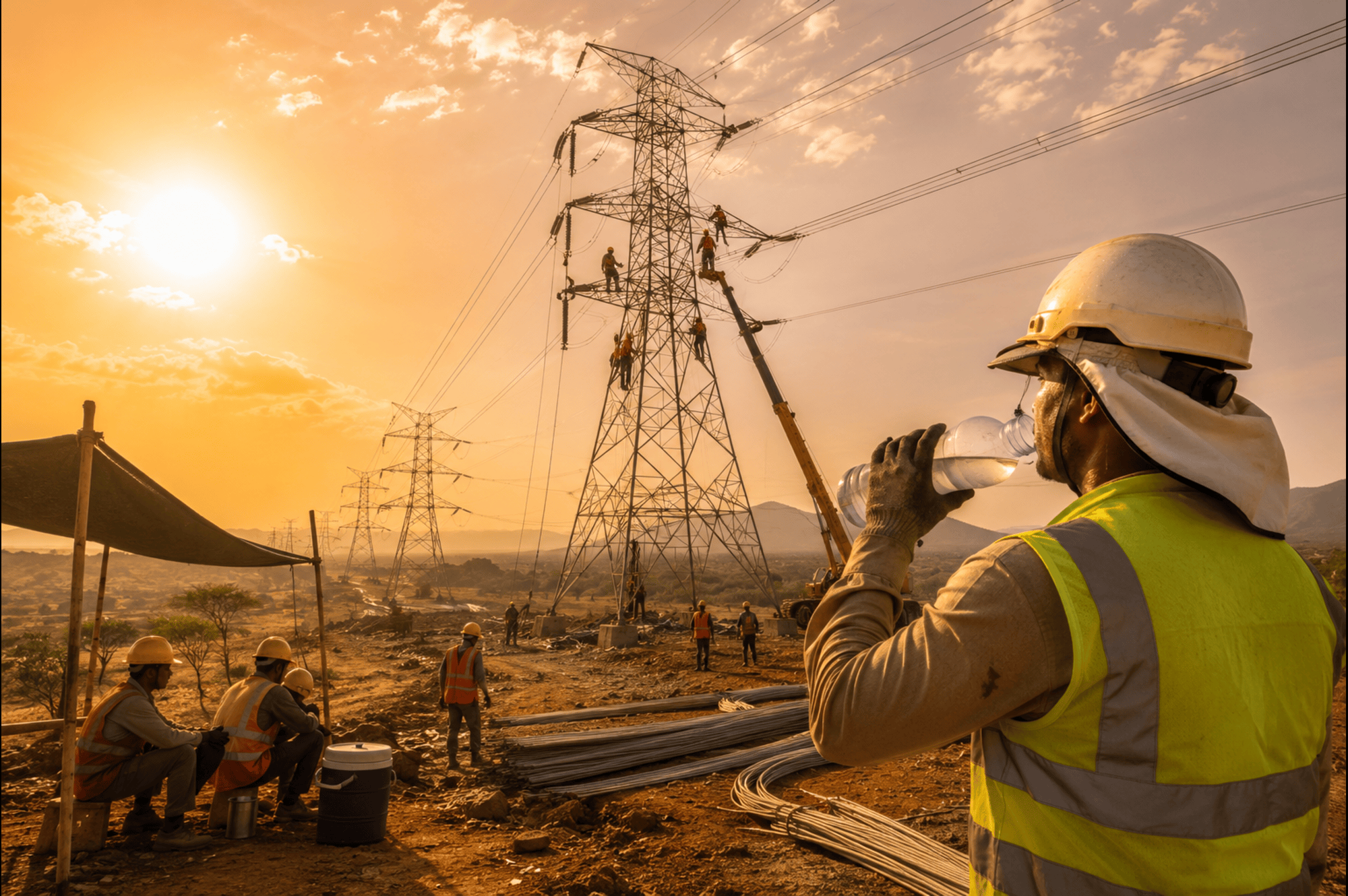
Power Transmission work is physically demanding, workers are climbing towers, lifting heavy materials, and operating in open terrain with little shade. When temperatures cross 45°C, the risk of heat stroke rises sharply, output slows, and the margin for error narrows.
Managing this well comes down to preparation and daily discipline. Before work begins each morning, site teams brief workers on heat-stress risks, hydration, and what to do in an emergency. Schedules are planned around the hottest hours, and rest areas with shade are available on site.
Workers should feel comfortable reporting symptoms as soon as they appear. Those around them often notice the early signs first, slower movement, confusion, or unusual fatigue can be visible to a colleague before the person affected recognizes anything is wrong. Making sure supervisors know what to look for, and are confident acting on it, is one of the most practical safeguards a site can put in place.
At Jyoti Structures, site-level heat management is guided by three simple principles: Support, Shade, and Share. Support focuses on ensuring continuous access to water, ORS, and electrolytes. Shade involves providing adequate rest away from direct sunlight during peak heat hours. Share means making summer safety a regular part of daily toolbox talks and site communication. Combined with early start times and planned rest periods, these measures help reduce heat-related risks across projects.
Building For the Conditions Ahead
The infrastructure being built today will operate for decades. The specifications governing conductor selection, tower design, and clearance margins need to reflect the temperatures those assets will actually experience, not the historical averages that shaped earlier generations of the network.
Industry bodies including the Central Electricity Authority and the Bureau of Indian Standards are reviewing these standards. High-temperature conductors that sag less under heat, and more conservative clearance margins in structural design, are practical steps already available to the industry.
EPC contractors who invest in design validation, testing towers and components under realistic load conditions before large-scale fabrication, are better placed to avoid failures that only surface years after a project is commissioned. At Jyoti Structures, this validation process is embedded within a certified Health, Safety and Environment framework that covers project sites and manufacturing facilities alike.
The Scale of What Needs to be Built
The Central Electricity Authority projects around 50,890 circuit kilometres of new transmission lines by 2030 to support 500 GW of renewable energy, requiring investment of approximately ₹2.44 lakh crore. That is a significant programme, and it needs to be built for the conditions it will actually face, across every season, every decade of its operating life.
Heatwaves are now a central variable in infrastructure planning. The sooner project timelines, design standards, and site safety practices reflect that, the more reliable India’s transmission network will be for the people depending on it.
Tags