The Next Wave of Data Centre Growth

Vimal Nadar, National Director & Head, Research at Colliers India
India’s digital economy is expanding at an unprecedented pace, and data centers have emerged as the key beneficiary of this ongoing transformation. Every digital transaction, cloud application, AI model, live stream, and enterprise workload ultimately relies on secure and resilient data storage & processing facilities. As digital adoption accelerates across economic sectors, India is entering a new phase of data center development that is larger, more sophisticated, and increasingly driven by artificial intelligence, cloud computing, and sustainability.
Over the last few years, India’s data center segment has evolved from a niche real estate asset class into a strategic pillar of nation development. India’s operational colocation data center capacity across the top seven cities reached close to 1,300 MW in 2025, more than doubling from 501 MW in 2020. During the same period, the sector’s real estate footprint expanded from 7.5 million square feet to over 16 million square feet in 2025.
Market Poised for Exponential Expansion
India’s data center capacity is expected to exceed 4,500 MW by 2030, representing a more than threefold increase from current levels. Correspondingly, the sector’s real estate footprint is projected to reach nearly 55 million square feet over the next four to five years. This growth will be underpinned by multiple structural drivers.
India today has more than 970 million internet subscribers and ranks among the world’s most digitalized economies. The rapid adoption of digital public infrastructure such as Aadhaar, UPI, DigiLocker, FASTag, and e-governance platforms has significantly increased data generation and storage requirements. Simultaneously, increasing smartphone penetration, expanding 5G coverage, and rising consumption of OTT and cloud-based services are creating unprecedented demand for computing infrastructure.
As enterprises continue migrating workloads to the cloud and consumers generate ever-increasing volumes of data, the requirement for large-scale, secure, and low-latency data processing facilities is expected to intensify in the long-term.
AI and Cloud Computing: The New Growth Catalysts
While digitalization laid the foundation for India’s data center expansion, artificial intelligence is expected to drive the next wave of growth. India’s AI market, estimated at over USD 9 billion in 2024, is projected to reach approximately USD 17 billion by 2030. At the same time, the country’s public cloud services market is expected to expand from USD 8.3 billion in 2023 to nearly USD 25.5 billion by 2028.
AI workloads demand significantly higher computing power, advanced GPUs, high-density racks, and enhanced cooling systems compared to traditional data center operations. This shift is prompting operators to redesign facilities capable of supporting large-scale AI and machine learning applications. Consequently, future developments are expected to increasingly focus on hyperscale facilities and AI-ready infrastructure, capable of handling large computational workloads while maintaining operational efficiency.
Rise of Hyperscale Data Centers
One of the defining trends in India’s data center market is the growing dominance of large-scale facilities. As of 2025, data centers exceeding 20 MW accounted for over 55% of total capacity across the country’s leading markets, compared to 42% in 2020. Going forward, facilities larger than 50 MW are expected to constitute nearly two-thirds of total inventory by 2030. The shift toward hyperscale infrastructure is being driven by global cloud providers, technology companies, and enterprises processing massive volumes of data. These facilities offer greater operational efficiency, scalability, and cost optimization while supporting increasingly complex digital workloads.
Beyond Mumbai: Emergence of New Growth Corridors
Mumbai continues to dominate India’s data center ecosystem, accounting for over 44% of the country’s supply addition since 2020. Together, Mumbai and Chennai currently hold nearly two-thirds of India’s data center capacity, benefiting from strong infrastructure, uninterrupted power availability, and presence of submarine cable landing stations. However, the next phase of growth is expected to be geographically more diversified.
Cities such as Hyderabad, Bengaluru, Pune, and Delhi NCR are likely to expand significantly in terms of data data center offerings. Simultaneously, Hyderabad is expected to witness substantial capacity additions over the next few years, positioning itself alongside Mumbai and Chennai as a major DC hub. The DC market is also gradually expanding into Tier II and Tier III cities such as Vijayawada, Jaipur, Mohali, Ahmedabad, Nashik, Kochi, etc. which collectively accounted for capacity to the tune of 80-85 MW in 2025. Looking ahead, such smaller cities including Indore, Lucknow, Raipur, Visakhapatnam, Hubballi, Coimbatore, and Madurai are expected to attract growing interest from DC operators and investors alike.
This regional expansion is closely linked to the rise of edge data centres, which bring computing power closer to end users, reducing latency and improving application performance. With increasing deployment of 5G networks and real-time digital applications, edge facilities are likely to play a pivotal role in India’s DC market.
Investments Worth USD 20-25 Billion Likely to Flow into the DC Market
The scale of upcoming development presents a significant opportunity for DC operators and EPC payers as well. The data center industry has already attracted investments worth over USD 15 billion since 2020. Over the next four to five years, an additional USD 20-25 billion investment is expected to flow into the sector. Importantly, real estate and construction activities account for nearly 30-40% of overall data centre development costs. This includes land acquisition, civil construction and development of electrical infrastructure, cooling systems, backup power facilities, and network connectivity infrastructure. For EPC companies, the upcoming investment cycle represents opportunities across design, power systems, renewable energy integration, mechanical-electrical-plumbing (MEP) solutions etc.
Interestingly, the recent grant of infrastructure status to data centers, favorable state-specific policies, and evolving data localization requirements are further enhancing investor confidence in the Indian DC market.
Sustainability to Become Central in Data Center Development
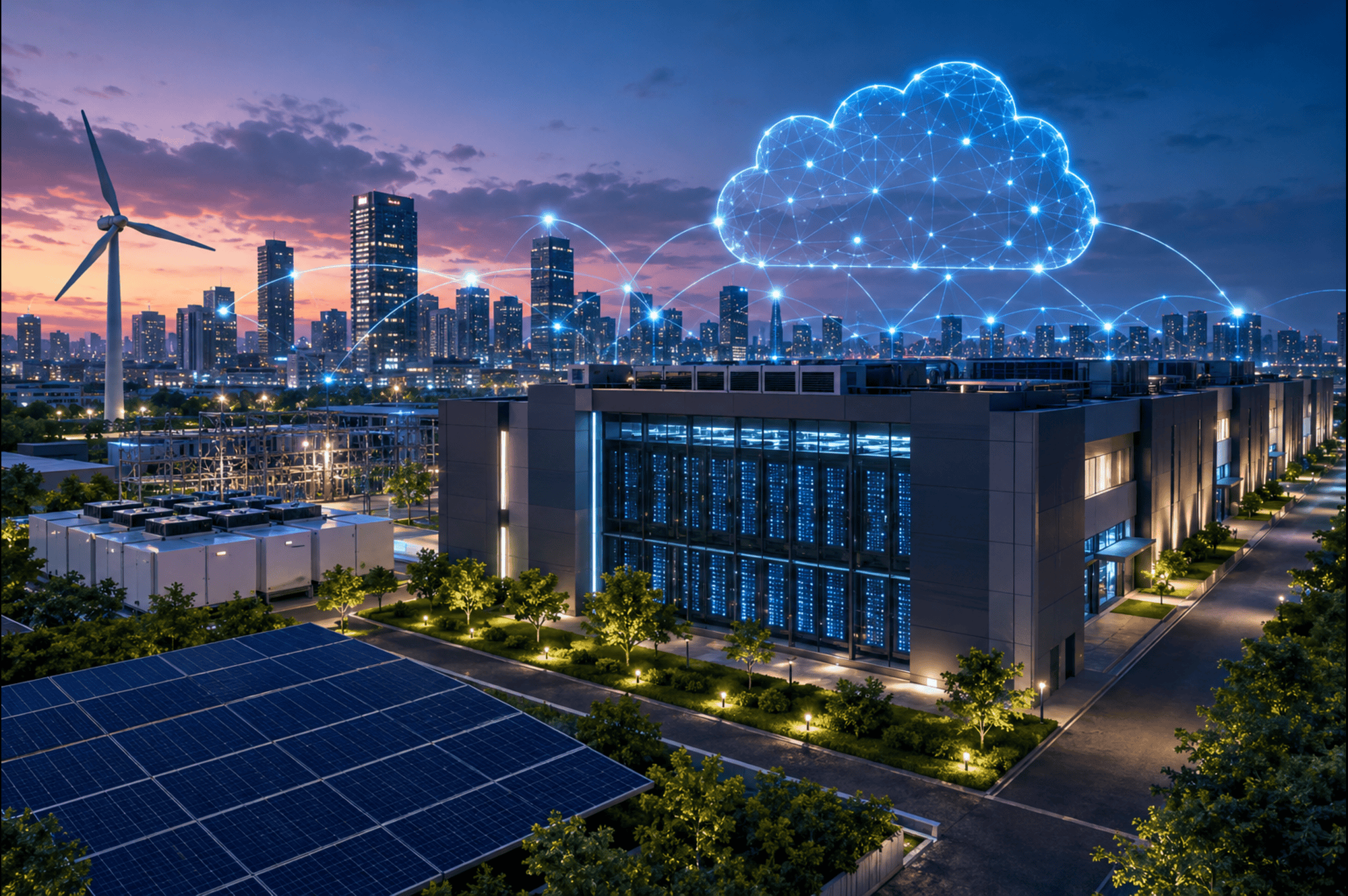
As data center capacity expands, sustainability is becoming a key focus area for operators globally and in India as well. Data centers are energy-intensive assets, and the rise of AI workloads is expected to increase power consumption further. Consequently, developers are increasingly investing in energy-efficient technologies, advanced cooling systems, renewable energy integration, and green building certifications. Currently, approximately one-fourth of the country’s operational data center capacity is green certified, and this share is expected to rise to 30-40% by 2030. The future data center ecosystem is likely to incorporate liquid cooling systems, immersion cooling technologies, AI-driven energy management, smart grids, modular construction techniques, and low-carbon building materials. In fact, sustainability will no longer be an optional feature but a core requirement in the design and delivery of future facilities.
Looking Ahead: 4,500 MW of Likely Data Center Capacity by 2030
India’s data center industry stands at a pivotal inflection point. The convergence of digitalization, AI adoption, cloud computing, supportive policies, and infrastructure investments is creating one of the fastest-growing data center markets globally. The next wave of data center growth will not simply be about adding capacity. It will be about building the digital backbone that supports India’s ambition to become a global technology and innovation powerhouse. For developers, investors, EPC companies, and real estate stakeholders, the opportunity is both significant and transformative.
Tags