How Data Centres Are Reshaping India’s Real Estate Landscape

by Hardik Pandit, Director of APICES Studio
India’s trillion-dollar digital economy is being built on a foundation of strong data centre facilities. While the creation of data centre space was once relegated to small, enterprise-owned server rooms, world-class data centres have now become a top-level strategic priority for the country. This boom can be attributed to a combination of factors, including the largest and most data-intensive mobile user base in the world, the roll-out of ubiquitous 5G, a government mandate for data sovereignty and the rapidly changing demands of artificial intelligence. Data from a 2025 KPMG report indicates that the total installed power of India’s data centres will reach over 2 GW by 2026, growing fivefold by 2030 to over 8 GW.
A significant impact of this development of data centres is being felt on India’s commercial and industrial real estate markets. Every part in the value chain – land acquisition, warehousing, power infrastructure and urban planning – is being influenced by data-centre growth.
India’s New Digital Infrastructure Corridors
Data centres attract entire ecosystems of connectivity, power and commercial development around them. These centres are typically built in areas where high-speed fibre networks, low-latency connectivity, reliable electricity and large land parcels are available. Alongside their development, they also spawn allied industries, including telecom operators, cloud providers, AI companies and enterprise technology firms. Hence, the establishment of data centres creates concentrated zones of digital activity. Mumbai has cemented its position as India’s data centre capital, as per Knight Frank’s 2025 Asia-Pacific Data Centres report. The city accounts for 40 per cent of the country’s capacity and 44 per cent of its live IT capacity, with factors such as cloud adoption, data localisation requirements and the growth of financial technology (fintech) and banking, financial services and insurance (BFSI) firms being cited as major growth drivers. Hyderabad’s strong government support and tech ecosystem, Bengaluru’s cloud and enterprise demand, and Noida’s extensive land availability and high-speed fibre connectivity have ensured that these cities are not far behind. All these cities are seeing a surge in demand for industrial land, logistics parks and fibre-connected commercial zones.
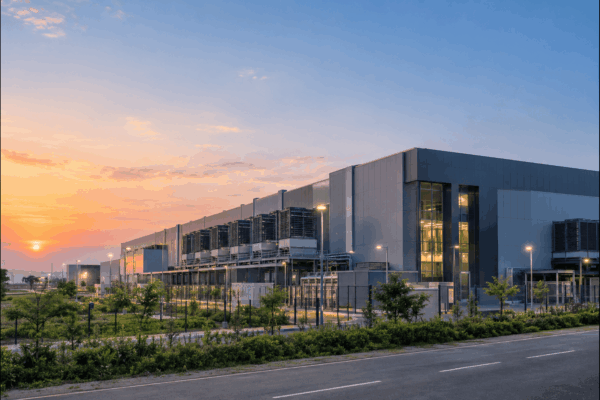
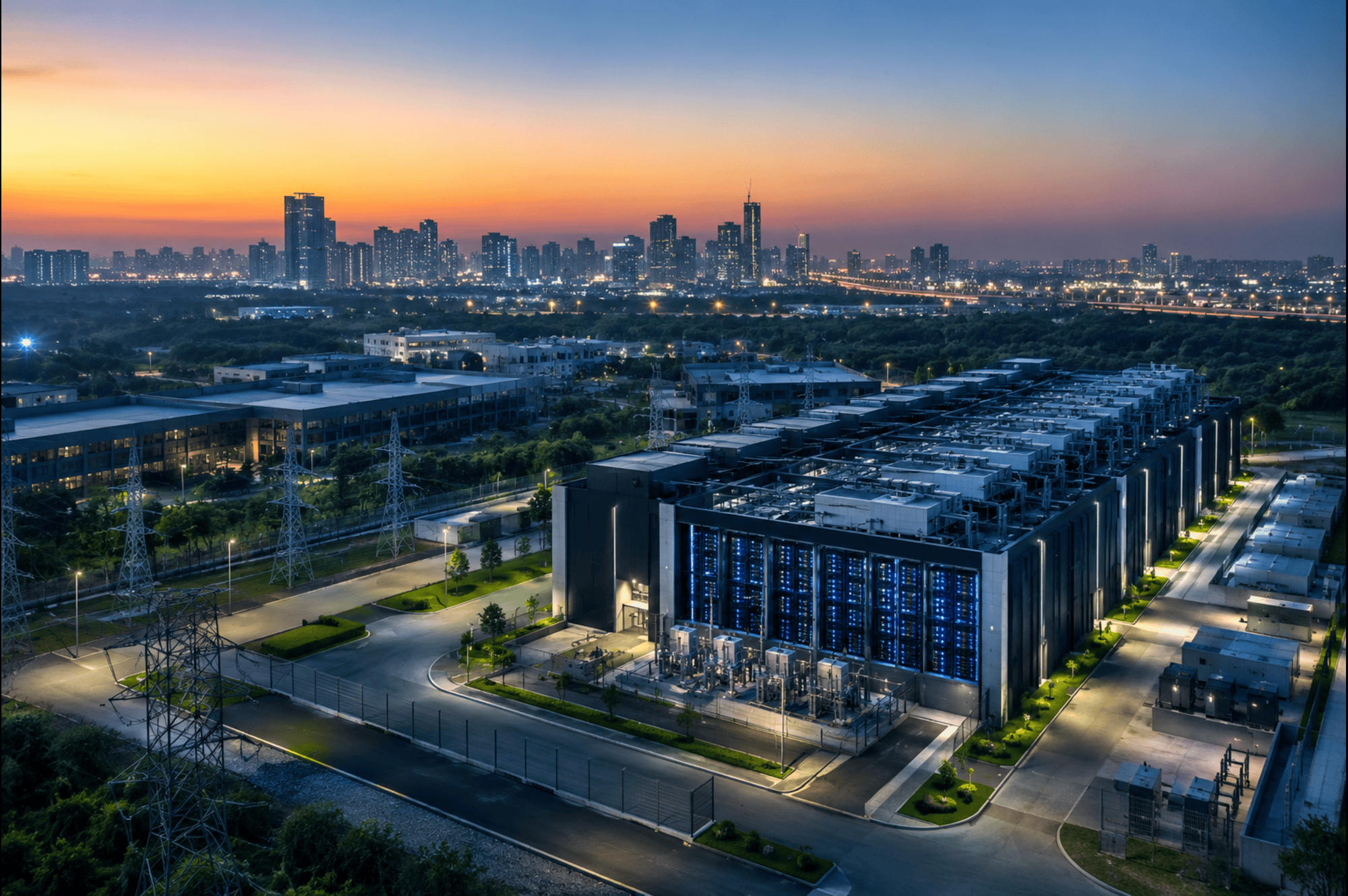
The growth of data centres also has a ripple effect on urban planning. Their enormous energy requirements are driving investments in substations, transmission infrastructure, renewable power integration and water systems, turning peripheral industrial belts into “power-ready” development zones. Real estate developers are now creating dedicated digital parks and hyperscale campuses in areas such as Navi Mumbai, Greater Noida and Hyderabad’s Western corridor, where expansion is easier and infrastructure can scale rapidly.
Mapping the Digital Boom
In India’s metros, land that would have otherwise been dedicated to IT parks or housing is now increasingly being allocated to data infrastructure. A November 2025 report from investment management firm Colliers traced an uptick in real estate funding for data centres, which accounted for 31 per cent of total private real estate funding raised globally between the first and third quarters of 2025, up from an average of 15 per cent since 2020.
However, unlike IT parks, data centres employ relatively fewer people. A 2024 study by the Virginia Joint Legislative Audit and Review Commission found that a typical 250,000-square-foot data centre employs approximately 50 full-time workers, which equates to 1 job per 5,000 square feet. Nearly half of these workers are contract workers. Thus, the study concluded that the number of jobs per square foot is much lower for data centres than competing uses of the same land. A direct consequence of this is that data centres do not driveup residential demand significantly in their neighbouring areas. However, they can increase land values in surrounding areas due to infrastructure upgrades. Tier-two cities such as Naya Raipur and Vizag are emerging as frontrunners in the data centre race. These locations offer operators the luxury of horizontal development due to ample land availability, which can be an inhibitor in more densely built-up cities. At the same time, they can also help mitigate the power constraints associated with larger, more densely clustered cities.
Real Opportunities
The most significant impact of data centres is that they are now treated as a new asset class or specialised real estate category, alongside office, retail and warehousing. Major global operators such as Equinix and Digital Realty are converting data centres into institutional-grade investments. From the perspective of investors, this asset class holds significant advantages, including longer-term leases of roughly 10-20 years, stable and utility-like income streams, and high tenant stickiness. As per McKinsey research, once a data centre achieves 80 or 90 per cent utility, tenants are less likely to take the business risk of moving all the servers and IT equipment for more modern equipment or slightly lower lease rates. Renewal rates for highly utilised data centres tend to be 90 per cent or higher.
Reports indicate that the second half of 2025 has seen a surge in land prices for data centre development, with developers prioritising high-quality, pre-zoned land near power and fibre corridors. Hyper-scalers and REITs are aggressively acquiring parcels to secure strategic positions, while developers are willing to pay premiums for land with multi-phase expansion potential and minimal regulatory risk. Data centre-led appreciation in real estate prices in proven corridors can be tracked at 15–25 per cent annually. Despite the higher upfront costs involved due to investments in land, power infrastructure and cooling systems, strong returns due to demand from the cloud, AI and digital services segments can offset risk to a great extent. Data centre build-ups are being viewed as a long-term trend rather than a hype-driven volatile boom owing to the crucial role they will play in the inevitable wide-scale adoption of AI. All in all, the surge in data centres will boost ancillary real estate, including warehousing systems and telecom infrastructure as well as substations and energy parks, creating an environment of rapid growth and development.
Tags