From Flood Response to Flood-Ready Cities

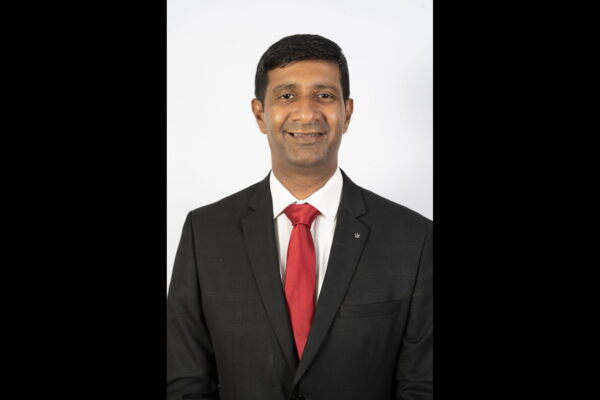
by Firoj Jena, CEO, Clancy Global
India’s cities are facing an increasingly complex monsoon environment, with intense rainfall, flash flooding and prolonged waterlogging placing unprecedented strain on urban infrastructure. In August 2026, the Centre approved ₹5,520 cr. for urban flood-risk management across 18 cities, including Mumbai, Bengaluru, Chennai, Hyderabad, Kolkata, Pune, Ahmedabad and Guwahati. A 25-year analysis of reported flood events, meanwhile, recorded 290 events in Hyderabad, 283 in Guwahati, 248 in Bengaluru, 220 in Kolkata, 211 in Chennai, 209 in Delhi and 189 in Mumbai. Together, these figures illustrate that urban flooding is no longer confined to a handful of vulnerable locations, but is becoming a widespread challenge shaped by different combinations of rainfall, drainage, topography, riverine and coastal exposure.
The response to flooding has traditionally focused on what happens during and immediately after an event: clearing drains, pumping out water, repairing roads and restoring disrupted services. But as extreme rainfall becomes more difficult to predict and urbanisation continues to increase the amount of built-up, impermeable surface, the more important question is what can be done before the rain arrives. That means thinking about flood resilience not only at the level of roads, drains and city infrastructure, but also within the buildings and systems that keep cities functioning. This is where MEPF (Mechanical, Electrical, Plumbing and Fire protection) becomes an integral part of climate-resilient design.
The question is no longer simply whether a building can withstand a flood. It is whether a structure’s essential systems can continue to operate when extreme weather puts pressure on the wider infrastructure around it and whether those systems have been planned with the possibility of more intense rainfall and future urban growth in mind.
Beyond Structural Resilience
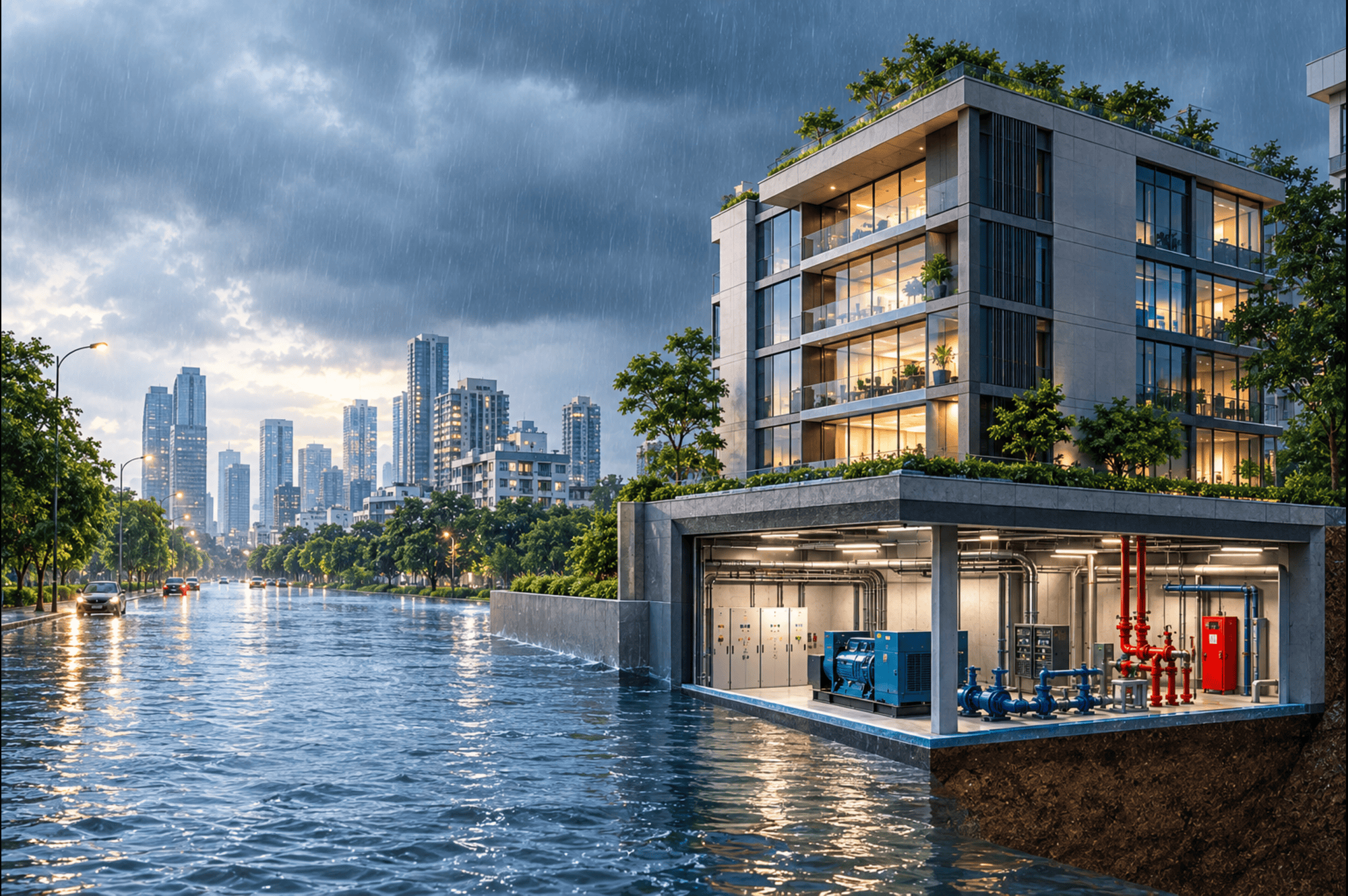
A building can remain structurally sound during a flood and still become unusable if its critical services are compromised. Water entering a basement can damage electrical panels, transformers, generators, pumps, servers and control systems, while also affecting elevators, fire protection, HVAC and communication networks. In hospitals, data centres, industrial facilities and other critical buildings, the resulting disruption can have consequences far beyond the physical damage to equipment.
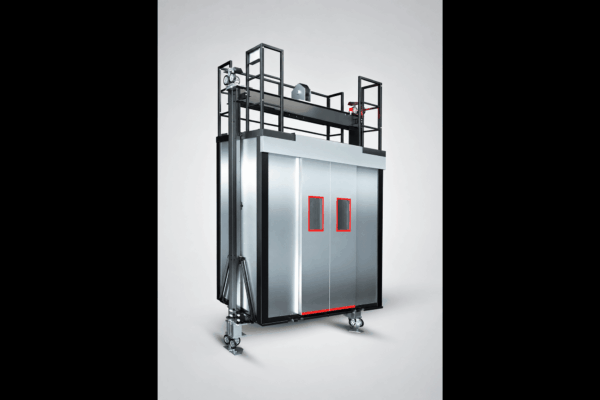
Flood resilience should therefore be considered alongside architectural and structural design from the earliest stages of a project. Critical equipment such as electrical panels, transformers, DG sets, fire pumps and servers should, wherever feasible, be located above anticipated flood levels or within protected service zones. Where lower-level installation is unavoidable, appropriate water-resistant protection and isolation arrangements can help limit exposure.
But building-level resilience cannot be viewed in isolation. A well-protected building can still be affected if the surrounding road network floods, storm-water systems surcharge or external power and water infrastructure fail. For rapidly urbanising cities such as Nagpur and Nashik, this makes coordination between building systems and broader urban infrastructure increasingly important. Plumbing and drainage systems require consideration of extreme rainfall and temporary surcharge conditions. Scientifically designed storm-water networks, adequately sized drainage and pipe systems, backflow prevention, non-return valves and sump pumping with standby capacity can help limit water ingress into critical areas. These systems must receive reliable emergency power if they are expected to operate during a wider power interruption.
Beyond removing water after it enters a building, the objective is to anticipate where water is likely to accumulate, how it will move through the site and surrounding infrastructure, and how it can be safely diverted and evacuated.
Designing for Changing Rainfall Patterns
The case for this approach is reinforced by the changing nature of rainfall. The India Meteorological Department classifies rainfall of 20 cm or more within 24 hours as extremely heavy rainfall, while much higher short-duration events are possible. Its assessments have also highlighted changing rainfall patterns and the importance of understanding extreme precipitation in the context of urbanisation and climate change.
For buildings and infrastructure designed to operate for several decades, historical weather patterns are therefore a less certain basis for future design assumptions. The same principle applies at the city level. Drainage infrastructure designed around past rainfall patterns may not perform in the same way when a much larger volume of water arrives within a shorter period, particularly as urban expansion reduces natural absorption.
Rather than attempting to design for every conceivable event, the focus can be on understanding how buildings and infrastructure will respond when conditions exceed their original design parameters. Critical systems should be capable of being isolated safely, while essential services can incorporate sufficient protection and backup to continue operating where possible. At the urban scale, this means identifying vulnerable zones in advance, understanding drainage capacity and bottlenecks, and considering how new development will affect the movement and accumulation of storm water. MEP planning can form part of this larger exercise by ensuring that individual buildings are not adding avoidable pressure to already stressed systems and that their own water-management infrastructure is designed for the conditions they are likely to face.
Building the Right Level of Redundancy
Redundancy is an important part of this approach, but its extent should reflect the criticality of individual systems rather than being applied uniformly across a building. Electrical infrastructure may incorporate dual sources of supply where feasible, together with standby generators and UPS systems for critical loads. Fire pumps and their controls should remain operational during flooding and can therefore benefit from protection against water ingress and emergency power. Drainage systems may require standby pumps or separate drainage zones so that a failure in one area does not compromise the entire building. Rainwater management systems can also be designed to temporarily retain, divert or safely discharge excess water rather than relying entirely on municipal drainage networks during peak rainfall. Critical HVAC, ventilation and pressurisation systems similarly require appropriate protection and backup power where environmental control is essential to operations.
The principle is particularly relevant to critical infrastructure. While a flooded commercial basement may be an inconvenience, a failed electrical or mechanical system in a hospital, data centre or industrial facility can interrupt essential operations and create much wider consequences. Resilience planning should therefore be proportionate to the function of the building and the consequences of failure.
MEPF and Urban Resilience
One of the larger gaps in current practice is that different aspects of flood resilience are often considered independently. Drainage may be addressed by the civil engineering team, structural protection by the structural consultant and equipment protection by the MEPF consultant, without necessarily being brought together into a single resilience strategy.
Extreme weather does not respect those professional boundaries. A major rainfall event can simultaneously overwhelm external drainage, flood basements, disrupt electricity, affect water supply and compromise mechanical systems. Planning these elements independently can therefore leave gaps precisely where resilience is most needed. This makes early coordination between architects, structural and civil engineers, MEPF consultants, developers and facility-management teams increasingly important. Flood risk should be assessed at the concept-design stage, with the team considering how different levels of flooding could affect the building, which systems must remain operational, where critical equipment should be located and how affected services can subsequently be restored.
The same thinking can be extended beyond individual projects. In rapidly growing cities such as Nagpur and Nashik, for example, infrastructure planning needs to account not only for today’s built environment but for the additional demand created by future development. Storm-water drainage, pumping capacity, rainwater management and utility infrastructure can be considered alongside urban expansion rather than upgraded only after flooding exposes a deficiency.
The larger opportunity is to move MEPF from being viewed primarily as a building-level technical requirement to recognising its role in a broader infrastructure ecosystem. Drainage, plumbing, electrical systems and water management are ultimately part of how a city absorbs disruption and keeps functioning.
Designing for Recovery
Resilience also extends beyond the event itself. Equipment affected by flooding may require inspection, cleaning, testing and controlled recommissioning before it can safely return to service. Designing for this process can significantly reduce downtime. MEPF systems should allow for safe isolation and inspection, with equipment rooms and service routes remaining accessible. Components vulnerable to water damage should be replaceable without extensive reconstruction, while buildings should have defined procedures for shutting down and restarting critical systems.
Building Management Systems can add another layer of resilience by monitoring water levels, pump operation, electrical parameters and critical equipment. Remote alerts allow facility teams to respond quickly, particularly when parts of a building become inaccessible. This also makes the location and accessibility of equipment rooms important considerations. Critical infrastructure should remain accessible for inspection and maintenance even when lower levels or external areas are affected by flooding. Resilience, in this context, is not simply about surviving the event; it is also about making recovery faster and safer.
From Flood Response to Flood Readiness
The scale of India’s urban development presents an opportunity to embed these principles into the next generation of buildings and infrastructure. The World Bank estimates that India could avoid around USD 5 billion in annual pluvial flood losses by 2030 and as much as USD 30 billion by 2070 through timely adaptation. That makes preventive planning increasingly difficult to separate from conventional infrastructure planning. If extreme rainfall is becoming a recurring threat, designing drainage and pumping systems only around historical conditions risks locking cities into a cycle of flooding, repair and reconstruction.
Resilient MEPF design should therefore be viewed not simply as an additional technical requirement, but as part of protecting the long-term performance and value of the built environment. Appropriate equipment placement, proportionate redundancy, intelligent monitoring, accessible service routes, effective rainwater management and planned recovery can help reduce damage, maintain critical operations and shorten disruption following an extreme weather event.
For India’s rapidly expanding cities, the opportunity is larger still. While better MEP planning cannot by itself solve urban flooding, it can ensure that buildings are designed to operate within that system rather than becoming additional points of vulnerability when it fails. The shift, ultimately, is from asking how quickly a city can respond after the water rises to asking how much disruption it can prevent in the first place. With extreme rainfall and urban flooding becoming recurring features of India’s future, the infrastructure being designed today has to account for that future. MEPF will be an important part of determining whether the buildings and the cities around them are merely built to function in normal conditions, or built to remain resilient when those conditions change.
Tags