
Interview: Anshuman Magazine, Chairman & CEO, India, Southeast Asia, Middle East & Africa, CBRE

What factors are driving the surge in domestic and global investments in Indian real estate, and how are evolving investor preferences shaping the market?
India’s real estate market has become a clear target for long-term global capital. The investment trajectory has continued to strengthen, with equity inflows reaching USD 18.6 billion in the first nine months of 2026, already surpassing every full-year total since 2018. Q3 2026 alone recorded USD 9.5 billion, the strongest quarter on record. Three factors are driving this momentum. First, the fundamentals are strong. Office leasing touched a record of about 66.4 million sq ft in the first nine months of 2026, led by global capability centers. Second, the investable universe has widened well beyond offices to data centers, logistics, retail and development platforms; data centers alone accounted for 57% of capital inflows in Q3 2026. Third, the market now offers greater depth across asset classes, investment strategies, and partnership structures, allowing investors to deploy capital at scale. Investor confidence has evolved accordingly. Capital is becoming more strategic, patient, and aligned to long-term operating fundamentals. Institutional investors contributed over 79% of inflows in Q3 2026, foreign capital made a strong comeback at about 59% of the quarter’s investments, and investors are increasingly committing through platforms and partnerships along with one-off transactions. India is increasingly being evaluated as a scaled, multi-sector opportunity with the capacity to absorb long-term domestic and global capital.
How is infrastructure development, including highways, metro rail, airports, and industrial corridors, influencing real estate growth across residential, commercial, and industrial segments in India?
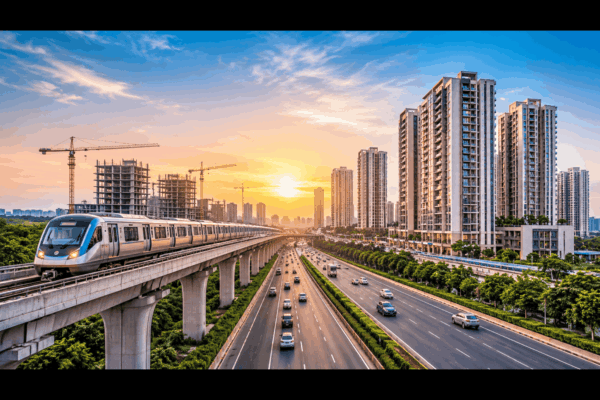
Infrastructure is redrawing India’s real estate map. Its impact is most visible where mobility, access to talent, freight connectivity, and planned urban development come together. Each form of infrastructure shapes real estate differently. In residential, metro lines, expressways and new airports are widening the radius of liveable housing. Homebuyers are willing to move further from city centers when commutes are predictable, which is why well-connected peripheral locations are attracting new launches and integrated townships. In commercial real estate, connectivity is central to the emergence of new business districts. Occupiers, particularly global capability centers, prioritize access to talent, and well-planned, transit-linked office micro-markets are best placed to provide it. In industrial and logistics, highways, dedicated freight corridors, and multimodal logistics parks are reducing transit times and costs, encouraging manufacturers and logistics players to locate along these corridors. Industrial and logistics leasing reached about 32 million sq. ft. in H1 2026, and better infrastructure will continue to widen the map of investable locations. Where infrastructure arrives, real estate follows.
Which cities, corridors or emerging micro-markets are witnessing the strongest real estate growth due to infrastructure development? Could you share a few examples of projects or locations where this impact is particularly evident?
The change is clearest where several large projects have come together. The Mumbai Metropolitan Region is a strong example. The Atal Setu, the Navi Mumbai International Airport, which commenced commercial operations in December 2025, and the expanding metro network are bringing Panvel, Ulwe and the wider Navi Mumbai belt into the region’s core economic geography. Navi Mumbai is also emerging as one of India’s leading data center hubs, supported by the availability of large land parcels, power, and network connectivity.
In Delhi-NCR, the Dwarka Expressway has transformed Gurugram’s western growth corridor. The Noida International Airport at Jewar, which commenced commercial operations in June 2026, together with the Yamuna Expressway, is creating new residential, logistics and industrial demand across Greater Noida and the Yamuna Expressway belt. Further afield, the Delhi–Mumbai Expressway and the Western Dedicated Freight Corridor are opening up new manufacturing and warehousing locations along their routes.
In southern India, North Bengaluru around the airport, Hyderabad’s western corridor along the Outer Ring Road, and Chennai’s OMR and Sriperumbudur–Oragadam belt continue to benefit from connectivity-led growth. Hyderabad and Bengaluru alone accounted for about 65% of GCC office leasing in Q3 2026 and are being strengthened by the combination of connectivity, deep talent pools, and established business ecosystems.
In logistics, rising land costs in established hubs are encouraging developers to explore peripheral corridors such as Kharkhauda and Badli in NCR and Khopoli–Patalganga near Mumbai, where improving road connectivity makes large-format facilities viable.
How are improved connectivity and infrastructure influencing property demand, land values, and development patterns beyond established urban centers, particularly in tier-II and tier-III cities?
Some of the most meaningful change is now taking place beyond the large metros. Expressways, new airports, metro projects, and industrial corridors are bringing tier-II and tier-III cities closer to markets, talent, and capital. This is reshaping demand in three ways. First, occupiers are adopting a hub-and-spoke approach. Global capability centers, technology firms, and flexible workspace operators are looking at cities such as Jaipur, Lucknow, Coimbatore, Kochi, Visakhapatnam, Ahmedabad, Indore and Bhubaneswar for their talent, lower costs, and improving quality of life. Second, manufacturing and logistics are spreading into new locations as connectivity improves. This is expanding the relevance of emerging manufacturing and distribution locations beyond traditional gateway markets. Third, equity investments into tier-II and tier-III cities crossed USD 1.2 billion in the first nine months of 2026, up about 37% year-on-year, led by cities such as Guwahati, Ahmedabad, Mohali, Ludhiana, and Chhatrapati Sambhajinagar. Large digital infrastructure investments are reaching these cities too; Google’s planned 1 GW AI data center hub in Visakhapatnam, an investment of about USD 15 billion, is a strong example. As connectivity improves, land values typically re-rate first, followed by plotted developments, housing, and retail, and eventually organized office and logistics space. The priority is to ensure that infrastructure, master planning, and land-use reform progress together, so that growth in these cities remains orderly, sustainable, and tied to long-term economic activity.
Which real estate segments stand to benefit most from infrastructure expansion, and what opportunities does this create for developers and investors?
Infrastructure expansion will benefit nearly every segment, but the scale of opportunity varies. Data centers and industrial and logistics are likely to be among the biggest beneficiaries. India’s data center capacity is expected to reach about 2 GW by the end of 2026, and the sector has attracted about USD 173 billion in cumulative investment commitments since 2021. Data centers accounted for 57% of real estate capital inflows in Q3 2026. Their growth depends directly on power, fiber connectivity, and land availability, which makes infrastructure decisive. Warehousing and logistics, meanwhile, are benefiting from expressways, freight corridors and the rise of e-commerce and quick commerce; quick commerce alone could drive about 75 million sq. ft. of urban logistics requirement by 2030. Institutional developers are responding, with about one-third of new warehousing supply in H1 2026 institutionally backed. Office remains the backbone of commercial real estate. Well-connected business districts will continue to attract global capability centers, as India continues to strengthen its position as a global hub for enterprise operations. Residential and retail will gain as connectivity opens up new catchments in suburban and peripheral locations, supporting integrated townships and modern retail destinations closer to where people live. For developers, the opportunity lies in integrated, mixed-use, and transit-oriented projects, build-to-suit industrial facilities, and land along emerging corridors. For investors, it lies in platforms, data center and logistics parks, REITs, and income-generating assets.
How will infrastructure investments and government initiatives shape India’s real estate sector over the next five years, and what challenges must be addressed to sustain this growth?
Over the next five years, infrastructure will be one of the most important determinants of where and how Indian real estate grows. The continued focus on multimodal connectivity, industrial corridors, urban transport, and regional economic development can create new growth centers, deepen regional economies, and widen the market for institutional real estate. To ensure that this growth is sustainable, a few issues must be addressed. Land and approvals remain critical; digitized land records, single-window clearances and predictable timelines will reduce both cost and risk. Planning must be integrated, so that land use, transit, housing, and employment centers are developed together rather than in isolation. Utilities, particularly power and water, need to keep pace, especially for data centers and industrial parks. Execution and last-mile connectivity will determine whether projects deliver their full economic value. And sustainability must be built in from the start, through green buildings, climate-resilient design, and efficient use of resources. If policy, infrastructure, and private investment continue to move in the same direction, infrastructure-led growth can make India’s real estate sector more productive, more inclusive, and more closely aligned with the country’s economic ambitions.