Redevelopment: What Do Residents Gain?

by Abhishek Jain, COO, Group Satellite
In South Mumbai’s Parvati Building redevelopment, tenants waited nearly 15 years while the appointed developer defaulted on temporary-accommodation rent, before MHADA was directed to take the project forward and provide transit accommodation. (Source: Hindustan Times)
That is the real weight of redevelopment. A family that agrees to it is not merely signing a construction contract; it is leaving a home it may have occupied for thirty or forty years, placing children’s schooling, elderly parents’ routines, neighbours and memories into temporary arrangements, and trusting a developer’s word for several years. When that trust breaks, either through stalled approvals, unpaid transit rent or abandoned sites, the cost is not measured in delays alone, but in the disruption of lives.
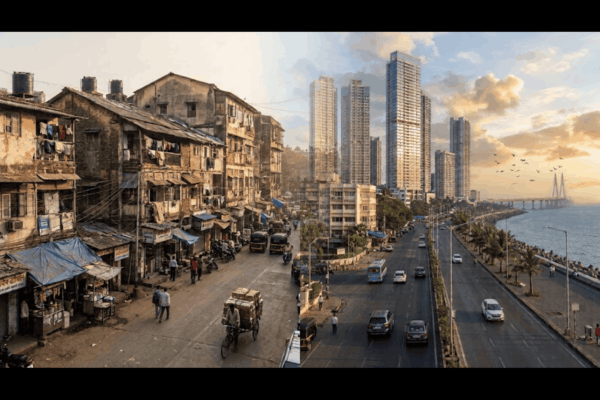
However, the fact that a large share of the city’s buildings was constructed many decades back cannot be ignored. Redevelopment is central to the city especially given the scarcity of land for new development. For those of us in the development business, the commercial case for redevelopment is clear: ageing buildings, scarce land and the need to renew housing stock. But for residents, the decision is an act of extraordinary faith. In my opinion, our first obligation is not to sell them additional area or a better amenity list; it is to demonstrate that their trust will be honoured- through transparent documentation and realistic timelines, with funded transit commitments and accountable delivery.
What Can a Resident Gain from Redevelopment?
For residents, the first and most visible outcome of redevelopment is simple: a home that does not need repair every few months. In older societies, a large part of members’ contributions often goes into recurring fixes – leaking terraces, ageing plumbing, overloaded electrical systems, lifts that fail at the wrong time – without improving the building’s core condition.
A redeveloped building changes that equation. It is designed to current structural and fire-safety norms, with services planned for the way families actually live today. But a good design on paper does not guarantee a good building. The outcome depends on what I see on site: the quality of materials procured, the discipline of supervision, and the rigour of quality checks at every stage.
The second gain is in how a home actually works. Decades ago, apartments were designed for a different era- different family sizes, working patterns and lifestyles. Households nowadays need flexible spaces, practical storage and adaptable rooms: a work-from-home corner, space for the elderly, or a children’s room that evolves as they grow.
Even with the extra space, it all boils down to precise planning. A well-designed apartment with efficient circulation serves a family better than a larger one with wasted corners. Mumbai needs homes planned for efficiency, supported by well-designed common areas.
Residents too, should have clear expectations on running costs. New buildings come with fire-fighting systems, lifts, security and amenities, all of which carry higher recurring maintenance costs compared to older, simpler structures. The redevelopment agreement must therefore specify the corpus fund- how it is held, what it covers, and the monthly outgoings members can reasonably expect in the initial years.
A further benefit lies in the less talked about continuity of location. In Mumbai, proximity to schools, hospitals, workplaces and transport, along with long-standing neighbourhood relationships shapes daily life. For senior citizens especially, familiar surroundings and an established support network are crucial to independence and security.
Redevelopment on the existing plot preserves this continuity while upgrading the physical environment. My focus has remained on established residential areas such as Tardeo, Khar, Santacruz, Jogeshwari and Mulund, where retaining the existing community in place is a main expectation of residents.
Challenges That Come with Redevelopment
The period between vacating the old building and taking possession of the new one is where residents face the greatest risk. Families bear the cost and disruption of temporary accommodation, and any delay in construction or rent payment affects them directly.
The terms must be settled and documented before vacating: the carpet area of the new apartment, transit rent and payment dates, the committed possession date, and clear consequences for delay. Societies should also insist on safeguards such as bank guarantees, delay penalties and escrow-style protections for the corpus fund.
The process before signing is crucial. Consent must be transparent and properly recorded, with members fully informed of the developer’s credentials, project plans and financial capacity. Registration under MahaRERA helps, it gives residents a formal framework for tracking commitments and seeking recourse if they are not met.
After vacating, residents are entitled to regular, candid progress updates and a defined channel to raise and resolve concerns. These requirements place a clear responsibility on the developer, to commit only to what can actually be delivered. Offering the highest area or rent in a locality is easy; sustaining it through approvals, construction costs, financing and market cycles is not. My view is that this discipline is required for sound redevelopment.
Residents should ask pointed questions before signing: Who is funding the project, and what are the financing arrangements? What happens if sales slow or approvals are delayed? Is the transit-rent obligation backed by a bank guarantee? What are the delay penalties, and who bears cost overruns? The answers reveal whether a proposal is legitimate or just promises built on unrealistic economics.
This is where Group Satellite’s approach becomes relevant. Rather than treating transit rent as a headline promise, a credible proposal should treat it as a funded obligation- supported by identified financing, a defined payment mechanism and, where appropriate, a bank guarantee. That distinction matters because residents are not asking for optimism; they are asking for certainty that rent will continue if approvals take longer, sales slow, or construction faces unforeseen costs.
Delivery is not the end of the process. Waterproofing, lifts, pumps and fire systems prove themselves only after occupation, and societies must be prepared to govern and maintain a larger, more complex property. A new, redeveloped structure is not free of maintenance.
Therefore, redevelopment should be judged beyond additional carpet area or amenities. A fuller measure considers whether residents have a safe and functional building, whether the costs of living in it are transparent, whether the transition was handled fairly and whether they have remained part of the neighbourhood they chose. When planning, execution and communication meet that responsibility, redevelopment renews Mumbai’s buildings while preserving the communities that give them meaning.
Tags