Commercial Real Estate: Beyond square feet

by Aniket Dani, Director, Crisil Intelligence
A multi-asset, sustainable commercial real estate ecosystem is emerging as a core enabler of Viksit Bharat
An economy grows through its workspaces, including offices, industrial parks, business complexes and warehouses that are together referred to as commercial real estate.
In India, over the past decade, the commercial real estate segment has evolved from powering office-led growth in metropolitan markets to becoming a diversified, institutional and technology-enabled platform spanning business districts, global capability centres (GCCs), data centres, logistics parks, mixed-use developments, smart corridors and sustainable offices in metros and Tier-II cities.
In short, commercial real estate has emerged a strategic infrastructure asset class shaping growth.
And as we work towards the vision of a Viksit Bharat by 2047, the way we build, finance and operate the sector will define how the country works, invests, innovates and urbanises.
Inflection point
India’s office market has been resilient despite the heightened global economic uncertainty of late.
Fiscal 2026 saw ~50 million sq ft of net leasing activity across the top seven cities, expanding 6-7% annually, led by the GCCs and the managed office space.
The growth comes despite the headwinds of global corporations recalibrating portfolios and adapting to hybrid work, underlining the country’s strength as a cost-competitive, talent-rich destination.
Notably, About 185 msf of Grade A office and retail spaces across India are managed by real estate investment trusts (REITs), which have a market capitalisation of ~$19 billion. For an asset class that was largely developed and privately owned barely a decade ago, the shift towards listed, transparent vehicles is a significant milestone.
Business districts and emerging corridors
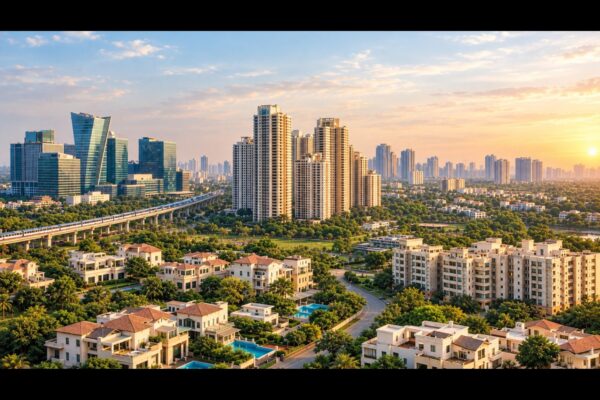
The top seven cities in India feature as leading commercial corridors, with a cumulative inventory of 860–870 msf of Grade A offices as of fiscal 2026. Established business districts such as Bandra-Kurla Complex in Mumbai, Cybercity in the National Capital Region, Outer Ring Road in Bengaluru and HITEC City in Hyderabad feature marquee office spaces.
These districts offer high-quality facilities that cater to the evolving needs of global and domestic occupiers, emphasising environmental responsibility and employee well-being.
What is happening beyond these core markets is equally important. Coimbatore, Jaipur, Lucknow, Ahmedabad, Kochi and Bhubaneswar have emerged as preferred locations for satellite offices, shared-services hubs and specialised operations, anchored by cost advantages, local talent pools and improving connectivity.
This spatial shift matters for the Viksit Bharat 2047 agenda.
Concentrating corporate activity in a few premium districts will not be enough for a country of India’s scale. Future growth will depend on multi-nodal urban regions where employment centres, housing, public transport, social infrastructure and digital connectivity dovetail and evolve in tandem.
From a policy lens, this dispersion of demand aligns with the government’s focus on balanced regional development.
It also calls for more deliberate planning of infrastructure and land use in emerging cities.
GCCs are becoming India’s strategic anchor…
GCCs have become one of the most important demand drivers for Indian office real estate. Once viewed as cost-arbitrage back offices, many GCCs now house engineering, product development, cybersecurity, analytics, finance, design and artificial intelligence teams for global corporations.
These centres account for 35-45% of the leasing activity in major markets and are gradually extending their footprint into emerging cities. GCC-driven demand is likely to remain a major underwriting theme. This would be alongside rental growth, tenant diversification, lease tenure, refinancing costs, sustainability standards and new supply pipelines.
This distinction is important: GCCs are a powerful structural driver, but they do not eliminate cyclical risk.
Hybrid work models, global technology spending, geopolitical shifts and corporate cost controls can still influence leasing decisions. The implication is clear: build for flexibility, resilience and diversification rather than relying on a single occupier category.
…even as data centres constitute the digital backbone
Data centres are becoming an essential part of India’s commercial real estate universe. Demand is driven by cloud adoption, enterprise digitalisation, 5G networks, artificial intelligence (AI) workloads, streaming, fintech, e-commerce and the policy emphasis on data governance.
The data centre market is expected to expand further on the back of sectoral data-residency requirements, regulatory attention to data governance, rising cloud usage and AI-led compute demand.
Mumbai, Chennai, Hyderabad, Pune, Bengaluru and Noida are among the key clusters, supported by the combination of subsea cable access, power availability, fibre networks, enterprise demand and state-level incentives.
We are also seeing a gradual move towards campus-style developments that integrate data centres with office space, network infrastructure and access to renewable power. Hyperscalers are reshaping clean-energy procurement to power AI workloads, with data centres accounting for ~63% of contracted clean energy capacity in the first quarter of 2026, a trend that is beginning to influence how Indian operators think about pairing data centres with green power.
The challenges are equally real. Power availability, cooling solutions, fibre redundancy and grid interconnection timelines have emerged as binding constraints, mirroring patterns seen in mature markets where utility interconnection is now the critical item rather than land or capital. Addressing these bottlenecks will require close coordination between developers, utilities, regulators and policymakers.
Logistics, warehousing and the Make in India push
The industrial and warehousing segment is the third major pillar of India’s commercial real estate story, supported by e-commerce, third-party logistics, manufacturing, consumption growth, supply-chain formalisation and infrastructure upgrades.
The sector is linked to the Make in India and Production-Linked Incentive schemes, port-led development, expressways, dedicated freight corridors and multimodal logistics parks. As companies diversify supply chains and seek faster access to consumption centres, demand is shifting from basic sheds to Grade A warehousing with greater heights, better floor loads, automation and features in tune with environmental, social and governance (ESG) norms.
For occupiers, conversation has moved from ‘space at the lowest cost’ to ‘space that supports efficiency, compliance and resilience’. For developers, this is about cluster-based development near transport nodes and a focus on park-level infrastructure.
Sustainability, smart cities and future-ready workplaces
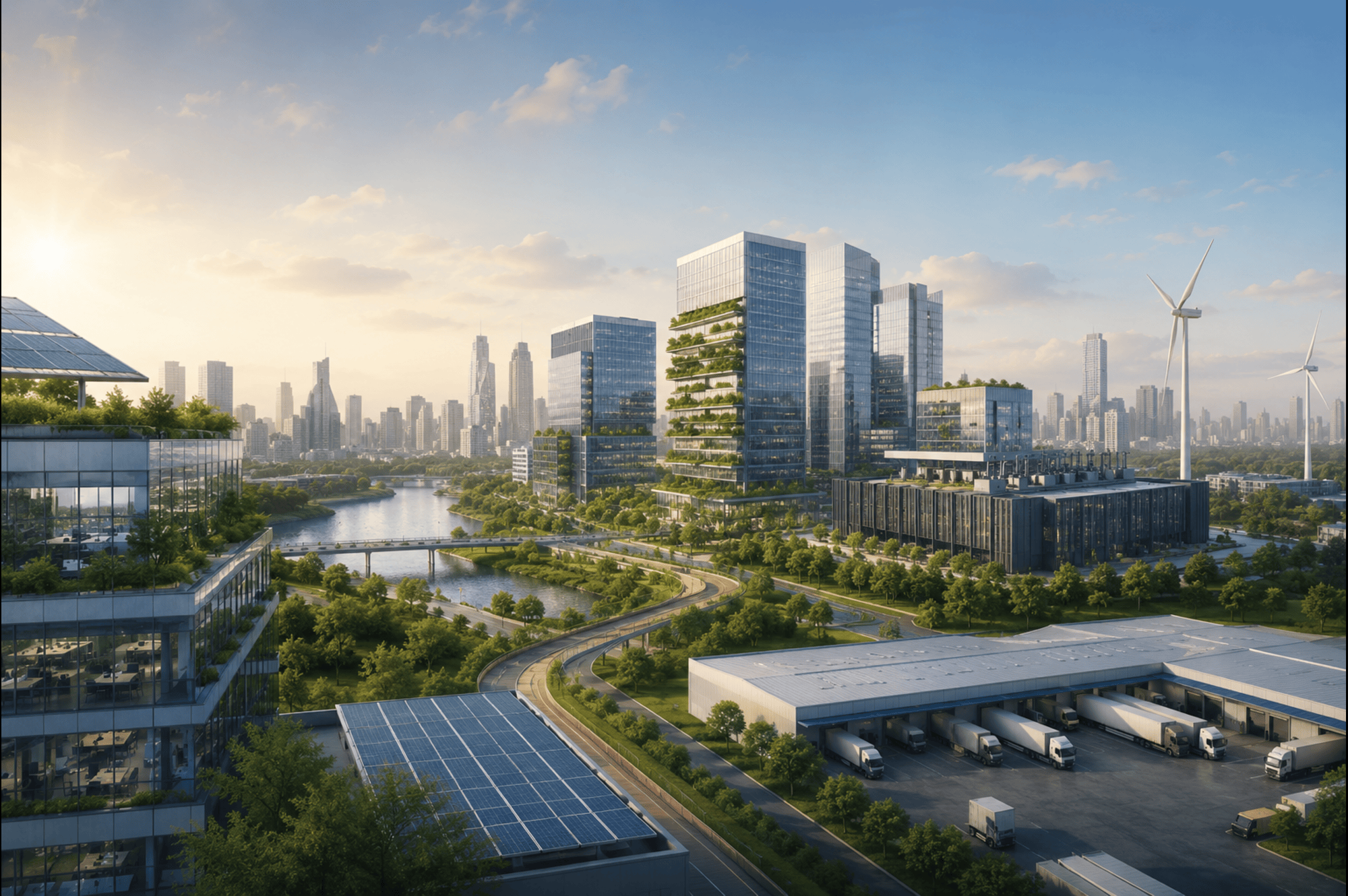
A Viksit Bharat 2047 commercial real estate strategy cannot be built on scale alone. It must also be built on sustainability and resilience.
Developers and occupiers are increasingly focused on green-certified buildings, energy efficiency, renewable power sourcing, water recycling, waste management, indoor air quality and climate-risk assessment. Investors are asking questions around ESG disclosures, retrofitting and long-term resilience.
Future-ready workplaces are changing. Occupiers want flexible floor plates, wellness-led design, digital building management systems, collaboration zones, smart access, cybersecurity-ready infrastructure and public transport connectivity.
The next phase will be judged not by square footage leased but by productivity, employee experience, operating efficiency and carbon performance.
Mixed-use districts will play a larger role. Integrated developments combining offices, retail, hospitality, housing, transit and public spaces can reduce commute stress and improve productivity. But this model requires planning coordination, faster approvals, stronger municipal capacity and long-term investment in public infrastructure.
For senior leadership, the opportunity lies in working with city authorities early in the project lifecycle to co-create these ecosystems.
Policy and investment requirements
For commercial real estate to support Viksit Bharat 2047, India will need more than private-sector enthusiasm. It will need predictable zoning, faster approvals, digitised land records, modern building codes, urban transport integration, reliable utilities and deeper capital markets.
REITs have helped institutionalise parts of the office market, but the next phase should broaden participation. As the market deepens, we can expect a wider investor base, greater emphasis on governance and more sophisticated risk-pricing across asset classes.
Policymakers and developers must address persistent challenges: land aggregation, approval delays, uneven urban infrastructure, construction-cost inflation, financing constraints, environmental compliance, climate vulnerability and skill gaps in property management. Bridging these gaps will require a partnership between the public and private sectors, with clear accountability and long-term policy stability.
Conclusion
Commercial real estate will not deliver Viksit Bharat 2047 by itself, but it will be one of the platforms on which that objective is secured.
Offices will house global capability and innovation teams. Data centres will power digital infrastructure. Warehouses will support manufacturing and consumption. Mixed-use districts will shape urban lifestyles. Green buildings will help reduce the environmental cost of growth.
The opportunity is substantial, but the sector must avoid complacency. The next two decades will reward developers, investors and policymakers who focus on quality over volume, infrastructure over speculation, sustainability over short-term cost savings and urban integration over isolated projects.
For those of us in the industry, the task is to move from viewing commercial real estate as a cyclical asset to treating it as long-term national infrastructure. If India gets this right, commercial real estate can become not just a beneficiary of growth, but one of its most important enablers.
Tags