
Beyond Location: What Really Drives Property Prices in Emerging Real Estate Markets?

“Location, location, location” is the oldest rule in property. It still holds. But in India’s fast-growing cities, two homes a few kilometres apart can see very different price movements. The reason is usually not the map itself. It is what is happening on and around that map.
The Reserve Bank of India’s latest House Price Index shows this clearly. In the April–June 2026 quarter, the all-India index rose 1.1 per cent over the previous quarter to 117.5. The rise was led by Chandigarh, Lucknow and Thiruvananthapuram, not by the largest metros. On a yearly basis, prices grew 3.6 per cent, with cities such as Chandigarh, Jaipur, Kanpur, Lucknow and Thiruvananthapuram contributing the most.
So what actually moves prices in these emerging markets? Here are the factors that matter most.
Infrastructure: The Price Signal That Comes First
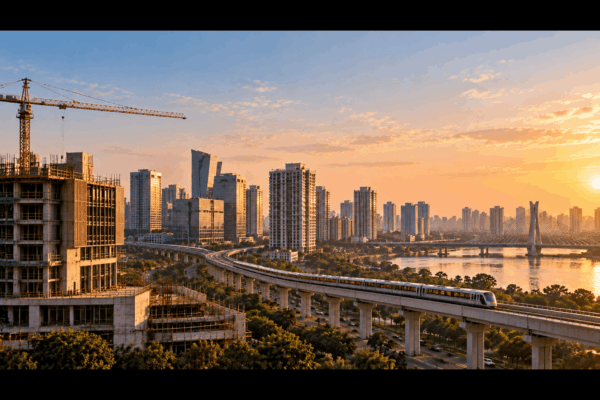
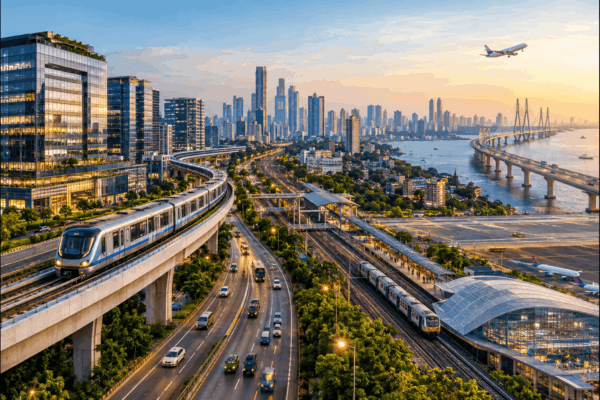
In an emerging market infrastructure often determines value before people move in. A new expressway, metro line or airport reduces travel time. Shorter travel time widens the pool of buyers who can live there.
Public spending on this front is high too. The Union Budget 2026-27 pegged capital expenditure at about ₹12.22 lakh crore (3.1 per cent of GDP). Effective capital expenditure (including grants for creating assets) rose to 4.4 pc of GDP from 3.9 pc in 2025-26 (revised estimates), according to RBI’s assessment of the Budget.
The Noida International Airport at Jewar is a live example. It started commercial flights on June 15, 2026. The first phase can take 1.2 crore passengers a year and once all phases are complete it is expected to cross 7 crore capacity.
One thing to bear in mind is that prices react in stages — at announcement, during construction and at completion. Buyers who are following progress (not just announcements) are usually better placed than those who aren’t.
Jobs And Economic Activity
Roads bring people within reach. Jobs give them a reason to stay. Housing demand in a growing city depends heavily on whether new offices, factories, warehouses and service businesses are opening nearby.
The wider economy sets the tone here. As per National Statistics Office estimates cited by the RBI, India’s real GDP grew 7.8 per cent in the April–June 2026 quarter. The RBI projects growth of 7.1 per cent for 2026-27 as a whole.
At the local level, the useful questions are simple. Is a new industrial or office cluster coming up? Are employers already hiring there? Areas with steady, local employment tend to attract end-users, and end-user demand usually holds up better than purely speculative buying.
Trust, Regulation and Delivery
Buyers in newer areas often buy houses that are still under construction. So trust is price factor all by itself.
The Real Estate (Regulation and Development) Act, 2016 (RERA) deals with this directly. Most projects have to be registered with the state authority before they can be advertised or sold. Projects on up to 500 square metres of land or with eight apartments are exempted only. Developers also have to keep 70 percent of money collected from buyers in a separate bank account. This money can only be used for construction and land cost and withdrawals must be certified by an engineer, architect and chartered accountant.
For buyers this has made due diligence easier. Details of projects, approvals and quarterly progress are available on state RERA websites. In practice projects by developers with a clear delivery record (and visible progress on the ground) hold better value in emerging areas.
The Cost of Money
Many homebuyers take out a home loan. So interest rates determine what buyers can afford and that in turn determines prices.
On October 7, 2026, The Monetary Policy Committee of RBI increased policy repo rate by 25 bps to 5.50 percent and changed stance from “neutral” to “calibrated tightening” on rising inflation. CPI inflation is now projected at 5.2 percent for 2026-27 by RBI.
Buyers in price-sensitive markets generally become more cautious when borrowing costs rise. Many emerging locations rely on first-time and mid-income buyers so they feel the impact quicker. Buyers who compare EMI’s over different rate scenarios (not just property price) are better prepared for such shifts.
Supply, Planning and Everyday Living
Price is always demand/supply balance. In a new corridor land is often available in large parcels and many projects can start at the same time. If supply runs well ahead of real demand prices can be flat for years even in a well-connected area.
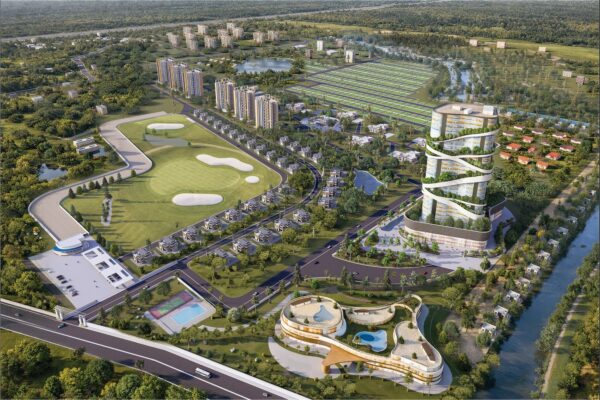
Planning also plays an important role . A clear master plan tells buyers which land is used for homes, offices green spaces and roads. That certainty makes it easier to judge what the area will look like in ten years’ time.
Then there is everyday life. Schools, hospitals, markets, water and power, safe streets make a place into a neighbourhood. These are often the last things to arrive in a new area. When they do they tend to support both demand and prices.
The Bottom Line
Location still matters but it’s not a pin on the map. Connectivity, jobs, regulation, interest rates, supply and social infrastructure are the important factors. Each one can push prices up or down.
For buyers and investors looking at emerging markets the best advice is to look beyond the brochure. See what’s already built, what’s under construction and what is only announced. Check project on RERA website. Plan finances for more than one interest rate scenario. Those who do this homework know a fair price when they see it — no matter which way the market moves.