Modernising India’s Commercial Buildings: Making Vertical Mobility More Sustainable

by Ravikrishnan Srinivasan, CEO and Managing Director, TK Elevator India
India’s commercial real estate sector is entering a new phase of growth. After two decades of rapid vertical construction, from office towers and malls to airports and mixed-use developments, the conversation is increasingly shifting from “how much we build” to “how well our existing buildings perform.” With India’s urban population projected to reach close to 600 million by 2031, according to the Ministry of Housing and Urban Affairs, pressure on the built environment and on the systems that keep people moving through it will only intensify.
Nowhere is this more visible than in vertical mobility. Elevators and escalators are the quiet infrastructure of commercial buildings. As these systems age, building owners increasingly face a familiar set of challenges: higher maintenance requirements, unplanned downtime, energy inefficiencies and the difficulty of supporting legacy components.
The Sustainability Opportunity Inside Existing Buildings
Elevators are often viewed as long-life assets, which means many commercial buildings continue operating with systems designed around the needs and technologies of an earlier era. This creates an important sustainability question: how do we extend the useful life of a building without extending the limitations of its infrastructure?
Modernisation provides one answer.
Rather than approaching every ageing elevator as a complete replacement exercise, building owners can assess which components still have useful life and which need to be upgraded. Controllers, drives, door systems, lighting and other components can be modernised individually or as part of a broader upgrade programme.
Modernization can be a way of preserving what still works while introducing what the building now needs.
Energy savings make the case tangible. Modern drives, machines, regenerative technology, LED lighting and intelligent standby modes can help reduce energy consumption compared with older systems. For equipment that operates from early morning to late night, even incremental improvements in efficiency can add up over time.
Making Efficiency Part of Every Journey
Sustainability in commercial buildings is often discussed through the lens of energy consumption, materials and building design. But there is another dimension that deserves greater attention: how efficiently people move through a building.
In a large office tower, for instance, thousands of people may enter within a short window in the morning. A vertical mobility system designed around a building’s requirements years ago may not necessarily be optimised for how that building operates today.
This is where intelligent traffic management can make a difference.
Destination-control technology can group passengers travelling to similar floors and assign them to specific elevator cars, reducing unnecessary stops and making better use of available capacity. TK Elevator AGILE destination- control technology can reduce travel time by 25% while increasing elevator capacity by up to 30%.
From Fixing Failures to Anticipating Them
Reliability is another part of the sustainability equation that is easy to overlook.
Traditional maintenance has often been built around scheduled inspections or responding once something goes wrong.
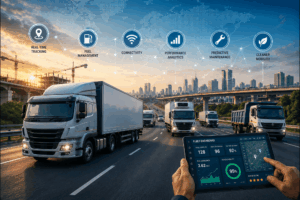
Connected technologies can use data from elevators to identify changes in equipment behaviour and flag potential maintenance requirements. TK Elevator MAX uses connected equipment data, cloud computing and predictive analytics to identify potential issues and support proactive maintenance.
For commercial buildings, the value goes beyond avoiding an unexpected breakdown.
Extending the life of an elevator is not simply about keeping an old machine running. It is about ensuring that the asset continues to perform efficiently, reliably and safely as the building around it evolves.
Modernisation Without Putting the Building on Hold
There is, however, a practical reality that every commercial building owner understands: the building cannot stop operating just because its infrastructure needs an upgrade.
Any modernisation programme therefore has to balance long-term improvement with short-term disruption.
Depending on the age, condition and requirements of an elevator system, building owners can prioritise specific components rather than automatically opting for a complete replacement. This can allow upgrades to be planned in phases, helping minimise disruption while addressing the areas that have the greatest impact on performance and reliability.
The principle is simple: modernise where it creates value, retain where it makes sense and replace where it is necessary.
This approach also fits into India’s wider push towards more efficient commercial buildings. The Government of India’s Energy Conservation and Sustainable Building Code 2024 establishes energy-performance requirements for commercial and office buildings, reflecting the growing emphasis on improving building efficiency and sustainability.
India’s commercial building stock will continue to expand, but the sustainability conversation cannot be limited to new construction. The Bureau of Energy Efficiency notes that the building sector accounts for over 30% of India’s total electricity consumption and highlights the need to optimise energy demand across both upcoming and existing building stock.
For building owners, the question should therefore not simply be whether an elevator is old. It should be whether it is still delivering the level of safety, efficiency, reliability and passenger experience that the building now demands. Modernisation offers a way to address that question without automatically starting from zero.
The future of sustainable commercial real estate will not be defined only by how many new efficient buildings India creates. It will also depend on how intelligently we improve the buildings we already have, including the systems that keep people moving through them.
Sometimes, making a building future-ready does not require building again. It requires looking at what is already there and making it work better.