The New Luxury Is Time: Why Homebuyers Are Redefining Living

by Akshay Taneja, CEO, TDI Infrastructure
A decade ago, the Indian homebuyer’s primary question was straightforward – How near is this area to the city centre? Proximity was prestige, and central addresses commanded premium prices almost by default. This calculation is evolving today on multiple aspects. Today, homebuyers across the National Capital Region are optimizing for something far more valuable: time saved in commute, reclaimed for family, and rescued from urban friction.
This shift isn’t mere sentiment. ANAROCK’s Q2 2026 data tells the story: housing launches across NCR fell 40% year-on-year, yet housing sales dropped only 6%. Demand outpaced shrinking supply as unsold inventory remained nearly flat at 89,086 units. Buyers aren’t waiting for the perfect central address; they’re moving toward homes that work for how they live now.
From Distance to Lifestyle
The old logic valued proximity to workplaces above all else. The new logic prioritizes what a location enables daily work, commute, healthcare access, school, and relaxation without losing hours to transit. This lifestyle-led housing philosophy now dominates NCR’s real estate conversation.
Data from industry consultants reveals that 35-40% of homebuyers actively seek homes with dedicated workspaces within communities built around wellbeing. When workspace ranks among the top three purchase criteria ahead of parking or clubhouse amenities it signals that the home has absorbed a function that once belonged exclusively to the office. Neighbourhood qualities have shifted accordingly: reliable internet and power, accessible roads, and daily-life infrastructure matter more than proximity to corporate parks.
Hybrid Work Culture reshapes everything
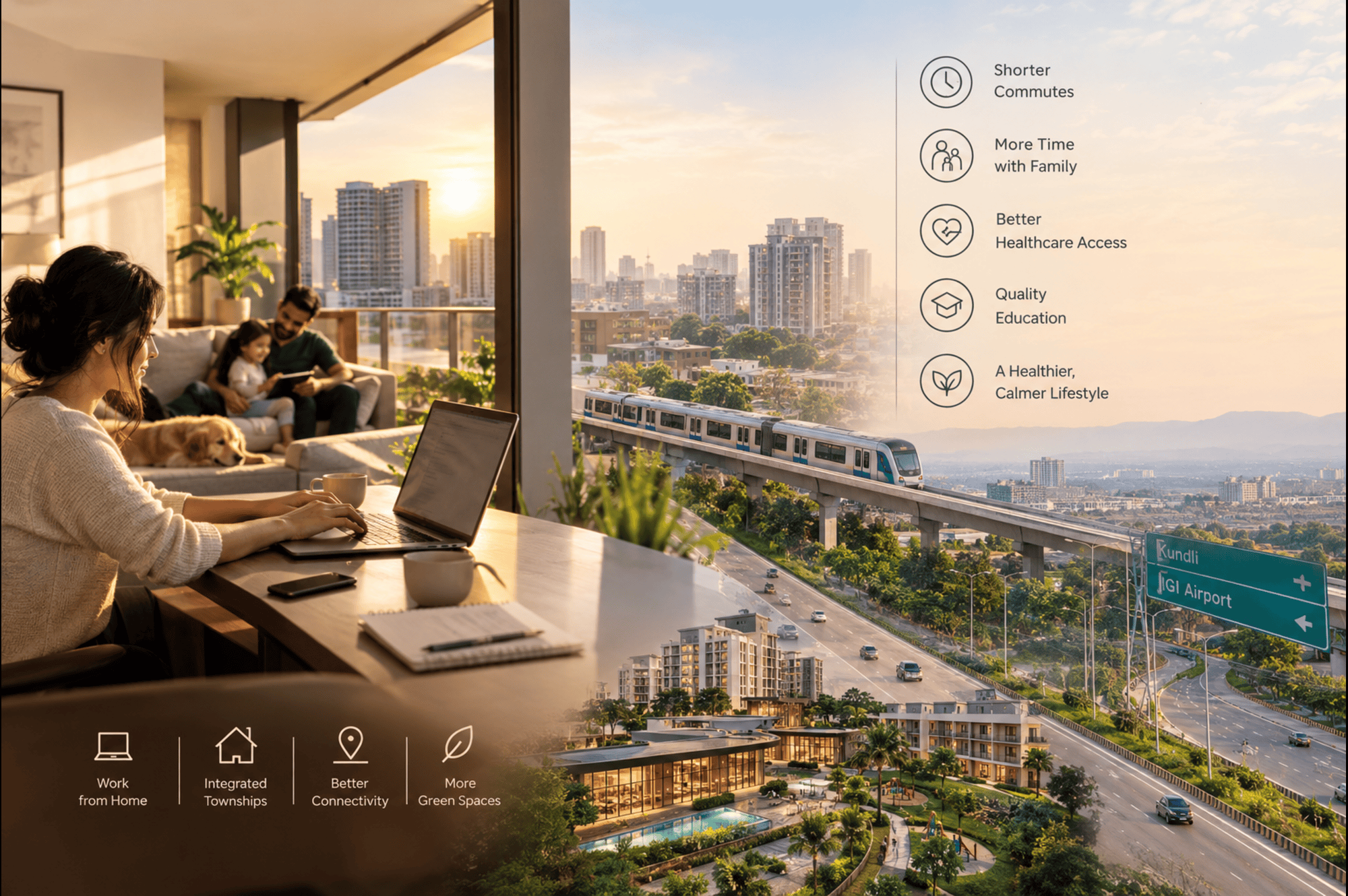
The pandemic didn’t just introduce remote work but it normalized hybrid arrangements which has been an empowering element for peripheral real estate market across metropolitan cities. Despite gross office leasing reaching 86 million sq. ft in 2025, workplace patterns have fundamentally changed. Global Capability Centres account for nearly 40% of new leasing, yet fewer employees work five days weekly. Industry surveys show 65-72% of IT professionals in cities like Pune now operate on hybrid schedules, spending two to three days at home not as a temporary arrangement, but a settled norm. This recalibration has profound implications for residential choices. Workers no longer need to live near offices; they need to live well.
The Rise of Integrated Ecosystems
Considering this growing preference for integrated townships over single towers. Residential houses with offices, schools, hospitals and retail are becoming a more attractive option for buyers looking to live in self-sufficient environments. JLL’s 2026 data showed a 30% year-on-year increase in housing sales in high-connectivity districts like Dwarka Expressway and Noida Extension where integrated planning meets better road access. That means the 15-minute city concept comes to mind as they are developing within a short radius that provides the essential daily needs for the people, less reliance on the wider transport network. Integrated ecosystems lower mobility and are better to live in long-term. Standalone projects lacking this integration face increasing competition from larger planned townships with built-in convenience.
Kundli: Infrastructure-led Transformation
As Kundli in Sonipat depicts, the border town of Delhi-Haryana has been transformed by the construction of big infrastructure projects. The Urban Extension Road-II, a 75.7 km six-lane expressway opened on August 25, 2025, consists of a 29.6 km Sonipat spur that connects to major expressways. The time from Kundli to IGI Airport’s Terminal 3 will drop from around two hours to 20-45 min. At the same time, the Delhi-Karnal Regional Rapid Transit System (136.3 km, ₹33,051 crore) and Delhi Metro Phase IV extension will connect Kundli to the metro. These two projects are converging, and they have already been affecting property values: land rates rose 190% from 2020 to 2025 to ₹61,216 per sq. yard. Developers are more likely to frame this development in terms of liveability benefits, more land parcels, lower density, cleaner air and pricing significantly lower than Gurugram or Noida rather than speculation.
Time redefines Prime Location
The trending link across hybrid work adoption, integrated townships, and infrastructure corridors is that they decouple prime location from close to centre. A location’s value today stems from how efficiently it connects households to life’s essentials, not distance from downtown.
For Kundli and similar emerging micro-markets, this reframing is transformative. They no longer compete on proximity to Delhi’s core but on connectivity, planning quality, and daily convenience terms increasingly mattering more to homebuyers than the address itself.As NCR’s infrastructure story unfolds, the pattern becomes clear: not a race toward centre, but a race toward time well spent.
Tags