Can Smart Fire Evacuation Lifts Change Emergency Response?

by Akhilesh Satre, Director and Elevator Personality, Avinyatech Elevators
AI, IoT, Data analytics, smart monitoring systems, and smart appliances have been the driving force of Indian Infrastructure. The old buildings did not have smart security cameras; they had security guards. In old structures, we did not have smart elevators; we had manually operated elevators. In houses, we had cylinders and a cooker, but now we have an induction cooker, an air fryer, and an electric shegdi as smart appliances. Our everyday life now revolves around smart technologies and machines. When everything from the house to the office to the gym to shopping centres to schools to hospitals is highly dependent on technology, why not our life-safety systems? Why do we not have smart elevators for vertical transportation? Why are we still reluctant when it comes to smooth and safer elevation?
Not only are Mumbai, Delhi, Hyderabad, and Bengaluru growing, but India’s Tier II and III cities are under immense transformation. When everything around us is moving so fast, from automobiles to our internet speed, so do our building lift systems need to be updated. As residential towers, commercial buildings and mixed-use developments become taller and more densely occupied, vertical transportation and evacuation can no longer depend on a single system. Stairs remain basic, but the ability to move people safely and efficiently across higher floors in tall buildings is becoming an important part of the overall emergency strategy.
Maharashtra is ahead in this subject as the state’s framework recognises that high-rise emergency evacuation requires dedicated infrastructure and technical planning already in place.
The next question is: can technology make these systems more responsive, intelligent and operationally reliable?
From An Emergency Lift to An Intelligent Safety System
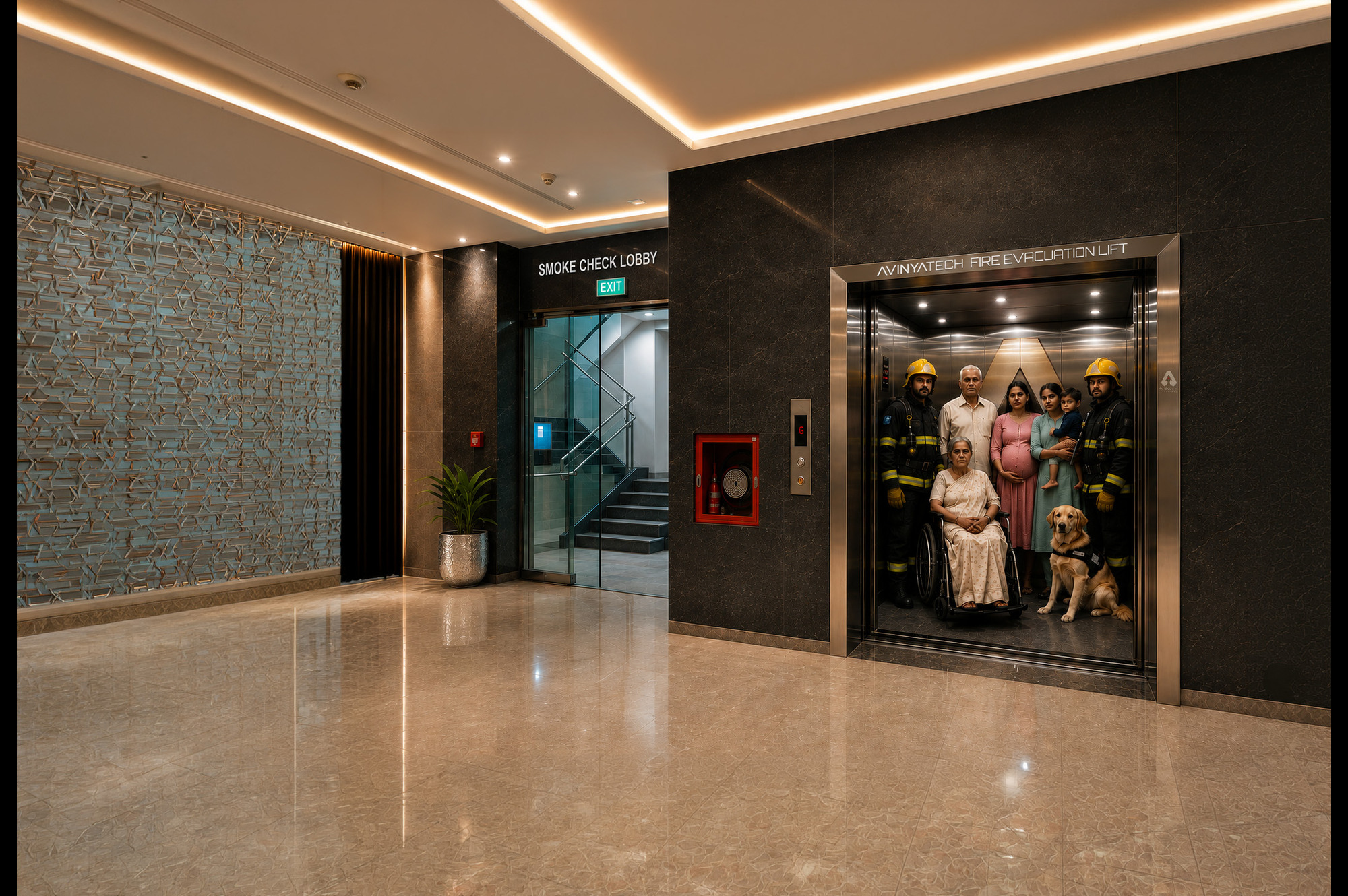
A Fire Evacuation Lift should not be considered a conventional lift with extra fire-safety features. Its real potential lies in integration with the building’s wider life-safety infrastructure.
Modern systems can incorporate real-time monitoring, emergency communication, fault reports, and Building Management Systems. IoT-enabled control platforms can also provide information such as operating status, fault history, and system status to building managers, AMC agencies, lift inspectors, and elevator manufacturers, providing them with insights into potential problems before an emergency occurs.
The potential of smart elevators takes the concept of equipment maintenance and places the elevator within the realm of infrastructure assets that can be continuously monitored.
Data Can Improve Emergency Decision-Making
In a fire, each second counts.
A smart evacuation lift can easily take signals from the building’s fire detection and emergency systems, and can function on a predetermined emergency plan. Depending on the authorised design of the building and evacuation planning, lift operations can be prioritised as per multiple factors such as floor location, occupant movement and emergency response requirements.
Maharashtra’s Fire Evacuation Lift advisory highlights how such systems can be linked with building management systems and programmed to support structured evacuation, including prioritising occupants from higher floors.
This is an important change in approach as instead of considering evacuation as a manual series of actions, technology can facilitate coordination.
But Automation Cannot Replace People
Technology, however, is not a substitute for preparedness.
This was particularly evident in light of a fire that took place last month in a 12-storey building in Vile Parle, Mumbai. Initial investigation revealed that the building’s firefighting system was in manual mode while only two people had knowledge on its operation.
This lesson also applies to more than firefighting systems.
An advanced fire evacuation lift, however, will not be of much use if the people in charge do not know how to operate it, there is no trial run for emergency procedures, or the system is unmaintained.
Smart safety therefore has two components: intelligent technology and informed human response.
Predictive Maintenance Could Be the Next Frontier
One of the great opportunities for connected evacuation infrastructure is predictive maintenance.
Instead of waiting for a fault to occur or losing a life to accidents, connected systems can oversee functioning parameters and send alarms when anomalies are noted. Knowledge of faults enables maintenance to identify reoccurrence of issues, and remote diagnostics can help with speed of response.
This is especially significant in the case of life safety systems. The aim must not be to have a functioning lift under normal conditions but to have systems that are ready for emergencies.
The Future Is Integrated Evacuation
The real change will come when the fire evacuation lift becomes a part of a major digital safety system.
Detection of fires, handling of smoke, emergency power supply, access governance, communications, CCTVs, management systems of buildings, and evacuation lifts must not be regarded as independent technologies. They must come together in terms of emergency response.
For designers, architects, fire safety consultants and lift manufacturers, this means changing the way they work from equipment-focused to life safety engineering methods.
India’s skyline will be growing in complexity. It is not just a question of technology for the sake of technology; it is technology that allows people to make more informed and safer choices when conventional systems reach their limits.
A smart Fire Evacuation Lift, therefore, should not be judged simply by how it is designed, installed, or how advanced sensors are.
Its real mechanism of intelligence is much simpler:
When an emergency happens, can the system help the building respond faster, operate more reliably and move people towards safety more effectively?
That is where the future of smart vertical evacuation lies.
Tags