
Interview: Harsh Pareek, Vice President, Direct Sales, Asia-Pacific, Trimble

How digital construction technologies are improving large infrastructure project’s alignment between planning and execution?
The difficulty with large infrastructure projects is rarely a lack of planning instead it is the accuracy with which that planning is implemented on the job site. By preserving design information throughout execution rather than freezing it at the beginning, digital construction tools are helping in the closure of that gap. While project leadership gets a better understanding of how tasks are proceeding against the schedule, teams on the ground can consult existing models and layouts. This makes course correction less disruptive because challenges are noticed while the task is still ongoing, not after the tasks are missed. It also improves coordination between disciplines since everyone is responding to the same information. Although subtle, the change is significant. Planning is no longer viewed as a distinct stage; rather, it continues to impact choices as the construction progresses, ultimately increasing the stability of delivery.
How the increasing importance of machine control systems and connected site solutions is improving on-ground accuracy and decreasing reliance on manual processes?
For a long time, site accuracy has relied on manual processes and the judgment of individual operators, which can differ between teams and timeframes. Machine control offers a more consistent reference by allowing equipment to work directly with design inputs. This reduces the need for repeated measurement cycles and keeps larger work fronts aligned. The need for physical remarking decreases significantly and updates happen more quickly when these systems are used in a connected site environment. This consistency maintains productivity without compromising quality. It also changes the way teams divide up the work, moving the focus from verification to planning and supervision. Being consistent becomes more important than discrete productivity gains as projects get larger. Instead of just speeding up the operation, machine control is increasingly seen as a means of sustaining it.
How 3D modeling and integrated project data are enabling better collaboration between architects, engineers and field teams?
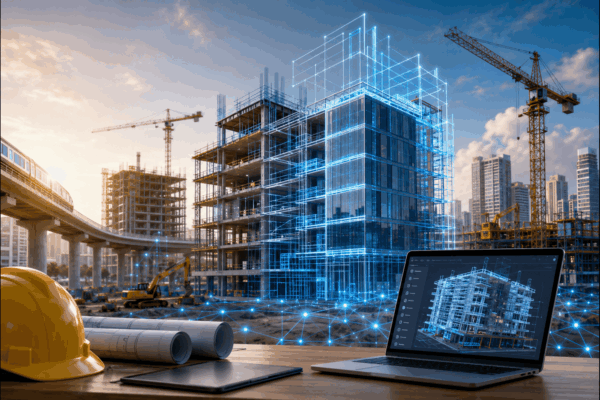
Collaboration tends to improve when teams are responding to the same information of the project. This common reference is given by 3D modeling, especially when it is backed by integrated data as compared to independent visuals. Constraints and sequencing are made clear and not assumed, which allows for grounded design discussions. Design teams get feedback before changes become expensive and field teams are able to improve it sooner. This reduces the interpretation cycle that frequently causes coordination to lag. Teams gradually put more effort into planning execution and less into balancing data. The practical impact is lesser late findings and easy handoffs between disciplines.
How real-time data transfer between the office and the site allows for quicker decision-making and reduces rework?
The speed at which reliable data circulates has a big impact on infrastructure project decision-making. The distance is reduced by real-time data transfer. Teams can respond while making manageable adjustments because progress, survey responses and operational updates are visible without waiting for official reports. Working on outdated guidelines becomes less frequent when design changes are communicated to the field beforehand. This keeps minor errors from getting worse, but it doesn’t eliminate complexity. Coordination discussions become more important because they are based on current conditions rather than assumptions. Over time, the project works with less uncertainty and lesser immediate actions. Maintaining decision-making continuity is more important than speed alone when it comes to real-time visibility.
Tags
Related Posts