Smart Ports: Engineering the Next Generation of Maritime Infrastructure

Nearly 95 per cent of India’s trade by volume and around 70 per cent by value moves through its ports, a dependency that has quietly turned quaysides, breakwaters and yard cranes into instruments of national strategy. What is changing today is not merely the scale of this infrastructure but its character. India’s ports are being re-engineered, digitally, structurally and environmentally, into intelligent systems that sense, predict and adapt. EPC World explores how the story of Indian ports over the next decade will be written less in tonnes of concrete and more in lines of code, sensor networks and decarbonisation curves.
India’s major ports handled a record 855 million tonnes of cargo in FY 2024-25, up 4.3 per cent from 819 million tonnes the previous year, according to official data from the Ministry of Ports, Shipping and Waterways. That single number captures a system under real strain — and also under real transformation.
The foundation for this transformation is Sagarmala, the Government of India’s port-led development programme, under which 840 projects worth ₹5.8 lakh crore are being implemented through 2035. Of these, 272 projects worth ₹1.41 lakh crore have already been completed and 217 projects worth ₹1.65 lakh crore are under way (PIB, October 2025). Sagarmala has since been folded into a wider strategic canvas: the Maritime India Vision 2030 (MIV 2030), which sets out more than 150 initiatives across ten themes — port capacity, logistics efficiency, shipbuilding, coastal shipping, technology and sustainability — anchored by a projected investment of ₹3–3.5 lakh crore (MoPSW, MIV 2030 document). Beyond 2030 lies the Maritime Amrit Kaal Vision 2047, envisioning nearly ₹80 lakh crore of investment and over 300 actionable initiatives to place India among the world’s leading maritime and shipbuilding nations by the centenary of independence.
The policy scaffolding has also been rewritten in law. The colonial-era Indian Ports Act of 1908 has been replaced by the Indian Ports Act, 2025, which embeds environmental safeguards, disaster preparedness and alignment with international maritime conventions directly into port governance. This is a meaningful engineering signal: sustainability targets that were once voluntary guidance are now closer to statutory expectation.
Momentum has been visible in recent months. In September 2025, the “Samudra Se Samriddhi — Transforming India’s Maritime Sector” event saw 27 Memoranda of Understanding signed, unlocking investment potential of over ₹66,000 crore and an estimated 1.5 lakh jobs across port infrastructure, shipping, shipbuilding and maritime finance. This was backed by a ₹69,725 crore package to revitalise India’s shipbuilding ecosystem.
Engineering the Smart Port
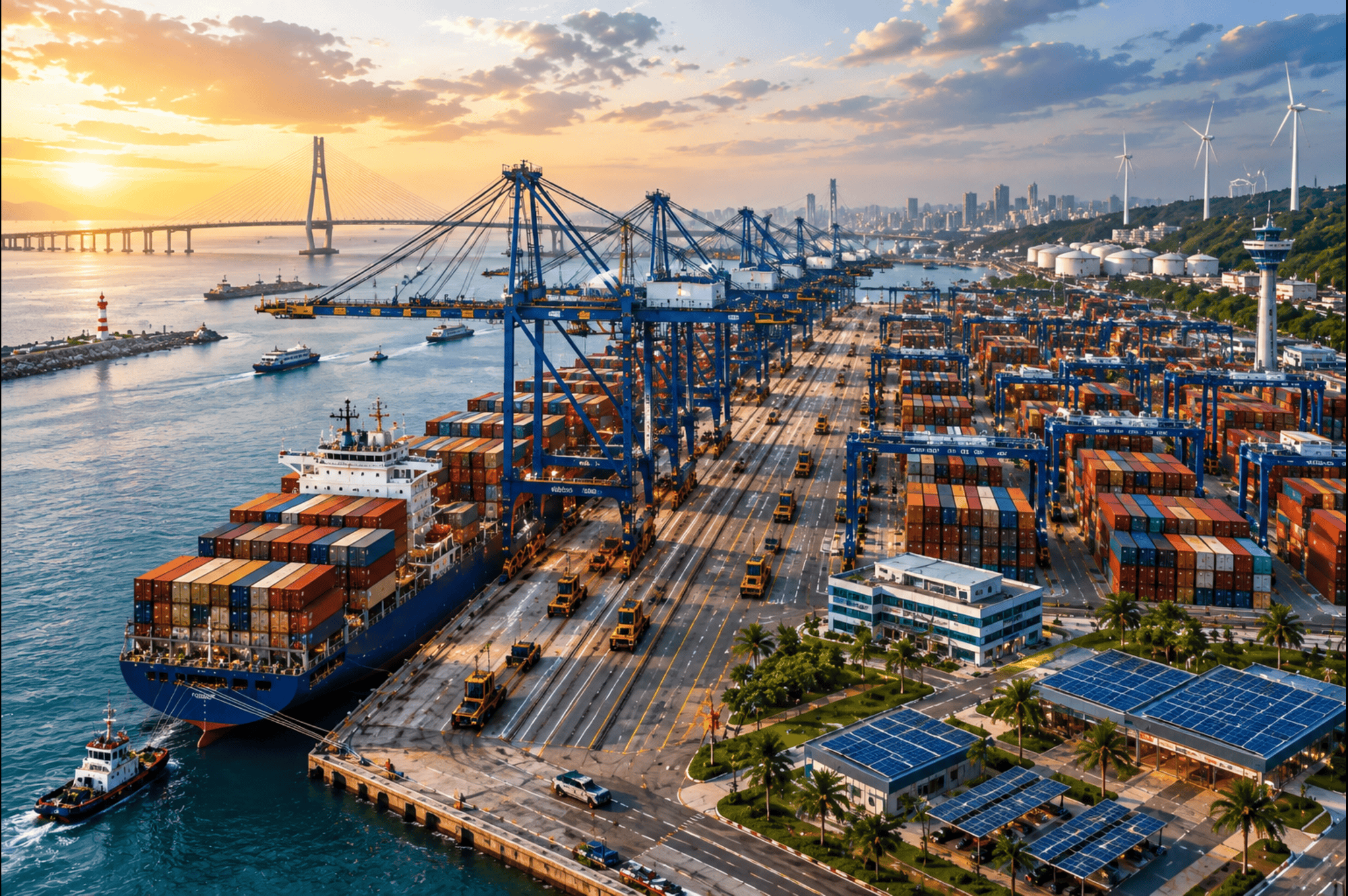
Traditional port engineering, dredging, breakwaters, berths, yard paving, remains the physical backbone of expansion. What is layered on top of it now is a stack of digital systems designed to squeeze efficiency out of existing and new assets alike.
Digital twins and BIM
The clearest example arrived in February 2026, when V.O. Chidambaranar Port Authority commissioned India’s first Digital Twin platform for port operations, inaugurated by Union Minister Sarbananda Sonowal. The system builds a continuously updated virtual replica of the port — vessel movement, cargo handling, equipment utilisation and logistics flows — using IoT sensors, GPS and LiDAR mapping to feed predictive algorithms that flag inefficiencies before they cascade into delays. Jawaharlal Nehru Port Authority has similarly adopted GIS-based infrastructure management and digital twin modelling alongside a fully digitised operating environment (India Shipping News, 2026). Building Information Modelling, though less publicised, is increasingly used at the design stage of greenfield ports such as Vadhavan, where breakwater geometry, berth alignment and reclamation sequencing must be modelled against complex hydrodynamic and geotechnical data before a single caisson is placed.
AI, IoT and IoT-enabled predictive maintenance
Analysts at the Indian Maritime University note that Indian ports have moved through a first wave of digitisation — RFID gate systems, Port Community Systems, blockchain pilots — and are now entering a second wave requiring genuinely “intelligent ports” powered by artificial intelligence rather than simple automation. AI-driven congestion forecasting and just-in-time berthing are being positioned as the next efficiency lever, since they compress vessel turnaround time by aligning arrival schedules with actual berth and yard availability rather than static slot allocation. IoT sensor networks embedded in cranes, conveyors and mooring systems increasingly support predictive maintenance — detecting vibration anomalies or thermal drift in equipment before failure, an approach already standard at ports such as Antwerp-Bruges and Singapore’s Tuas Port and now being adapted for Indian terminals.
Recent ministry releases suggest that India’s port digitisation agenda is moving from routine automation toward genuinely intelligent infrastructure. In February 2026, a PIB release linked to the VOC Port pre-event to the IndiaAI Impact Summit framed AI as a tool for improving port efficiency, safety and competitiveness. By March 2026, the same port had become the first Indian major port to implement a digital twin with AI-based asset monitoring for predictive maintenance, marking a significant shift from reactive maintenance to condition-based engineering. The ministry’s June 2025 digital initiatives, including a Digital Centre of Excellence, and JNPA’s NIVIDA, described as India’s first AI-driven tender evaluation engine, show that AI is now being pushed into both operations and procurement. Together, these updates indicate that Smart Ports India is no longer being discussed only in conceptual terms; it is beginning to appear in concrete, port-specific deployments with measurable operational intent.
Automation: cranes, AGVs and robotics
Vizhinjam International Seaport in Kerala has emerged as India’s most technologically advanced facility, deploying AI-powered vessel traffic management, fully automated rail-mounted gantry cranes in the yard and remote-controlled ship-to-shore cranes at the quay. This places it in the same automation category as global benchmarks like Rotterdam’s Maasvlakte II or Qingdao’s automated terminal, where automated guided vehicles move containers between quay and stack without a human operator in the loop, and smart yard-planning software continuously re-optimises stacking sequences based on onward rail, road or transhipment schedules.
Digital command centres, drones and cybersecurity
Centralised digital command centres — consolidating vessel traffic, weather, security and cargo-flow data on a single dashboard — are becoming standard at major ports; Mumbai Port, for instance, has upgraded its vessel traffic management infrastructure with advanced radar, AIS integration and hydro-meteorological sensors feeding a digital harbour management system. On the governance side, the Ministry has pushed digital single-window platforms — the National Logistics Portal (Marine), Sagar Setu and e-Samudra — alongside the “One Nation One Port” (ONOP) initiative to standardise documentation and processes across cargo types. As these systems interlink port operations with customs, railways and banking networks, cybersecurity has moved from a back-office concern to a design requirement: a compromised terminal operating system can now halt physical cargo movement as effectively as a cyclone.
Building Green: Electrification, Renewables and Coastal Resilience
Engineering ports for the future also means engineering them for a warming, more regulated world. The Ministry’s 2023 “Harit Sagar” Green Port Guidelines set binding-in-spirit targets: over 50 per cent electrification of port equipment and vehicles by 2030, rising to 90 per cent by 2047; a 30 per cent cut in carbon emissions per tonne of cargo by 2030 and 70 per cent by 2047; renewable energy sourcing above 60 per cent by 2030 and 90 per cent by 2047; and a 20 per cent expansion of green belt cover by 2030, rising to 33 per cent by 2047 (MoPSW, Sagar Vidya Kosh). Shore-to-ship power — allowing berthed vessels to draw grid electricity instead of running diesel auxiliary engines — is being rolled out in phases, with port craft covered first, Navy and coastal vessels next, and foreign-flagged cargo vessels following.
Early results are visible. Mormugao Port Authority now generates 3 MW of solar power, meeting its entire in-house consumption, and became the first Indian port to launch a Green Ship Incentive scheme — “Harit Shrey” — offering reduced port charges to vessels with strong environmental performance, placing it alongside only two other ports in Asia with such a scheme. New Mangalore Port now runs entirely on solar power, while the Green Tug Transition Programme has seen four ports — Deendayal, JNPA, Visakhapatnam and V.O. Chidambaranar — place work orders for electric harbour tugs. Kandla, Paradip and Tuticorin have been identified as green hydrogen hubs under the National Green Hydrogen Mission, and V.O. Chidambaranar has already commissioned a pilot green hydrogen plant and is developing a green methanol bunkering facility.
Coastal resilience engineering — cyclone-resistant berth design, elevated electrical infrastructure, mangrove buffer zones and reinforced breakwaters — is being written into new port design rather than retrofitted later, a lesson drawn from repeated cyclone disruption on the east coast.
Mega Projects Redefining the Coastline
Vadhavan Port, approved at an estimated cost of ₹76,220 crore and being developed by a special-purpose vehicle jointly owned by Jawaharlal Nehru Port Authority (74 per cent) and the Maharashtra Maritime Board (26 per cent), illustrates the engineering ambition of India’s next mother port. Its natural depth of nearly 20 metres will allow ultra-large container vessels to call directly, while its design requires reclaiming roughly 1,448 hectares of sea, building a 10.14-kilometre offshore breakwater, and constructing nine 1,000-metre container terminals across two phases targeting a combined capacity of around 23.2 million TEUs.
Vizhinjam Port in Kerala, India’s first fully automated deep-water container terminal, is designed to intercept transhipment cargo currently routed through Colombo or Singapore, directly serving international mother vessels from a natural depth port.
JNPA, India’s premier container gateway, handled a record 7.3 million TEUs in FY 2024-25, a 13.5 per cent year-on-year increase, and went on to cross 8 million TEUs and 102 million tonnes of cargo in FY 2025-26.
Paradip Port Authority and Deendayal Port Authority each crossed 150 million tonnes of cargo handling for the first time in FY 2024-25. Further greenfield capacity is rising on the Andhra coast, with the Ramayapatnam port project around 69 per cent complete and Machilipatnam and Bhavanapadu ports progressing in parallel, each engineered on an EPC basis with phased breakwater and berth construction.
By the Numbers
- Total Indian port capacity: from 1,400 MMTPA (2014) to 2,762 MMTPA (2026)
- Cargo handled by major ports, FY 2024-25: 855 MT, up 4.3% from 819 MT in FY 2023-24
- Cargo handled by major ports, FY 2025-26: 915.17 MT, exceeding the 904 MT target, up 7.06% YoY
- Container traffic at major ports: up from 7.9 million TEUs (FY15) to 13.5 million TEUs (FY25)
- Sagarmala: 840 projects worth ₹5.8 lakh crore targeted by 2035; 272 completed (₹1.41 lakh crore)
- Maritime India Vision 2030 investment target: ₹3–3.5 lakh crore across 150+ initiatives
- Maritime Amrit Kaal Vision 2047 investment target: ~₹80 lakh crore
- Port-led industrialisation: 962 acres of port land allocated in FY 2024-25, valued at ₹7,565 crore, expected to draw ₹68,780 crore in future investment
- PPP investment in major ports: from ₹1,329 crore (FY23) to ₹3,986 crore (FY25)
- Inland waterways cargo: from 18 MMT (2014) to 146 MMT (2025), a 710% rise
Expert Insight
Maritime policy researchers at the Indian Maritime University note that India’s ports have already completed a first wave of digitisation — port community systems, RFID gate automation, e-documentation — but the next phase demands a shift from digitised operations to genuinely data-driven, AI-informed decision-making. As one analysis puts it, congestion forecasting and just-in-time berthing, rather than additional berths alone, may deliver the next major reduction in vessel turnaround time. This reframes smart-port investment: the highest-value engineering work ahead is less about pouring more concrete and more about instrumenting what already exists.
Economic Impact
AI adoption in Indian ports could unlock an estimated ₹20,000 crore in annual cargo-handling savings and about ₹15,000 crore in annual logistics savings, according to an EAC-PM member’s February 2026 estimate. The largest gains are expected from predictive maintenance, smarter berth and yard planning, automated gate management and better coordination across port, road and rail interfaces. These savings would come not just from lower operating costs, but from reduced vessel delays, faster cargo evacuation and higher equipment uptime. Importantly, the estimate should be treated as a policy and industry projection rather than a realised government figure.
Challenges on the Horizon
The transition is not without friction. Cybersecurity risk grows in step with digital integration across single-window platforms; legacy brownfield infrastructure at older ports complicates retrofitting for automation and electrification; financing large greenfield projects such as Vadhavan requires complex debt-equity structuring; coastal land acquisition and environmental clearances — as seen in Vadhavan’s mangrove-clearance litigation — can delay construction timelines; and a shortage of skilled personnel in port automation, digital twin modelling and green-fuel bunkering remains a bottleneck. Interoperability between the multiple digital platforms now in use, and harmonising state-level non-major ports with national digital and green standards, will determine whether these gains scale uniformly across India’s coastline.
Looking Ahead
India’s maritime sector is no longer measured only by tonnes handled or berths built. The metrics that will define competitiveness over the next decade — turnaround time, carbon intensity per tonne of cargo, automation depth, and digital interoperability — are engineering metrics as much as economic ones. Capacity expansion under Sagarmala and Maritime India Vision 2030 has given India the physical scale to compete globally; it is the layering of digital twins, AI-driven operations, automation and green infrastructure atop that scale that will determine whether Indian ports merely handle more cargo or actually compete with Rotterdam, Singapore and Shanghai on efficiency and sustainability. Engineering innovation, not infrastructure expansion alone, will decide whether India’s maritime ambition converts into global maritime leadership by 2047.
Tags