GBCI India: Cooling a Data Centre in Chennai Is Not the Same as Cooling One in Noida

by P. GopalaKrishnan, Managing Director, GBCI India
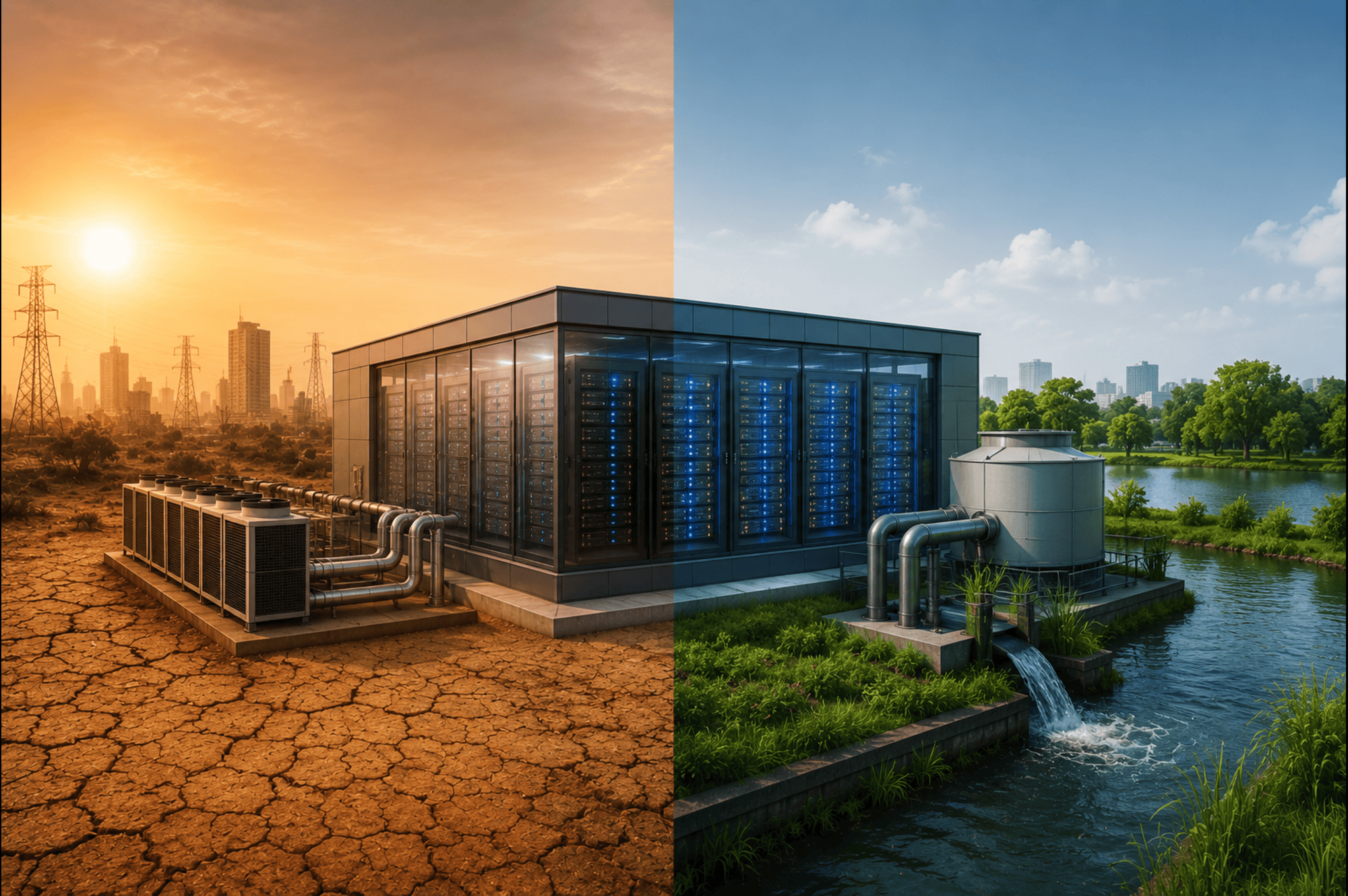
Spend a summer in Noida and you understand quickly why the cooling never quite wins. The mercury pushes toward 48 degrees, the grid strains, and every machine that must stay cold works twice as hard to manage it. Travel south to Chennai and the trouble shifts entirely. There, the enemy is rarely the heat on its own. It is the water. The city ran dry in 2019, when its four main reservoirs dropped to almost nothing and millions of residents found themselves queuing behind tankers.
Two cities, both sitting at the heart of India’s data centre boom. They share the same broad task, keeping rooms full of servers from overheating, and almost nothing about how they should go about it is the same.
This gap is really the whole point I want to make.
India is adding data centres faster than at any time in its history. Installed capacity has tripled since 2020 to about 1.5 GW, and most forecasts put us close to 6.5 GW by the end of the decade. We host about 300 facilities today. The Union Budget has handed the sector a tax holiday that runs all the way to 2047. The drivers go beyond commercial demand. Minister of State for Electronics and IT Jitin Prasada described data centres as India’s “data factory of the world” and was explicit that keeping critical data within the country is now a national priority alongside attracting foreign investment. Data sovereignty, as the Minister framed it, sits at the heart of the government’s future strategy for the sector. What India stores here, and how securely and sustainably it stores it, is no longer just a market question. It is a matter of strategic interest.
Capital is arriving quicker than anyone predicted, and it is landing, overwhelmingly, in cities that are already short of water. By some estimates, nearly three-quarters of our data centres sit in water-stressed regions. S&P Global’s modelling suggests that 60 to 80 percent of them could be under high water stress by 2030.
Here is the part that tends to get lost in the policy conversation. A data centre’s thirst is not a fixed number you can write into a national rule. It depends on where you build it. Most facilities in India still cool the conventional way, by evaporating water, and roughly four of every five litres they draw simply disappear into the air. The hotter and drier the location, the more they drink. Karnataka’s own IT minister has put the figure at about 25 million litres a year for every megawatt of capacity. Multiply that across a hyperscale campus and you are competing, quietly, with farms and homes for the same aquifer.
So, when people call for one national rulebook to fix all of this, I understand the instinct. I simply do not think it can carry the load on its own.
A blanket standard, by design, treats Chennai and Noida and Mumbai and a small town in inland Maharashtra as if they were interchangeable. They are not. Coastal Chennai can draw on seawater for cooling in ways that landlocked Noida can’t. A facility in a heat-stressed, groundwater-depleted district needs very different choices from one near a coast with a sea-water intake, or one in a city with a working sewage-treatment network it can tap for reused water. Write a single rule for all of them and you end up with one of two bad outcomes. Either the bar sits so low that it changes nothing, or it is so rigid that it penalises good projects because of geography.
This is exactly where a green building rating system earns its place. LEED (Leadership in Energy and Environmental Design), the world’s most widely used green building rating system, does not begin from a national average. It begins from the site. It examines the local climate, the water table, the grid, the surrounding community, and then asks what genuine high performance looks like in that particular spot. The newest version, LEED v5, builds this thinking in through a Project Priorities and Innovation category, which lets the real context of a project, its typology, its location, its specific constraints, shape how it is assessed. A data centre certifies on what it actually does on the ground, not on a checkbox that ignores whether it stands on the coast or in a drought corridor.
For us, this is not a hypothetical. There are now more than 700 LEED-certified data centres around the world, and well over 1,797 certified and registered, covering some 542 million square feet. The framework already presses projects on the two numbers that matter most in this debate, Power Usage Effectiveness and Water Usage Effectiveness. Those are the very metrics that most Indian state policies still do not require anyone to report.
And that, frankly, is the deeper problem. You cannot manage what you don’t measure. Across most of India, operators are under no obligation to disclose how much water they use, which is a large part of why so many of them rate water as a low business risk. It reads as cheap on their books because municipal water is cheap, no matter how depleted the source has become. The price signal tells them almost nothing true. A rating system brings that information into the open, project by project, and turns an invisible cost into a visible one that a board must look at.
In practice, climate-responsive design ends up looking different in each city, which is the entire argument for letting the site lead. In a coastal hub it might mean seawater cooling done carefully, with proper attention to coastal regulation and marine impact. In a water-scarce inland city, it might mean closed-loop chillers, or direct-to-chip and immersion cooling that cut water use sharply, fed by recycled and treated wastewater rather than fresh groundwater. Bengaluru already requires certain thermal plants near the city to run on treated water. Extending that logic to data centres, and letting a rating framework verify that it actually happens, is the kind of locally intelligent solution a flat national mandate struggles to deliver.
None of this is an argument against good policy. We need both. A national framework can set direction, demand transparency, and rule out the worst siting decisions before they get locked in for 20 years. But the engineering judgment, the part that decides whether a specific building in a specific city is genuinely sustainable, must happen at the level of the project. That is precisely what certification is designed to do.
India will build its data centres. The sovereignty case is real, and the demand is not going anywhere. The only open question is whether the facilities we approve this year, the ones still running in 2045, have been designed honestly for the place in which they operate. Chennai is not Noida. Our buildings should be built as though we know that.
Tags