Construction Chemicals: Engineering Durability, Strength & Performance

Often hidden beneath concrete and steel, construction chemicals have become indispensable to modern construction and infrastructure development. From enhancing durability and waterproofing structures to improving concrete performance and extending asset life, these specialised solutions are transforming the way India builds. Driven by massive infrastructure investments, rapid urbanisation, technological innovation, and performance-based construction practices, the construction chemicals industry is emerging as a critical pillar of the country’s infrastructure growth story
There are few industries that remain largely invisible to the public eye, yet play a critical role in shaping the built environment around us. The construction chemicals sector is one such industry. It rarely grabs headlines, but its importance becomes evident whenever a building develops severe leakages, concrete begins to deteriorate prematurely, or a structure fails to perform as intended. In many ways, construction chemicals are the unseen force that binds, protects, and strengthens modern infrastructure. It protects basements and underground structures from water ingress, concrete admixtures enhance strength and workability, sealants safeguard thousands of expansion joints, while protective coatings shield structures from corrosion, weathering, and chemical attack. Though invisible once construction is complete, these technologies are as critical to a building’s lifespan as the concrete and steel that form its skeleton.
India is witnessing an era of iconic skyscrapers and luxury residential towers to sprawling commercial complexes and modern industrial facilities, structures are becoming more sophisticated in both design and performance requirements. The artistic facades, intricate geometries, vast basement levels, and long-span structures that define contemporary construction would be difficult to achieve without specialised construction chemical solutions. The contribution of construction chemicals extends far beyond buildings. They have become indispensable to the delivery of modern infrastructure projects. India’s infrastructure transformation over the past decade has been remarkable, particularly in sectors such as roads and highways, metro rail, tunnels, airports, ports, industrial corridors, and renewable energy facilities. Behind many of these engineering achievements lies the extensive use of advanced construction chemical solutions.
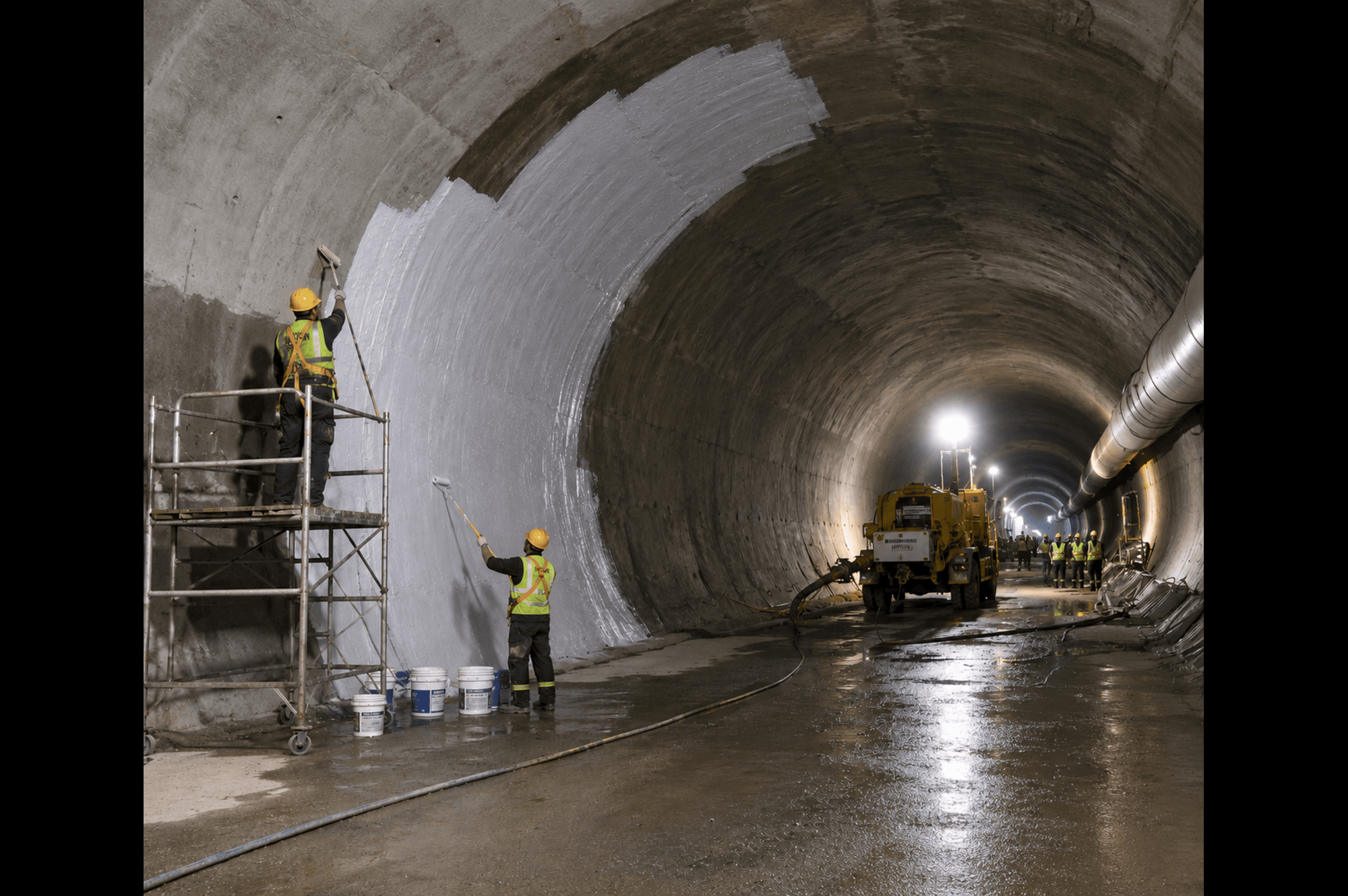
India’s ambitious tunnelling programme across the Himalayas and other geologically challenging regions offers a compelling example of the importance of construction chemicals. Landmark projects such as the Atal Tunnel, along with several railway and highway tunnels under development, have had to contend with severe water ingress, unstable rock strata, high overburden pressures, and harsh climatic conditions. Advanced construction chemical solutions – including specialised grouts, waterproofing membranes, shotcrete accelerators, injection resins, and ground stabilisation systems – have been instrumental in overcoming these challenges, enabling contractors to ensure structural integrity, durability, and long-term performance. Similarly, India’s highways and expressways have expanded at an unprecedented pace. Construction chemicals are extensively used in road infrastructure to improve pavement performance, enhance concrete strength, reduce cracking, increase resistance to temperature fluctuations, and extend service life. Concrete admixtures improve workability and durability, curing compounds ensure proper hydration, bonding agents strengthen repairs, while protective coatings and sealants help preserve bridges, flyovers, culverts, and elevated corridors against moisture, chlorides, and environmental degradation. These solutions reduce maintenance requirements and significantly improve lifecycle performance.
Strengthening Market Reach
The growing importance of construction chemicals is reflected in the sector’s strong market expansion. As India undertakes one of the largest infrastructure development programmes in its history, demand for advanced construction chemical solutions is rising across virtually every construction segment. Metro rail corridors, data centres, high-speed rail networks, expressways, airports, renewable energy parks, logistics hubs, and smart industrial cities are reshaping the country’s economic landscape. Behind each of these projects lies a growing reliance on construction chemicals that enhance durability, performance, and lifecycle value. This infrastructure-led growth is providing a significant boost to the industry. According to Mordor Intelligence, the Indian construction chemicals market was valued at USD 3.69 billion in 2025 and is projected to grow from USD 3.97 billion in 2026 to USD 5.68 billion by 2031, registering a CAGR of 7.46% during the forecast period. The market’s expansion is being driven by a combination of infrastructure investments, rapid urbanisation, technological advancements, and evolving construction practices. Government-led spending remains one of the strongest growth drivers. Initiatives such as the National Infrastructure Pipeline (NIP), PM GatiShakti, Smart Cities Mission, metro rail projects, industrial corridors, and highway expansion programmes are generating sustained demand for specialised construction chemicals. As project owners increasingly focus on durability and lifecycle performance, products such as high-performance admixtures, waterproofing systems, repair materials, protective coatings, grouts, and sealants are becoming standard components of modern construction.
Urbanisation and population growth are creating an equally powerful demand catalyst. India’s expanding cities require new residential developments, commercial complexes, healthcare facilities, educational institutions, industrial parks, and urban infrastructure. This construction activity is driving the use of products that improve structural strength, enhance durability, prevent water ingress, and reduce maintenance costs over the life of an asset. The growing adoption of ready-mixed concrete (RMC), particularly beyond Tier-I cities, is another important factor supporting market growth. Modern infrastructure projects increasingly require concrete with precise performance characteristics, including higher strength, improved workability, faster setting times, and enhanced durability. This has accelerated the use of advanced admixtures and concrete performance enhancers that help contractors meet stringent project specifications while improving construction efficiency. Sustainability is also emerging as a major growth driver. As developers pursue green building certifications such as IGBC and EDGE, demand is increasing for environmentally friendly construction chemicals, including low-VOC sealants, bio-based waterproofing systems, recycled-content additives, and energy-efficient flooring solutions. At the same time, technological innovations such as new-generation admixtures, corrosion inhibitors, self-healing materials, and advanced repair systems are helping improve asset performance and service life.
Another promising segment is repair, rehabilitation, and refurbishment. As India’s stock of buildings, bridges, flyovers, industrial facilities, and public infrastructure ages, the need for structural strengthening, corrosion protection, waterproofing upgrades, and asset life-extension solutions is growing steadily. With infrastructure investments continuing to rise and the industry increasingly focusing on lifecycle value rather than just construction cost, construction chemicals have evolved from a niche segment into a critical pillar of modern construction. The outlook for the sector remains highly positive as India continues its journey towards building durable, sustainable, and resilient infrastructure.
Sealing Leaks, Securing Durability
Despite its strong growth prospects, the construction chemicals industry faces several challenges that could influence its pace of expansion. One of the biggest hurdles remains the limited awareness of the lifecycle benefits offered by construction chemicals. While large infrastructure developers and organised real estate players increasingly recognise the value of advanced solutions, a significant portion of the market continues to prioritise upfront costs over long-term performance. As a result, lower-cost alternatives are often chosen, compromising durability and increasing maintenance expenses over the life of a structure. Price-led competition remains another major concern. Although construction chemicals account for only a small fraction of total project costs, procurement decisions are frequently driven by initial pricing rather than lifecycle value. This challenge is compounded by the presence of unorganised players and counterfeit products. Low-cost alternatives often mimic established brands and offer short-term savings, but can result in premature failures in critical applications such as waterproofing, repair, and corrosion protection. The industry also faces volatility in raw material prices. Since many products depend on petrochemical-based and specialty chemical inputs, manufacturers remain vulnerable to global supply chain disruptions, currency fluctuations, and commodity price movements. Maintaining profitability while ensuring consistent quality continues to be a balancing act. A shortage of skilled applicators is another critical bottleneck. Construction chemicals are highly application-sensitive, and their performance depends as much on correct installation as on product quality. Inadequate surface preparation, incorrect dosage, poor workmanship, and the absence of a structured certification framework often lead to suboptimal results on site. The lack of comprehensive standards and uniform code implementation across several product categories presents an additional challenge. In many cases, project-specific specifications or international benchmarks are used in place of standardised national guidelines. This can lead to inconsistent quality, product substitution, and varying application practices. Similarly, the absence of a specification-driven procurement culture in many projects allows approved products to be replaced with lower-grade alternatives, undermining intended performance standards. Commercial pressures also persist. Extended payment cycles and long credit periods strain the working capital of manufacturers, particularly those investing heavily in research, innovation, and technical support. Meanwhile, low-cost imports continue to exert pricing pressure on domestic manufacturers across categories such as tile adhesives, sealants, and waterproofing products.
Sustainability is emerging as another key growth driver. With developers pursuing green building certifications and governments promoting environmentally responsible construction practices, demand is rising for low-VOC coatings, eco-friendly waterproofing systems, recycled-content additives, and energy-efficient flooring solutions. At the same time, innovations such as self-healing concrete additives, advanced admixtures, corrosion inhibitors, and smart repair systems are opening new opportunities for improving asset durability and construction efficiency. As India’s construction industry gradually shifts from a cost-driven to a performance-driven approach, the opportunities for the construction chemicals sector are expected to outweigh the challenges. Companies that invest in innovation, sustainability, skill development, and customer education will be best positioned to capitalise on the industry’s next phase of growth.
The Shift from Cost to Performance
One of the most significant developments shaping the construction chemicals industry is the transition from volume-driven construction to performance-based construction. Traditionally, construction projects were largely evaluated on initial cost and speed of execution. Today, however, infrastructure owners, developers, and consultants are increasingly focusing on durability, lifecycle performance, maintenance costs, and long-term asset reliability. This shift is changing the way construction materials are specified and procured. Whether it is a metro rail corridor, expressway, airport, data centre, industrial facility, or high-rise building, project stakeholders are demanding solutions that can deliver measurable performance over decades of operation. Construction chemicals have become central to this transformation, enabling structures to withstand water ingress, corrosion, chemical attack, temperature variations, heavy traffic loads, and other environmental stresses. The growing emphasis on performance is particularly evident in infrastructure projects. Agencies such as NHAI, metro rail corporations, airport authorities, and leading EPC contractors are increasingly adopting performance-based specifications that prioritise service life and lifecycle value over lowest initial cost. As a result, products such as high-performance admixtures, advanced waterproofing systems, corrosion protection technologies, repair materials, and specialised coatings are becoming integral to project design and execution. The rise of performance-based construction is also encouraging greater accountability across the value chain. Manufacturers are expected to provide technical support, testing data, warranties, and application guidance, while contractors are required to follow stricter quality-control procedures. This is gradually transforming construction chemicals from a commodity purchase into an engineered solution that directly influences project outcomes. As India builds increasingly sophisticated infrastructure, the demand for products that enhance durability, resilience, and sustainability is expected to grow. In this environment, performance-based construction is likely to emerge as one of the most important drivers of the construction chemicals industry’s future growth.
As construction projects become larger, more complex, and performance-driven, innovation is emerging as a key differentiator in the construction chemicals industry. The focus is no longer limited to improving concrete strength or preventing water ingress; manufacturers are increasingly developing solutions that enhance durability, accelerate project execution, reduce maintenance requirements, and support sustainability goals. Advanced admixtures are enabling contractors to achieve higher-strength concrete, improved workability, and faster construction cycles. New-generation waterproofing systems, including crystalline technologies and hybrid membranes, are offering enhanced protection against water ingress in basements, tunnels, bridges, and underground structures. At the same time, corrosion inhibitors and specialised protective coatings are helping extend the lifespan of critical infrastructure exposed to harsh environmental conditions. Innovation is also gaining momentum in the repair and rehabilitation segment. High-performance repair mortars, injection resins, fibre-reinforced systems, and structural strengthening solutions are enabling ageing assets to be restored and upgraded without extensive reconstruction. Meanwhile, sustainability concerns are encouraging the development of low-VOC products, environmentally friendly coatings, and solutions that reduce the carbon footprint of construction activities. As infrastructure owners increasingly prioritise lifecycle performance, manufacturers are investing heavily in research and development to create products that deliver greater durability, resilience, and long-term value. The industry’s future will be shaped not only by how much infrastructure India builds, but by how effectively these advanced technologies help that infrastructure perform over decades of service.
Growth Drivers Remain Intact
As India advances towards its Viksit Bharat 2047 vision, the emphasis is steadily shifting from merely building infrastructure to building infrastructure that lasts. The country’s next generation of highways, metro systems, airports, industrial corridors, renewable energy facilities, data centres, and urban developments will be judged not only by the speed at which they are delivered, but by their durability, resilience, sustainability, and lifecycle performance. In this evolving construction landscape, construction chemicals are no longer auxiliary materials but critical enablers of modern engineering. From enhancing concrete performance and preventing water ingress to protecting assets against corrosion and extending service life, they are helping shape a built environment that is stronger, safer, and more sustainable.
The long-term outlook for the industry remains highly positive. Massive investments in infrastructure, rapid urbanisation, evolving regulations, and growing awareness about quality and lifecycle performance are creating favourable conditions for sustained market growth. As project owners increasingly focus on building durable and future-ready assets, the role of construction chemicals is expected to become even more critical. As innovation accelerates and performance-based construction becomes the norm, the construction chemicals industry is poised to play an increasingly vital role in building the infrastructure foundations of a developed India.
Tags