Case Study: Spark and WSP Revolutionize Melbourne’s Infrastructure with the North East Link for a Sustainable Future

Bentley and Seequent’s Innovative Solutions Helped Save 46,000 Work Hours and AUD 2 million by Optimizing Design
Bridging the Gap in Melbourne’s Highway Network
Circling its way around Melbourne, the city’s highway network had long struggled with one essential missing link – a connection from the M80 to the Eastern Freeway. Without it, drivers had to make their way through local roads and communities to complete their journeys.
The North East Link, comprising Victoria’s longest road tunnels, makes that connection, taking 15,000 trucks off congested streets, improving the environment, and reducing noise and pollution by shaving 35 minutes off travel times. It will significantly benefit Melbourne residents but is also an enormous project, requiring twin 6.5-kilometer-long tunnels, three major underground road interchanges, and some extensive and sophisticated 3D geological modeling. Costing AUD 11 billion and due for completion in 2028, the 17-meter-diameter road tunnels will be at the heart of Victoria’s largest infrastructure project.
Spark was tasked with delivering this project, and they quickly realized the value of establishing a detailed 3D model to visualize the complex geological conditions and risks, as well as aid communication with the legion of stakeholders. Therefore, they engaged engineering consultants WSP to provide ground engineering services in the design phase and carry out a range of geotechnical site investigations.
Tackling Geological and Coordination Hurdles
Building the North East Link presented two major challenges. The first was how to fully understand the subsurface that the tunnels would travel through. The second, and just as important, was how to share that information with the seven infrastructure design consultancies, who would all need to work together to deliver the additional elements of the far-reaching scheme.
It was an undertaking that would engage more than 300 people over nearly two and half years, delivering around AUD 30 million of site investigations, with a similar figure going on detailed subsurface modelling and ground engineering design analysis.
Building Off of a Leapfrog Works Model
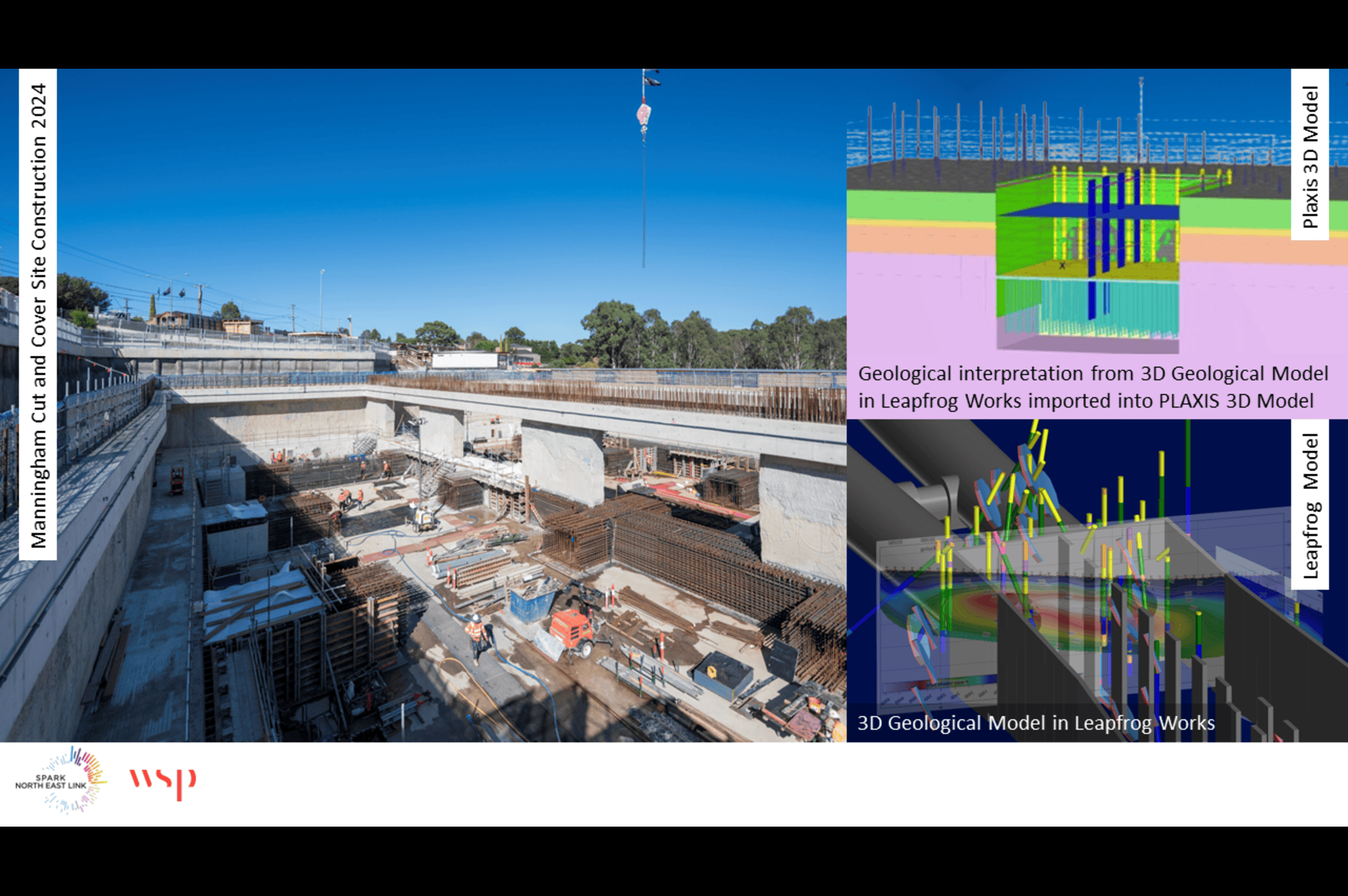
Facing the sheer volume of site investigation data available for the North East Link Project, Spark and WSP leveraged the efficiencies provided by Leapfrog Works, PLAXIS, and ProjectWise to rapidly deliver up-to-date subsurface ground modeling for design analyses and construction planning. They began with a baseline model of Melbourne’s regional geology in Leapfrog. Over time, they steadily incorporated the data of more than 1,900 boreholes, as well as thousands of in-situ measurements and lab test results. They then developed a program of targeted additional site investigations to fill the gaps and refine geotechnical resolution in key areas.
Additionally, the team stored more than 370 multidiscipline design packages from native 3D digital design models in ProjectWise. These models were fully coordinated with the latest information, being used as the basis for design drawings, schedules, and construction set-out information.
By isolating geological features in the model, the teams were able to find savings and optimizations in the PLAXIS-led designs, such as identifying the risk of a planar sliding rock mass during the design of the 35-meter deep piled retention system, as well as visualizing the tunnel’s intersection to reduce the risks associated with such unstable ground. The team also used Leapfrog’s ability to combine multiple data types to refine the ground models and optimize the diaphragm wall embedment depth.
A Digital Environment for a Better Environment
By implementing a digital strategy on the North East Link, Spark and WSP improved communication, enhanced the quality of design and construction, and mitigated risks, particularly those associated with geotechnical conditions. Implementing Leapfrog Works at the scale reflective of this mega project supported remarkable sustainability outcomes, refined management of subsurface ground risks, and advanced Spark’s best practice digital engineering aspirations. Once the project is complete, the models will be incorporated into the asset information model to support tunnel operation, maintenance, and emergency management, identifying potential ground risks should a critical event occur.
The results were astounding. With Bentley and Seequent applications helping to efficiently share geological information, the team saved 46,000 works hours by implementing a 3D geological model, compared to modeling and interpretation using traditional methods. They also saved AUD 2 million by optimizing design. Over 1 million cubic meters of material were recycled for use in the project’s construction rather than sent to a landfill, which helped save AUD 10 million by reducing spoil disposal and haulage. But perhaps most importantly, Spark and WSP saved AUD 6 million by cutting drilling work by a year, significantly reducing the impact on the community.
Pat McLarin has over 20 years of experience as a product manager in the research and development of geospatial hardware and software solutions for the GIS, geotechnical, and construction user communities. In his seven years at Seequent, his focus has been on addressing the needs of geoscientists and geotechnical engineers in understanding and communicating subsurface conditions to enable collaborative decision making on civil and environmental projects. Pat currently leads Seequent’s global strategy for civil infrastructure and participates in open standard development and the NZ Digital Twin Partnership to raise the profile of the geotechnical disciplines in BIM and digital twins.
Tags