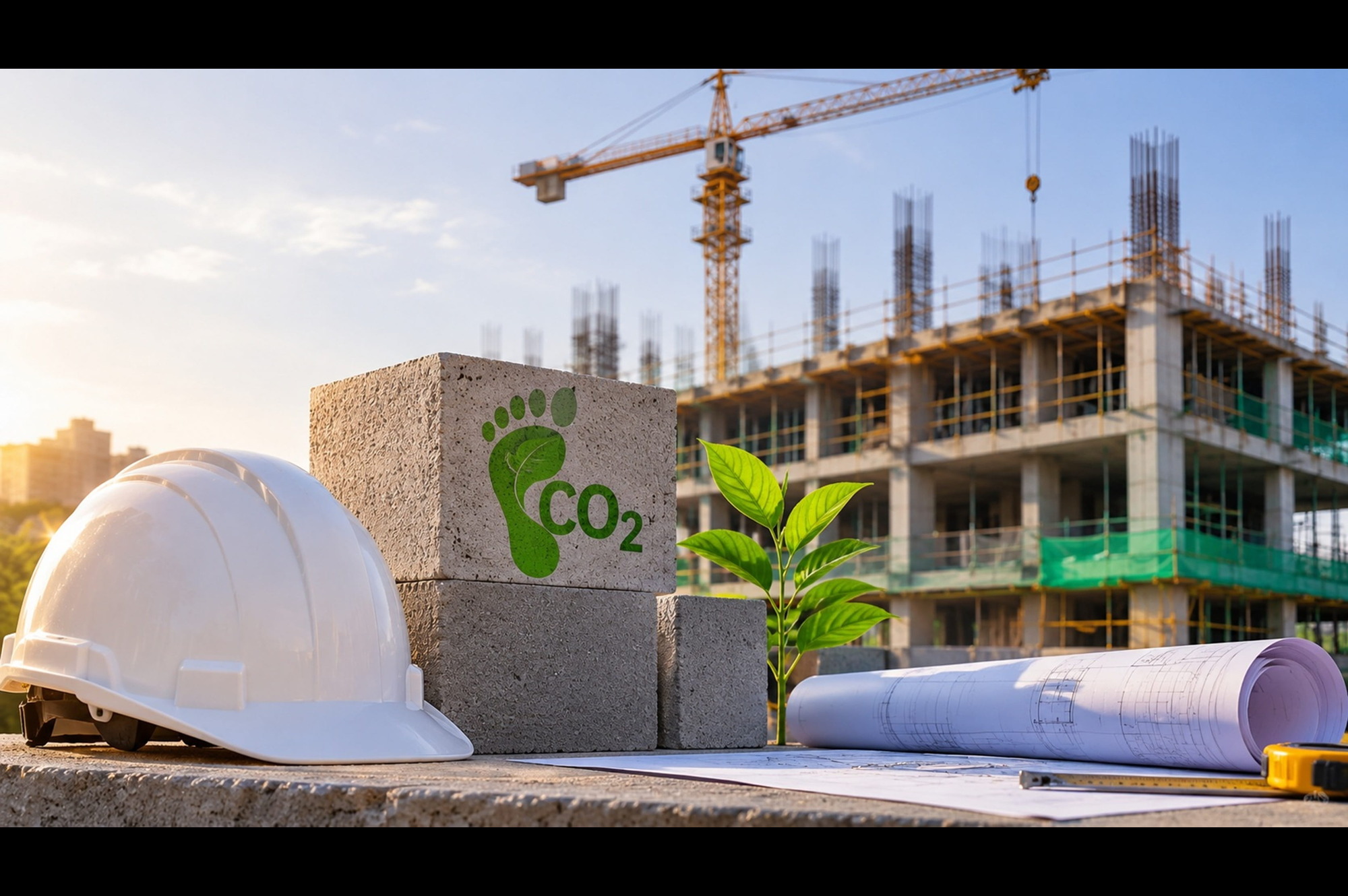
The Hidden Carbon Cost of Construction: Why India Must Rethink How It Builds

by P. GopalaKrishnan, Managing Director, Southeast Asia and Middle East, GBCI
When we talk about making buildings greener, the conversation usually begins with what happens after the building is occupied. How much electricity will it consume? How efficiently will it cool the space? Can we reduce water consumption? Can the building perform better over its lifetime? These are important questions. But in my work with developers, architects and project teams across different markets, I have increasingly found myself asking another question much earlier in the process: what did it take to build this building in the first place?
That is where the conversation around embodied carbon becomes important. A building can be highly efficient once it is operational and still carry a significant carbon footprint from the materials and processes that went into constructing it. Concrete, steel, glass, aluminium, insulation, finishes and other construction materials all come with an environmental cost that is often incurred long before the first occupant walks through the door. NITI Aayog’s (National Institution for Transforming India) latest building-sector assessment estimates that key building materials, including cement, steel, bricks, aluminium and glass, together account for around 453 million tonnes of CO₂e in annual embodied emissions in India. Cement accounts for an estimated 214 million tonnes, followed by steel at 143 million tonnes. For a country like India, which is going through one of the largest periods of urban and infrastructure development in its history, this is a conversation we cannot afford to postpone.
The Carbon We Don’t See
NITI Aayog estimates that the building sector, including operational and embodied emissions, accounts for around 25% of India’s national greenhouse gas (GHG) emissions when cooking is excluded. In my experience, project discussions often focus on cost, timelines, design and operational efficiency, while carbon considerations come in much later. By then, key decisions around structural systems, concrete and steel usage, façade design and material sourcing have already been made. Revisiting them can be difficult and expensive. Embodied carbon therefore needs to be part of the project brief from day one.
Rethinking Design Questions
At the design stage, project teams must look beyond just the cost of materials. It’s essential to consider the entire lifecycle of these materials, including their source, manufacturing process, transportation, durability, and end-of-life impact. By prioritizing better structural design, locally sourced materials, recycled content, and the reuse of existing structures, teams can significantly reduce embodied carbon. A 2025 assessment of a 30-story residential building in India revealed that the embodied carbon ranged from 373 to 530 kgCO₂e per square metre, with concrete and reinforcement steel contributing approximately 80% of this total. Material and structural choices made at the design stage largely set a building’s carbon footprint.
Focusing On Concrete and Steel
Concrete and steel are indispensable to India’s construction sector; however, their production is associated with substantial embodied carbon emissions. The aim is to use them more efficiently through better structural design, recycled content, lower-carbon alternatives and sharper project planning. This calls for closer collaboration among architects, engineers, developers, contractors, and manufacturers. KPMG India’s analysis of sampled capital projects indicates that in a studied commercial real estate project, concrete was responsible for 29% of the embodied carbon, while steel and logistics accounted for 22% and 24%, respectively. Although these figures fluctuate with different projects, they highlight a crucial insight: construction emissions are not solely influenced by the materials used, but also by their sourcing, transportation, and application.
Addressing Construction Waste
Another significant factor contributing to overall carbon emissions is construction waste, often stemming from poor planning, inaccurate estimates, design modifications, and improper material storage. Every tonne of waste represents not just lost resources, but also the emissions generated during production and transportation. To mitigate waste, strategies like better quantity estimation, digital coordination, prefabrication, and efficient material management are vital. By considering the full spectrum of a material’s lifecycle and collaborating effectively, we can make strides toward a more environmentally friendly built environment.
India Has a Window of Opportunity
The buildings we are designing today will remain part of our cities for decades. That gives us a responsibility, but it also gives us an opportunity. We do not have to choose between economic growth and lower-carbon construction. We need to find ways of achieving both. India’s construction sector is already changing rapidly. New materials, better technologies, digital tools and stronger sustainability standards are becoming part of the industry. The next step is to bring embodied carbon into that mainstream conversation.
A building’s carbon story does not begin when the lights are switched on. It begins much earlier in the materials we extract, the factories that produce them, the trucks that transport them and the decisions made on the drawing board. If we want genuinely sustainable cities, we must start looking at that part of the story too.