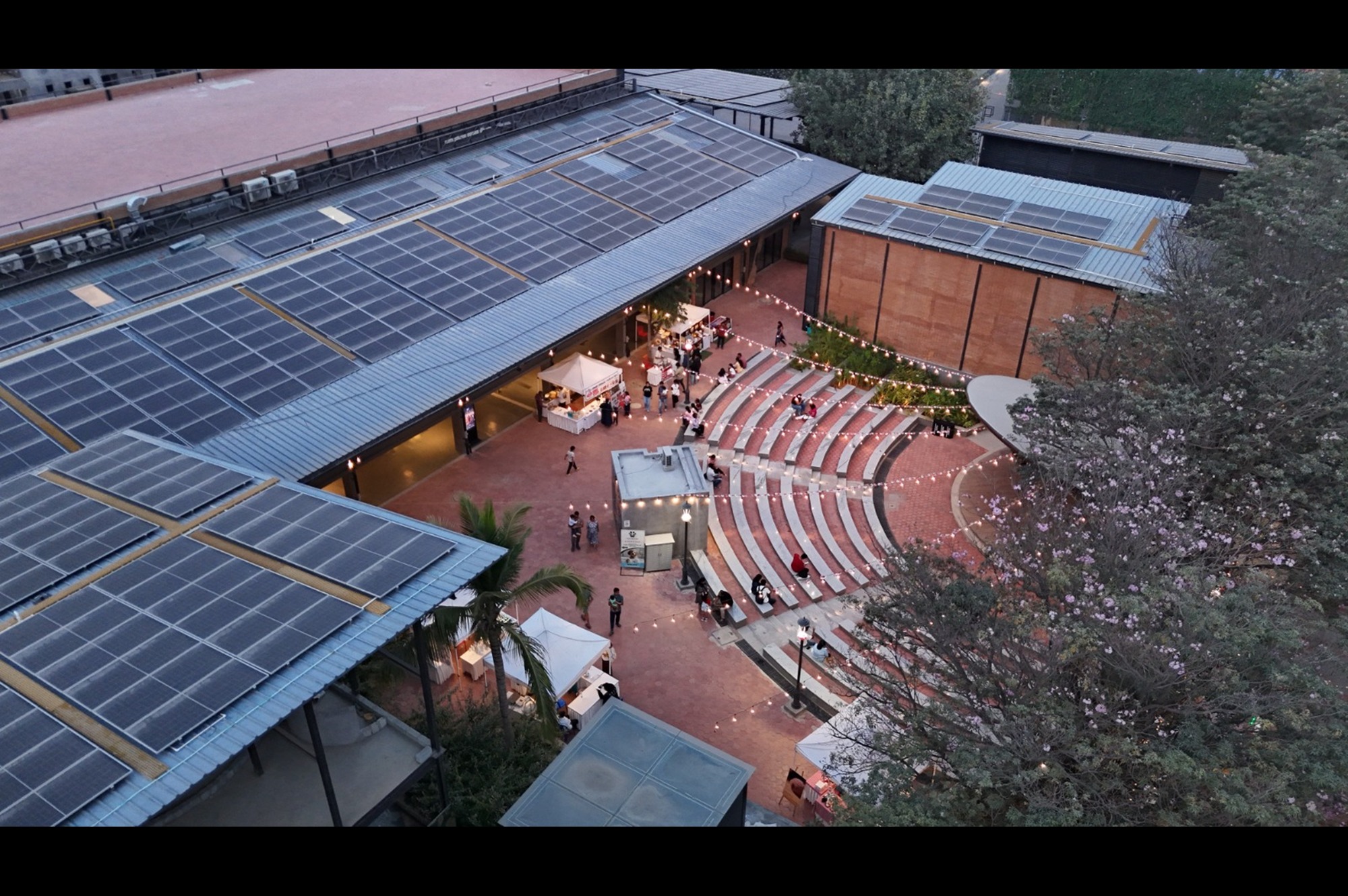
Cooling by Design: Why Climate-Responsive Infrastructure Will Define the Next Era of Urban Development

by Haresh Mirpuri, Founder, Essensai067
India’s infrastructure sector is confronting a challenge that extends far beyond construction. As urbanisation accelerates, temperatures rise and extreme heat events become more frequent, cooling is emerging as one of the defining infrastructure questions of the coming decades.
For years, thermal comfort has largely been addressed through mechanical cooling. Air conditioners have become the default response to rising temperatures across homes, offices, commercial developments and public infrastructure. While they provide immediate relief, they also increase electricity demand, place growing pressure on power networks and contribute to rising urban temperatures through waste heat emissions.
This challenge is becoming increasingly significant. India’s Cooling Action Plan projects that cooling demand could increase nearly eight-fold by 2037-38 if current trends continue. At the same time, cooling is expected to become one of the fastest-growing drivers of electricity demand in the country.
The cooling debate is often framed as an environmental issue. In reality, it is equally an economic and infrastructure issue. Rising cooling demand affects electricity infrastructure, operating costs, workforce productivity, public health and the long-term competitiveness of cities. Every degree of heat that can be mitigated through better planning and design reduces pressure on energy systems while improving the quality of urban life.
The question facing India is therefore not simply how to install more cooling equipment. It is how to create buildings, neighbourhoods and cities that require less cooling in the first place.
The Infrastructure Cost of Heat
Much of the focus on cooling centres on individual buildings, but the challenge often starts at the urban scale, where factors such as heat, density, limited greenery and poor airflow can significantly influence temperatures.
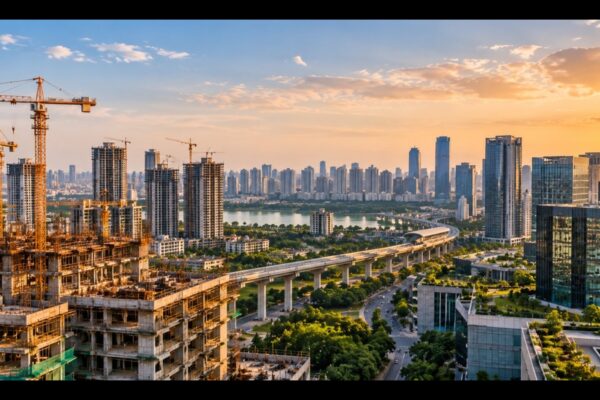
Rapid urbanisation has replaced permeable landscapes with concrete, asphalt and glass. As green cover declines and built density increases, cities become significantly warmer than surrounding areas, creating what is commonly known as the urban heat island effect.
The consequences are already visible. Several Indian cities are developing cooling action plans as rising temperatures place increasing pressure on public infrastructure, energy systems and urban resilience strategies. Gurgaon, for example, recently introduced a city-level Cooling Action Plan that prioritises passive design, green roofs and district cooling as long-term solutions to rising cooling demand. Studies supporting the plan suggest that passive interventions can reduce cooling energy use by up to two-thirds in certain building types.
This evolution in thinking is important because cooling cannot be solved one building at a time.
Cities themselves must become part of the cooling infrastructure. Urban forests, shaded streets, green corridors, reflective surfaces, restored water bodies and interconnected public open spaces are no longer simply environmental interventions. They are climate-resilience assets that help reduce ambient temperatures, lower energy demand and improve public health outcomes.
Future cities will not merely consume energy to stay cool. They will be planned and designed to remain cooler by default.
Why Passive Cooling Is Becoming a Strategic Imperative
The next phase of development requires a different mindset. The question is not only how much infrastructure we build, but how intelligently that infrastructure performs under increasingly challenging climatic conditions. Climate-responsive design offers a practical path forward.
Building orientation, cross-ventilation, external shading, reflective roofs, thermal mass, landscape integration and passive cooling strategies can significantly reduce heat gain before mechanical cooling becomes necessary. India’s Cooling Action Plan has specifically identified passive cooling and energy-efficient building design as critical components of reducing future cooling demand.
This shift is not about eliminating technology. It is about using technology more strategically. Smart building systems, advanced controls, energy analytics, efficient HVAC systems and renewable energy solutions can work alongside passive design measures to create buildings that deliver comfort with significantly lower energy consumption.
Materials Matter More Than Ever
The cooling performance of a building is shaped long before the first air-conditioning system is installed. Materials play a critical role in determining thermal performance, energy consumption and long-term resilience. Buildings are not simply structures. They are thermal systems.
Climate-responsive materials such as terracotta, stone, engineered timber, bamboo and compressed earth products can help regulate temperatures while reducing both operational energy demand and embodied carbon. Increasingly, developers are recognising that material selection has a direct impact on lifecycle performance, operating costs and sustainability outcomes.
The future of cooling will depend as much on what we build with as how we cool it.
Adaptive Reuse and the Circular Economy Opportunity
One of the most underutilised opportunities in sustainable development lies in adaptive reuse.
In many cases, the most sustainable building is not a new building. It is an existing one.
Retrofit is becoming an important strategy for making buildings more sustainable without the environmental cost of demolition and reconstruction. By upgrading existing structures with energy-efficient systems, better insulation, improved façades and renewable technologies, developers can extend building lifespans while reducing embodied carbon and construction waste. Globally, former industrial facilities, warehouses and manufacturing sites are being transformed into mixed-use developments, commercial hubs and community destinations. These projects demonstrate that sustainability is not only about efficiency. It is also about resource optimisation, circular economy principles and long-term stewardship.
The future of development cannot be measured solely by what we build. It must also be measured by what we choose to preserve.
From Buildings to Cooling Ecosystems
As India urbanises and cooling demand accelerates, the challenge is no longer about how efficiently we cool buildings, but how intelligently we design them.
Cooling must move from being a building-services consideration to a core infrastructure priority. By integrating climate-responsive design, passive cooling, sustainable materials and smart energy systems, India has an opportunity to build infrastructure that delivers comfort with significantly lower environmental and economic costs.
The future of cooling will belong to developments that reduce dependence on energy-intensive systems and embrace a more resilient, climate-responsive approach to growth.
Tags