Aluminium vs. Galvalume Turbo Ventilators: An Engineering Perspective on Performance, Durability and Industrial Applications

by Prerana Fernandes, Research & Development, JSW Steel Coated Products
As industries increasingly adopt sustainable and energy-efficient building solutions, passive roof ventilation systems have become a critical component of modern industrial infrastructure. Among these, turbo ventilators offer continuous, electricity-free ventilation by harnessing natural wind and thermal convection. However, the choice of material significantly influences their efficiency, durability, maintenance requirements and lifecycle cost. This technical article compares Aluminium and Galvalume turbo ventilators from an engineering perspective, helping industry professionals make informed material selection decisions for diverse operating environments
As industrial facilities continue to pursue higher levels of energy efficiency, sustainability and workplace comfort, natural ventilation systems have emerged as an integral component of modern building design. Among the various passive ventilation solutions available today, turbo ventilators have gained widespread acceptance across industrial, commercial and institutional buildings due to their ability to continuously extract hot and contaminated air without consuming electrical energy.
From manufacturing plants and warehouses to steel mills, cement facilities and pharmaceutical units, turbo ventilators help maintain healthier indoor environments while reducing dependence on mechanical ventilation systems. Their ability to harness natural wind energy and thermal buoyancy makes them one of the most cost-effective and environmentally responsible ventilation solutions available. However, the performance and longevity of a turbo ventilator are determined not only by its design but also by the material used in its construction. Material selection directly influences airflow efficiency, corrosion resistance, maintenance requirements, service life and overall lifecycle cost.
While Aluminium has traditionally been regarded as the industry benchmark due to its lightweight nature and superior corrosion resistance, Galvalume is increasingly being considered as a cost-effective alternative offering structural strength and durability.
Understanding Turbo Ventilators
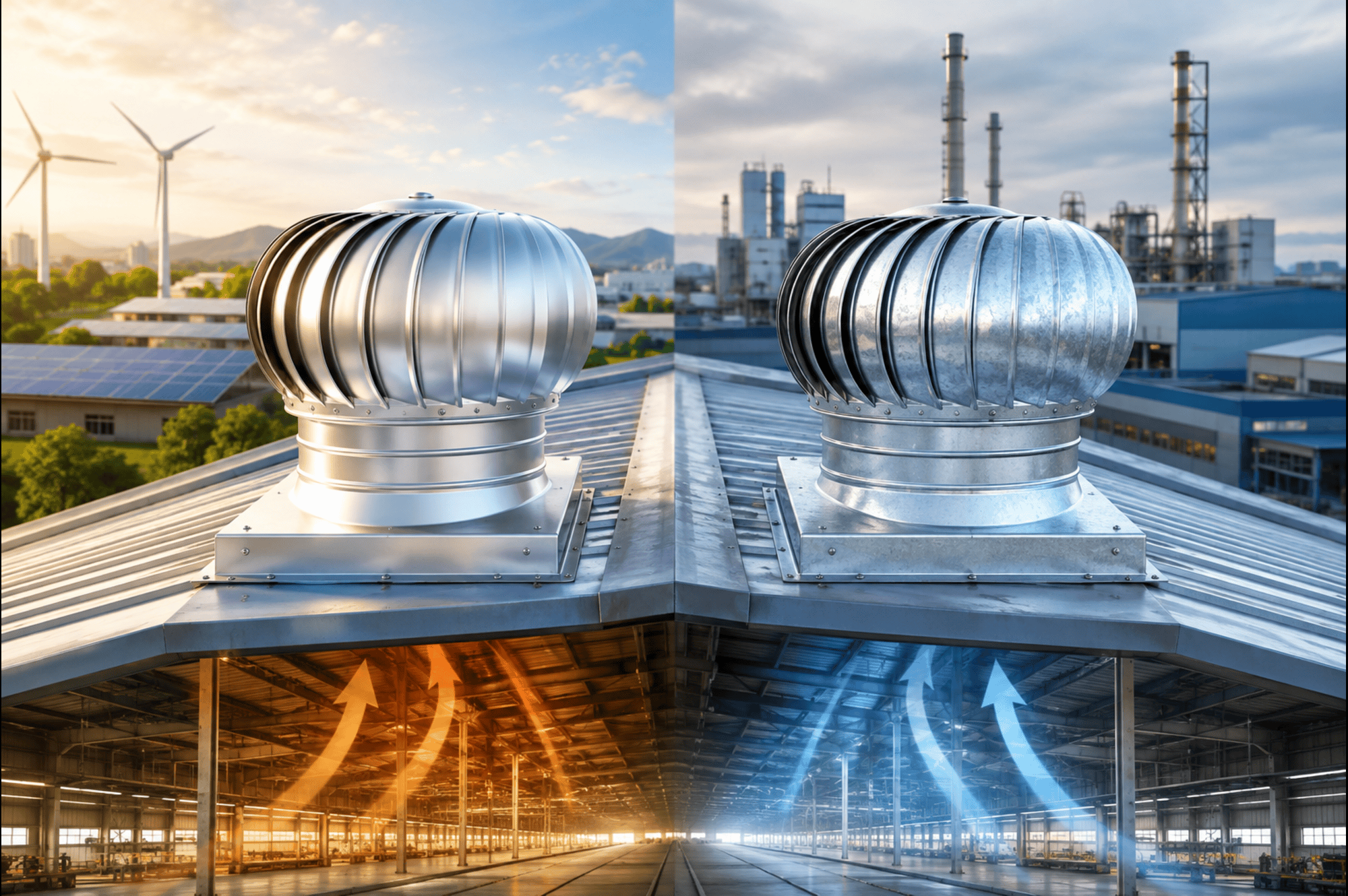
A turbo ventilator is a wind-driven rotary roof ventilator designed to remove hot, humid and contaminated air from enclosed structures through natural ventilation principles. The system consists of a rotating turbine head mounted on a roof opening. As external wind strikes the turbine blades, the ventilator rotates and creates a low-pressure zone within the throat section.
Simultaneously, hot air accumulated beneath the roof rises naturally due to thermal buoyancy and is extracted through the rotating turbine. This continuous process promotes natural air circulation within the building and provides several benefits, including reduction of indoor heat accumulation; removal of fumes, smoke and airborne contaminants; lower humidity levels; improved indoor air quality; enhanced worker comfort; reduced energy consumption; and lower operational and maintenance costs
Unlike powered exhaust systems, turbo ventilators operate without electricity, making them particularly attractive for large industrial buildings seeking sustainable and economical ventilation solutions.
Why Industrial Ventilation Matters
Industrial facilities generate substantial amounts of heat due to machinery operation, manufacturing processes, lighting systems and solar heat gain through roofing structures. When this heat becomes trapped inside a building, it can lead to elevated indoor temperatures; reduced worker productivity; increased equipment stress; moisture accumulation; accelerated corrosion; deterioration of stored materials; and higher cooling costs.
Effective roof ventilation plays a crucial role in mitigating these challenges by facilitating the continuous removal of hot air and maintaining a more stable indoor environment. As industries increasingly focus on energy efficiency and ESG objectives, passive ventilation systems such as turbo ventilators are becoming an essential element of sustainable industrial infrastructure.
Manufacturing Process of Turbo Ventilators
The performance of a turbo ventilator depends heavily on manufacturing precision and quality control.
The typical manufacturing process involves several key stages:
Raw Material Selection: The process begins with selecting suitable material based on application requirements. Common materials include Aluminium alloys, Galvalume steel, stainless steel and galvanized iron (GI).
Sheet Cutting and Forming: Sheets are cut to specified dimensions using shearing or CNC cutting equipment. Individual turbine blades are then formed through rolling and press-forming operations to achieve the required aerodynamic profile.
Assembly: The blades are assembled around support rings using rivets, mechanical fastening systems or welding techniques. The central shaft assembly is manufactured separately and integrated with the turbine structure.
Bearing Installation: High-quality sealed bearings are installed to ensure smooth rotational movement and long operational life.
Dynamic Balancing: Dynamic balancing is one of the most critical stages in turbo ventilator manufacturing. Poor balancing can lead to excessive vibration, noise generation, bearing failure, reduced airflow efficiency, and structural instability.
Premium-quality ventilators undergo rigorous balancing tests to ensure smooth performance under varying wind conditions.
Quality Inspection: Before dispatch, the completed ventilator is inspected for dimensional accuracy, rotational smoothness, structural integrity, corrosion protection and bearing performance.
Material Selection: The Foundation of Performance
Material selection has a direct impact on the efficiency and durability of a turbo ventilator.
An ideal material should provide low weight, high strength, excellent corrosion resistance, good formability, dimensional stability, and long service life. The two most commercially significant materials today are Aluminium and Galvalume steel.
Aluminium Turbo Ventilators
Aluminium turbo ventilators are manufactured using lightweight Aluminium alloy sheets and have long been considered the preferred choice for industrial ventilation applications.
Key Advantages
Lightweight Construction: With a density of approximately 2.7 g/cm³, Aluminium is significantly lighter than steel-based materials. Lower weight translates into reduced rotational inertia, enabling the turbine to rotate even under low wind conditions.
Superior Rotational Efficiency: The reduced mass of Aluminium blades allows quicker startup and higher rotational speeds, resulting in improved airflow extraction.
Excellent Corrosion Resistance: Aluminium naturally forms a protective oxide layer that shields the material from atmospheric corrosion. This makes Aluminium particularly suitable for coastal regions, humid environments, chemical processing facilities, and high-moisture industrial operations.
Reduced Bearing Load: The lighter structure imposes lower loads on shafts and bearings, extending bearing life and reducing maintenance requirements.
Long Service Life: Properly manufactured Aluminium ventilators can provide reliable performance for more than two decades under normal operating conditions.
Aluminium vs. Galvalume: A Comparative Engineering Assessment
While both materials offer significant benefits, their engineering characteristics differ considerably.
Weight and Rotational Performance: Weight is one of the most important parameters affecting turbo ventilator performance. Because Aluminium is substantially lighter, it exhibits lower rotational inertia and begins rotating at lower wind speeds. This results in faster start-up, higher RPM, better airflow extraction and improved ventilation efficiency. Although Aluminium generally offers lower rotational inertia, the use of optimized thinner Galvalume gauges (0.45–0.55 mm) reduces the weight difference considerably. Consequently, the increase in starting wind speed is only marginal, and well-designed Galvalume ventilators are capable of delivering comparable airflow performance under most industrial operating conditions.
Corrosion Resistance
Corrosion resistance becomes increasingly important in industrial environments. Aluminium offers excellent resistance due to its self-protective oxide layer. Galvalume steel, with its 55% Aluminium–43.5% Zinc–1.5% Silicon coating, offers excellent atmospheric corrosion resistance and generally outperforms conventional galvanized steel in most environments. However, optimum long-term performance depends on proper design, good fabrication practices, and the use of corrosion-compatible fasteners, particularly in coastal, marine, or highly corrosive industrial environments. For severe coastal or marine environments, Aluminium remains the preferred choice, although AZ200 Galvalume also offers excellent corrosion resistance when proper design, fabrication and corrosion-compatible fasteners are used.
Bearing Life and Maintenance
Bearing reliability plays a vital role in ensuring the long-term performance of turbo ventilators. Aluminium offers the advantage of lower bearing loads due to its lighter weight. Modern Galvalume ventilators are designed using optimized thinner gauges, precision-balanced rotating assemblies and premium sealed bearings. These engineering improvements significantly reduce the effect of the higher material density, enabling smooth rotation, dependable bearing performance and long service life under normal industrial operating conditions. Routine inspection and proper installation further ensure reliable operation with minimal maintenance.
Thermal Behaviour: Industrial roofs frequently experience large temperature fluctuations. Repeated thermal expansion and contraction can influence dimensional stability, structural alignment and rotational balance. Although both materials are affected by temperature changes, proper engineering design and manufacturing controls are essential to maintaining long-term performance.
Typical Performance Comparison
| Parameter | Aluminium (1.0 mm) | Equivalent Galvalume (0.45–0.55 mm) | Remarks |
| Thickness | 1.00 mm | 0.45–0.55 mm | Galvalume thickness optimized for stiffness and manufacturability |
| Weight | Low | 20–40% Higher | Despite thinner gauge, steel density is ~3× aluminum |
| Structural Rigidity | Moderate | High | Higher modulus (210 GPa vs. 69 GPa) provides greater stiffness |
| Strength (Yield) | Moderate | High | G300: ~300 MPa; G550: ~550 MPa |
| Rotational Efficiency | Excellent | Good | Slightly lower due to higher inertia |
| Starting Wind Speed | Lower | Slightly Higher | Additional inertia requires marginally higher startup wind speed |
| Wind Resistance | Good | Excellent | Better resistance to blade deformation under high winds |
| Corrosion Resistance | Excellent | Very Good to Excellent (AZ150/AZ200) | AZ200 recommended for coastal and marine environments |
| Maintenance Requirement | Very Low | Low | Periodic inspection of cut edges and bearings recommended |
| Initial Material Cost | High | 30–45% Lower | Significant cost advantage for Galvalume |
| Manufacturing | Excellent Formability | Good (G300), Moderate (G550) | G300 preferred for deep drawing/spinning |
| Coastal Suitability | Excellent | Excellent (AZ200) | AZ150 suitable for general roofing; AZ200 for severe environments |
Industrial Applications: Aluminium turbo ventilators are particularly suitable for coastal industries, chemical plants, pharmaceutical facilities, food processing units, high-humidity environments, and premium industrial buildings. Galvalume turbo ventilators perform effectively in warehouses, manufacturing sheds, logistics facilities, inland industrial zones, commercial buildings and cost-sensitive projects.
Can Galvalume Replace Aluminium
This is perhaps the most frequently debated question within the ventilation industry. The answer depends largely on environmental conditions, performance expectations and lifecycle considerations. Although for highly corrosive, coastal or chemically aggressive environments, Aluminium continues to remain the preferred engineering solution. For a large proportion of industrial, commercial and warehouse applications, Galvalume has emerged as a practical and cost-effective alternative to Aluminium. Its high structural rigidity, excellent wind resistance, good corrosion resistance and significant material cost advantage make it well suited for inland and moderately corrosive environments. When manufactured using optimized sheet thicknesses (typically 0.45–0.55 mm) and appropriate engineering practices, Galvalume ventilators can deliver reliable long-term performance comparable to Aluminium in many applications.
However, successful implementation requires proper engineering controls, including minimum 0.50 mm material thickness, AZ150-200 coating specification, stainless steel shafts, high-quality sealed bearings, dynamic balancing and corrosion-compatible fasteners. Without these safeguards, Galvalume ventilators may experience premature failures such as corrosion, vibration, bearing wear and reduced airflow performance.
Future Outlook
Advancements in coated steel technologies are expected to further improve the performance of steel-based ventilation systems. Emerging developments include Zinc-Magnesium (ZM) coated steels, hybrid Aluminium-Steel designs, improved corrosion-resistant coatings, advanced balancing technologies and enhanced bearing systems. These innovations may narrow the performance gap between Aluminium and Galvalume in the coming years, creating new opportunities for cost-effective industrial ventilation solutions.
Conclusion
Turbo ventilators have become an indispensable component of modern industrial infrastructure, offering continuous ventilation without electrical energy consumption. Their ability to improve indoor air quality, reduce heat buildup and support sustainable building operations makes them a preferred choice across a wide range of industries. The comparative evaluation of Aluminium and Galvalume demonstrates that each material possesses distinct advantages. Aluminium delivers superior rotational efficiency, corrosion resistance making it the preferred choice for demanding industrial and coastal environments.
Galvalume, on the other hand, offers an economical and structurally robust alternative for inland and moderately exposed industrial applications. When supported by proper engineering specifications and manufacturing quality, Galvalume ventilators can provide reliable and cost-effective performance. Ultimately, the decision-makers must consider cost, the entire lifecycle of the ventilation system, including operating conditions, maintenance requirements, expected service life and long-term performance objectives. The Galvalume is emerging as strong alternative to Aluminum.
In the evolving landscape of industrial construction and sustainable infrastructure, the right material choice remains the key to maximizing the effectiveness and value of passive ventilation systems.
Tags