The Engineering and Operational Advantages of Large-Scale Captive Precast Facilities

by Jash Panchamia, Promoter, Suraksha Smart City
The real estate business in India is at a point where the demands of rapid urbanisation require not just faster delivery but also greater engineering precision. Labour dependency, complex coordination, weather disruptions and inconsistent quality control across large developments are conventional site-based execution challenges that emerge frequently. As cities expand and housing demand continues to rise, conventional site-based construction activity will need an upgrade.
Construction quality is often judged by visible finishes, while the real measure of a building lies in its structural integrity, resistance to leakage, earthquake resilience, fire safety and long-term durability. These expectations can be consistently met at scale only through a fundamental shift in how buildings are made. One of the modern ways of doing this is placing industrialised construction and large-scale captive precast facilities at the centre of the job. The result is a more efficient, precise and reliable construction ecosystem.
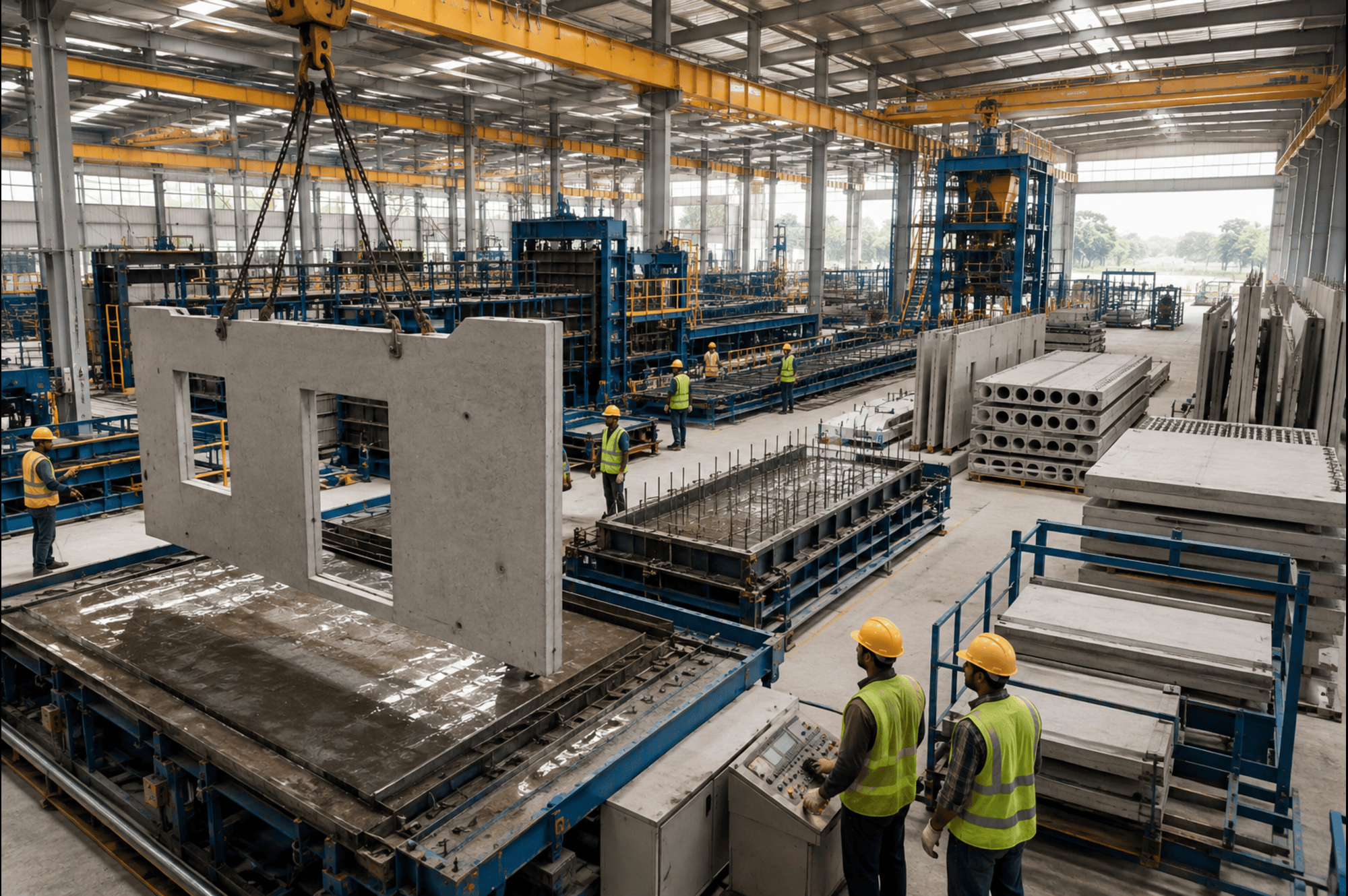
Moving to large-scale captive precast facilities offers a significant engineering and operational advantage. Beyond casting structural elements individually at the construction site, major components including walls, slabs, staircases and other structural systems can be easily manufactured within a dedicated factory under controlled conditions before being transported for installation. The availability of this technology today effectively shifts construction from an unpredictable outdoor activity towards an industrial manufacturing process. A process where precision, standardisation and quality assurance are integral to every stage of construction.
The engineering advantages of large-scale captive precast facilities go beyond the benefit of faster construction. By moving the production of structural components such as walls, slabs and staircases into a controlled factory environment, construction shifts from site-based execution to a highly standardised manufacturing process. Every stage from concrete batching and reinforcement placement to curing and dimensional accuracy is monitored systematically, ensuring a greater level of precision and consistency. Such precision is generally difficult to achieve through conventional construction methods.
This industrialised approach ensures consistent quality, uniform structural performance and rigorous quality assurance before components are transported to the site for installation. Factory-based manufacturing also enables engineering innovations possible. These are innovations that enhance the long-term performance of buildings. Advanced three-dimensional load-bearing precast systems, for instance, allow multiple structural walls to be cast together in a single concrete pour, creating structural units with far fewer joints.
Casting in this form reduces the risk of water ingress and long-term maintenance issues alongside improving structural continuity during seismic events. Complementing this are hollow-core slab systems, which reduce the dead load of buildings without compromising strength. Their lighter weight allows for casting of longer spans, smaller foundations and greater architectural flexibility, while simultaneously improving thermal insulation, acoustic performance and fire resistance.
From an operational perspective, one of the greatest strengths of depending on a captive precast facility is the ability to manufacture structural components while site development progresses simultaneously. Foundations can be worked on even as walls, slabs and other building elements are produced simultaneously in the factory. This allows construction assembly to begin immediately once the site is ready. This parallel workflow significantly reduces project timelines and the uncertainty associated with weather disruptions, resulting in more predictable delivery schedules and greater execution efficiency.
Mechanised construction also addresses one of the sector’s most pressing challenges, its dependence on large site-based workforces. Mechanised manufacturing, supported by automation and specialised equipment, cuts down the need for multiple trades to operate simultaneously on site while improving productivity and coordination. Since many high-risk construction activities are transferred from open construction sites to controlled factory environments, worker safety is enhanced and site congestion is considerably reduced.
The benefits of large-scale captive precast facilities go beyond productivity to sustainability and lifecycle performance. Factory-controlled production cycles help optimise the use of concrete, steel and other materials, substantially reducing wastage. It also offers surplus materials to be reused or recycled within the manufacturing process. Building services such as plumbing and electrical conduits can also be integrated into structural elements at the time of casting, improving installation accuracy, reducing coordination challenges on site and minimising rework.
But the most significant contribution of large-scale captive precast facilities is perhaps that it redefines construction as a manufacturing-led process and not a purely site-based activity. The combination of engineering precision, standardisation and operational efficiency makes it possible to deliver high-quality buildings. It allows delivery at scale with greater certainty than conventional methods. As urban development accelerates and expectations around the structural performance of buildings continue to rise, precast construction is set to become an increasingly important benchmark for delivering resilient, durable and future-ready buildings.
Tags