How Smart Architecture Can Reduce Indoor Temperatures Naturally

by Rohana Sarah, Founder & CEO, Green World Design
Across many Indian cities today, indoor heat is becoming a much larger issue than most developers anticipated a few years ago. In Bangalore, residential and commercial buildings that were once naturally comfortable are heating up far more through the afternoon. In cities like Hyderabad, Chennai, and Mumbai, the combination of heat gain, humidity, reflective surfaces, and reduced tree cover is changing how buildings behave and increasing dependence on cooling systems.
What is becoming clear is that cooling can no longer be approached only through mechanical systems. Building orientation, façade exposure, hardscape ratio, ventilation movement, material selection, and landscape planning all influence how much heat a site absorbs and transfers into the building itself. A large part of indoor thermal comfort is usually decided much earlier — through orientation, shading, façade treatment, vegetation planning, and how the building interacts with its surroundings.
Across our projects at Green World Design, we have seen that relatively small architectural and landscape decisions can significantly change how indoor spaces behave over the course of the day. Buildings exposed to long west-facing heat gain, excessive hardscape, poor ventilation movement, or low tree cover tend to accumulate and retain heat much faster. Once that happens, internal spaces become harder to cool efficiently, cooling systems work continuously, and energy consumption increases substantially.
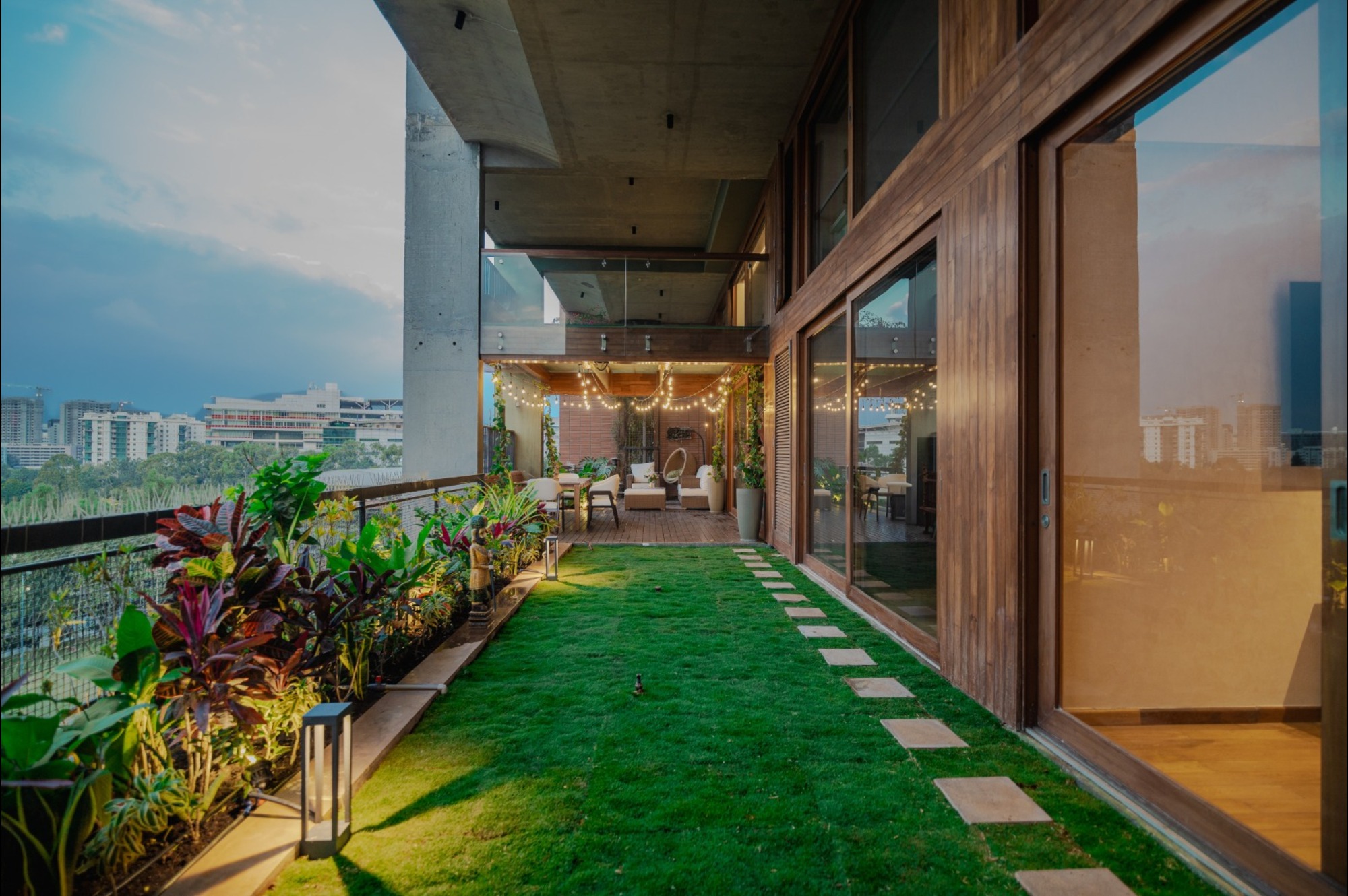
Some of the most effective interventions are also relatively practical when planned early. Tree canopies around built edges reduce direct heat absorption on surrounding surfaces and prevent adjacent walls from radiating excess heat indoors. Design interventions like shaded transition spaces, recessed balconies, layered planting and limited concrete exposure help lower ambient temperatures. This influences internal comfort levels. Permeable surfaces and vegetation buffers also help reduce reflected heat buildup across the site.
Ventilation planning plays a much larger role than many projects account for. In large-scale developments, issues like blocked wind movement and compressed built masses create heat pockets around buildings. Small changes in spacing, open space orientation, and landscape placement can materially improve air movement.
The role of biophilic landscaping is also evolving in this context. We increasingly work with developers and architects to integrate landscape and biophilic planning alongside architecture and engineering from the beginning, rather than after construction is substantially complete.
In several premium residential developments we have worked on, deeper balconies, shaded spillover spaces, dense peripheral planting, and reduced exposed hardscape have noticeably improved indoor comfort within residences, particularly during peak afternoon heat. Residents tend to rely less aggressively on continuous cooling during certain parts of the day because the surrounding built environment itself behaves differently.
This becomes especially important in large residential communities, business parks, hospitality projects, and mixed-use developments where indoor comfort directly affects occupier experience. In corporate offices and managed office environments, naturally cooler circulation zones and shaded breakout spaces remain consistently occupied because adjacent indoor environments also stay more comfortable through the day. In hospitality and residential projects, buyers are increasingly responding to homes that feel cooler and less heat-intensive even before mechanical cooling systems are fully relied upon.
There are also long-term operational implications. Buildings that reduce heat gain naturally tend to experience lower cooling dependence, more stable indoor temperatures, and lower operational stress on HVAC systems over time. As energy costs rise and climate conditions become less predictable, developers are starting to evaluate thermal performance much more carefully at the planning stage itself.
Across the next decade of real estate development in India, architecture will play a critical role in reducing indoor temperatures and providing thermal comfort to occupants and buyers. The buildings that remain more comfortable indoors would be ones where thermal management was considered early in the planning and architecture process.
Tags