Tunnelling Through the Himalayas: How L&T is Redefining Rail Infrastructure in Uttarakhand

From navigating fragile Himalayan geology to achieving record tunnelling milestones, L&T’s Package-2 highlights engineering excellence, digital innovation and sustainable construction on the Rishikesh–Karnprayag Rail Link
Engineering a Railway Through the Himalayas
The Himalayas have always presented one of India’s greatest infrastructure challenges. Characterised by steep gradients, deep river valleys, unstable geology and unpredictable weather, the region has remained difficult to access despite its immense cultural, economic and strategic importance. Constructing a modern railway through this terrain requires not only engineering expertise but also the ability to adapt continuously to nature’s uncertainties. The Rishikesh–Karnprayag Broad Gauge Rail Link, being developed by Rail Vikas Nigam Limited (RVNL), represents a landmark step towards transforming connectivity in Uttarakhand. Stretching approximately 125 kilometres, the electrified railway corridor will improve access to remote towns, facilitate pilgrimage tourism, strengthen regional trade and enhance strategic mobility. More importantly, it is expected to become a catalyst for long-term socio-economic development across the Garhwal region.
Among the project’s ten construction packages, Package-2, executed by Larsen & Toubro (L&T), is widely regarded as one of the most technically challenging. Covering a 14.653-km section between Shivpuri and Byasi, the package includes extensive tunnelling works, major railway and road bridges, slope stabilisation, earthworks and associated infrastructure. Executing these works through one of the youngest and most geologically active mountain ranges in the world has demanded an exceptional combination of engineering capability, technological innovation and operational resilience.
Conquering Himalayan Terrain
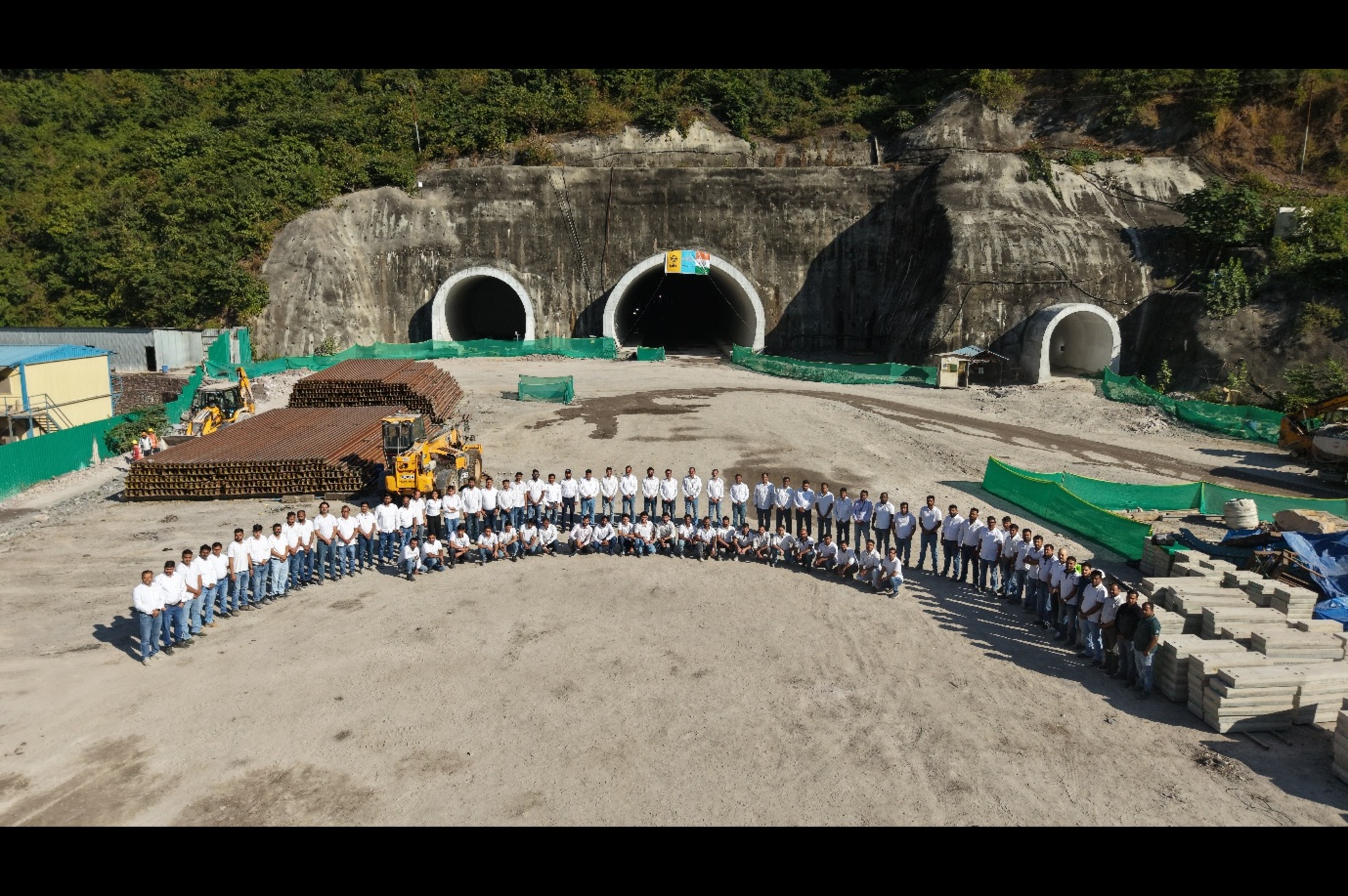
At the heart of Package-2 are two major tunnel systems—Tunnel T-2, measuring about 6.09 km, and Tunnel T-3, extending 6.65 km—along with parallel escape tunnels, cross passages and associated underground structures. Together, these account for over 26 kilometres of cumulative tunnelling, making the package one of the most significant underground construction assignments within the Rishikesh–Karnprayag Rail Link. Complementing the tunnels are major railway bridges at Shivpuri and Guller, a road bridge, culverts, embankments, access roads and extensive slope protection measures. These structures are essential for ensuring seamless rail connectivity across a terrain marked by steep valleys and unstable mountain slopes. The tunnels were excavated using the New Austrian Tunnelling Method (NATM), an internationally recognised construction methodology particularly suited to variable geological conditions. Unlike conventional tunnelling techniques that rely on predetermined support systems, NATM continuously monitors ground behaviour during excavation, allowing engineers to modify support measures based on actual site conditions. This flexibility proved invaluable in the unpredictable Himalayan geology.
Construction Amid a Global Pandemic
Barely weeks after construction commenced in January 2020, the COVID-19 pandemic brought unprecedented disruption to infrastructure projects across the country. Lockdowns halted the movement of labour, interrupted supply chains and created major logistical challenges. For a project involving continuous underground excavation, simply suspending work was not an option. Tunnel ventilation, groundwater management, equipment maintenance and safety monitoring had to continue around the clock. L&T responded by redesigning its execution strategy. The workforce was divided into smaller, independent teams assigned to dedicated tunnel faces, reducing interaction between groups and limiting operational disruption in case of infections. Residential camps established near tunnel portals functioned as bio-secure work zones equipped with medical facilities, sanitisation systems and isolation areas. Project planning also shifted towards short-interval scheduling through the Last Planner System, enabling managers to reallocate manpower and equipment based on changing site conditions. This flexible planning approach ensured that construction activities continued despite restrictions, helping minimise delays during one of the most challenging periods for the global construction industry.
Overcoming Complex Geological Conditions
While the pandemic tested organisational resilience, the mountains presented an even greater engineering challenge. The Garhwal Himalayas are characterised by highly fractured rock formations, active fault zones, shear zones and significant groundwater movement. As excavation progressed, engineers encountered geological conditions that were considerably weaker than those anticipated in the original investigations. Instead of stable rock suitable for rapid tunnelling, construction teams frequently encountered loose strata, running ground conditions, excessive groundwater ingress and unstable tunnel crowns. In several locations, apparently stable tunnel faces could suddenly deteriorate due to water pressure, resulting in muck falls and requiring immediate stabilisation. Equally challenging were the squeezing pressures generated by the young fold mountains. Continuous deformation of surrounding rock placed enormous stress on freshly excavated tunnels, necessitating frequent modifications to support systems. Rather than allowing these conditions to slow progress, L&T adopted a highly flexible execution strategy. Active work fronts were increased by dynamically redeploying equipment and specialised crews between excavation faces, ensuring that available resources were utilised to their fullest potential. Ground improvement techniques became an integral part of daily operations. Engineers implemented extensive pre-grouting to strengthen weak rock before excavation, while pipe roofing systems provided temporary support in highly unstable zones. Systematic rock bolting, fibre-reinforced shotcrete and upgraded steel support systems further enhanced tunnel stability under difficult geological conditions. High-capacity ventilation systems and continuous gas monitoring maintained safe working conditions despite elevated temperatures, dust generation and occasional gas pockets encountered underground.
Weathering Nature’s Fury
Construction above ground proved equally demanding. Every monsoon season brought intense rainfall, flash floods, landslides and debris flows that repeatedly threatened tunnel portals, access roads and construction yards. To minimise disruption, the project adopted a comprehensive monsoon preparedness programme. Detailed inspections of slopes, drainage channels and vulnerable locations were undertaken before the onset of each rainy season. Temporary protection works were strengthened, drainage systems were improved and potential landslide-prone areas were closely monitored. Heavy machinery and critical equipment were relocated to higher ground before severe weather events, while emergency response teams equipped with earthmoving machinery remained on standby throughout the monsoon. This proactive approach enabled damaged access roads to be restored quickly and construction activities to resume with minimal interruption. Another significant challenge emerged from the deteriorating quality of excavated rock. The original execution plan had envisaged processing tunnel muck into aggregates for concrete production. However, as geological conditions worsened, much of the excavated material became too weak and silt-rich for structural concrete. Faced with a potential shortage of aggregates, the project team rapidly identified alternative sources of high-quality riverbed material. Crushing plants were modified to process the new material, while advanced washing and screening systems ensured that concrete quality remained uncompromised. Close coordination with regulatory authorities enabled timely approvals, allowing concrete production and tunnel lining activities to continue without affecting the overall construction schedule.
Sustainability as a Construction Philosophy
Executing a major railway project in the ecologically sensitive Himalayan region demanded a construction strategy that balanced engineering excellence with environmental responsibility. Throughout Package-2, L&T integrated sustainability into its day-to-day operations, demonstrating that large-scale infrastructure development can coexist with responsible environmental management. One of the project’s most significant initiatives was reducing dependence on diesel generators by establishing permanent state electricity grid connections at active tunnel portals. This transition substantially lowered diesel consumption, reduced carbon emissions and minimised noise pollution at construction sites. Diesel generators were retained only as standby systems, improving both operational efficiency and environmental performance. Water management was another critical focus area. Given the project’s proximity to the Ganga and its tributaries, high-capacity Effluent Treatment Plants (ETPs) and Sewage Treatment Plants (STPs) were installed at tunnel portals and workers’ camps. Construction wastewater and domestic sewage were treated before discharge, preventing contamination of nearby water bodies and helping preserve the fragile Himalayan ecosystem. The project also embraced resource optimisation. Wherever suitable, excavated rock from stable tunnel sections was processed into aggregates for concrete production, reducing waste generation and minimising the need for externally sourced materials. When geological conditions produced poor-quality excavated rock, the project team quickly adapted by sourcing high-quality riverbed material and modifying crushing plants to maintain uninterrupted concrete production. These measures reflected a practical approach to circular resource management while ensuring construction quality remained uncompromised.
Digital Construction Enhances Project Delivery
Digital technologies played a vital role in improving productivity, resource management and decision-making throughout the project. By integrating real-time monitoring systems with conventional construction practices, L&T enhanced both operational efficiency and project control. An Internet of Things (IoT)-enabled fuel management system was introduced to monitor fuel storage, dispensing and equipment consumption. Using RFID-enabled dispensers, storage sensors and surveillance cameras, the system reduced fuel losses while improving accountability and inventory management. The resulting savings demonstrated how relatively simple digital interventions can generate significant operational benefits. Wireless communication systems were integrated with drill jumbos operating inside the tunnels, allowing excavation data to be transmitted in real time. Engineers could monitor drilling progress, geological conditions and equipment performance more efficiently, enabling quicker technical decisions and improved planning. Camera-based monitoring further enhanced productivity inside confined tunnel spaces. Heavy equipment such as telehandlers and dumpers was fitted with side-view and reverse-view cameras, reducing blind spots and improving operational safety. These systems also reduced equipment positioning time, accelerating activities such as muck disposal, grouting and concrete placement. The project additionally utilised a web-based Project Management Information System (PMIS), providing real-time visibility of construction progress, resource deployment, scheduling and quality control across multiple work fronts.
Engineering Innovation Creates Value
Beyond adopting advanced technologies, the project became a showcase for practical engineering innovation. Instead of relying solely on new equipment, engineers developed several in-house solutions that significantly improved productivity while reducing project costs. A notable innovation involved modifying Hagg loaders used for muck removal. By introducing a customised hydraulic lifting arrangement, the discharge height was increased, enabling dumpers to carry substantially larger loads. This simple engineering modification reduced mucking cycle times, increased equipment productivity and eliminated the need for procuring additional machinery. Conventional rebar jumbos were also upgraded with electric drive systems that enabled independent movement inside the tunnels. Previously, relocating these machines required cranes and large crews. The modified system reduced relocation time dramatically while lowering manpower requirements, improving both efficiency and safety. To ensure uninterrupted water supply for drilling operations, engineers developed an innovative floating barge equipped with submersible pumps capable of lifting water from the Ganga to construction sites located high above the river. This eliminated dependence on water tankers and additional pumping equipment while ensuring continuous construction activities. Other innovations included standardised plug-and-play electrical connections that simplified equipment installation, in-house fabrication of specialised drill components that significantly reduced maintenance costs, and customised dust-suppression systems mounted on drum cutters to improve equipment life while enhancing underground air quality. These innovations illustrate how practical engineering solutions can deliver substantial improvements in productivity without requiring major capital investment.
Safety Above All
Safety remained a defining feature of the project throughout its execution. Underground construction presents unique risks arising from confined working spaces, heavy machinery movement, dust generation and changing geological conditions. Addressing these challenges required continuous monitoring and innovative safety measures. Mobile ventilation systems were deployed to rapidly remove dust, smoke and fumes generated during excavation, shotcreting and finishing activities. Improved air circulation created healthier working conditions while supporting uninterrupted construction operations. Heavy construction equipment operating inside the tunnels was equipped with advanced camera systems that eliminated blind spots, particularly in narrow passages where machinery frequently manoeuvred. This significantly reduced the risk of collisions while improving operational efficiency. To simplify maintenance activities within confined spaces, engineers also introduced mobile high-pressure water jetting systems capable of cleaning underground pipelines without extensive manual intervention. These systems reduced worker exposure to hazardous environments while improving maintenance efficiency. The project’s strong safety culture resulted in the achievement of 15 million safe man-hours and earned recognition from leading safety organisations, reflecting its commitment to protecting its workforce throughout construction.
Precision Through Advanced Surveying
Surveying plays a critical role in long tunnel projects where multiple excavation faces advance simultaneously over several kilometres. Even small alignment errors can have significant consequences during tunnel breakthroughs. To ensure exceptional accuracy, the project adopted several advanced surveying technologies. Drone surveys provided rapid topographical mapping and three-dimensional visualisation of construction areas while significantly reducing field survey time. Differential GPS (DGPS) enabled highly accurate establishment of control points, considerably shortening survey durations. Inside the tunnels, high-speed 3D laser scanners accelerated section measurements while improving precision over conventional survey methods. The project also deployed the Gyromat 3000 for underground alignment control, enabling accurate determination of tunnel bearings over long distances. Together, these technologies improved construction accuracy, enhanced quality assurance and supported faster project execution.
Setting New Benchmarks
Despite the combined challenges of difficult geology, severe weather and pandemic-related disruptions, Package-2 established several significant milestones in underground construction. L&T completed approximately 26.6 kilometres of NATM tunnelling within 58 months, making it one of the fastest large-scale NATM tunnelling achievements in India. The project also recorded a world-best daily tunnelling progress of nearly 108 metres, demonstrating exceptional operational efficiency under extremely challenging conditions. Another notable achievement was the successful execution of India’s first seven-stage tunnelling methodology, completed ahead of schedule. Tunnel lining operations also established new benchmarks, including more than 1.3 kilometres of in-situ reinforced concrete lining completed within a single month. Tunnel T-2 mining works were handed over six months ahead of schedule, while Tunnel T-3 mining was completed eleven months early despite the unprecedented challenges encountered during execution. These accomplishments underline the project’s effective planning, engineering adaptability and disciplined execution.
Building More Than a Railway
The Rishikesh–Karnprayag Rail Link represents far more than another infrastructure project. Once operational, it will significantly improve connectivity across Uttarakhand, provide faster access to pilgrimage destinations, stimulate tourism, strengthen regional commerce and enhance strategic mobility in the Himalayan region.
L&T’s execution of RVNL’s Package-2 demonstrates how engineering excellence, technological innovation and sustainable construction practices can successfully overcome some of the world’s most demanding geological and environmental conditions. Equally important, the project offers valuable lessons for future infrastructure development in mountainous terrain, highlighting the importance of adaptive engineering, digital technologies, environmental stewardship and collaborative project management.
As trains eventually pass through the tunnels and across the bridges carved into the Garhwal Himalayas, the project’s legacy will extend well beyond construction records. It will stand as a powerful example of India’s growing capability to deliver world-class infrastructure in the most challenging landscapes, creating lasting economic opportunities and bringing remote communities closer to the nation’s development journey.
Tags