How Technology is Reshaping Industrial Procurement and Execution Efficiency in India

by Sumit Kumar, Founder & Director, Headsup B2B
India’s industrial and infrastructure economy is entering a far more execution-driven phase of growth. As sectors such as infrastructure, warehousing, manufacturing, logistics, renewable energy, commercial real estate, and industrial automation continue expanding rapidly, procurement is no longer a backend function. It is the difference between a project that executes on time and one that haemorrhages cost in the last mile.
Businesses today are under growing pressure to complete projects faster, manage tighter timelines, control working capital more efficiently, and minimise execution delays. Yet the markets through which most of this procurement happens remain fragmented, largely offline, and opaque. Contractors cannot easily source verified materials on time. Vendors cannot offer credit because payment cycles routinely stretch to 90 days. Project managers lose weeks — sometimes entire schedules — because a critical component is unavailable in the region where it is needed most. These are not edge cases. They are the daily reality of industrial procurement in India.
For many industrial buyers, the challenge is no longer simply about finding vendors. It is about executing reliably across sourcing, fulfilment, logistics, financing, and delivery — simultaneously, and at pace. That combination is what breaks projects. And it is what the market has yet to adequately solve.
Procurement is shifting from transactions to execution
Industrial procurement in India has traditionally been relationship-led. Businesses relied on phone calls, spreadsheets, fragmented vendor networks, and offline coordination to manage sourcing requirements. That fragmentation was manageable when projects moved slowly and timelines had slack. Today, it is the silent killer of project schedules.
A delayed delivery can now disrupt entire project schedules. Limited supplier visibility often creates uncertainty around inventory availability, fulfilment timelines, and execution planning. Teams managing projects across multiple cities or states face additional complexity in identifying trusted suppliers, coordinating deliveries, and ensuring consistency across procurement cycles.
As industrial ecosystems become larger and more interconnected, businesses are increasingly looking for procurement systems that simplify coordination, improve visibility, and reduce operational friction. The global conversation about infrastructure focuses almost entirely on capital mobilisation — how much is being committed, through which instruments. What it consistently underestimates is the last-mile execution gap. You can allocate ₹11 lakh crore for infrastructure in a Union Budget. But if the supply chain delivering materials to the project site is fragmented, opaque, and credit-starved, that capital sits underutilised while timelines slip. The solution is not more capital. It is a smarter supply chain infrastructure.
Integrated supply-chain ecosystems are becoming critical
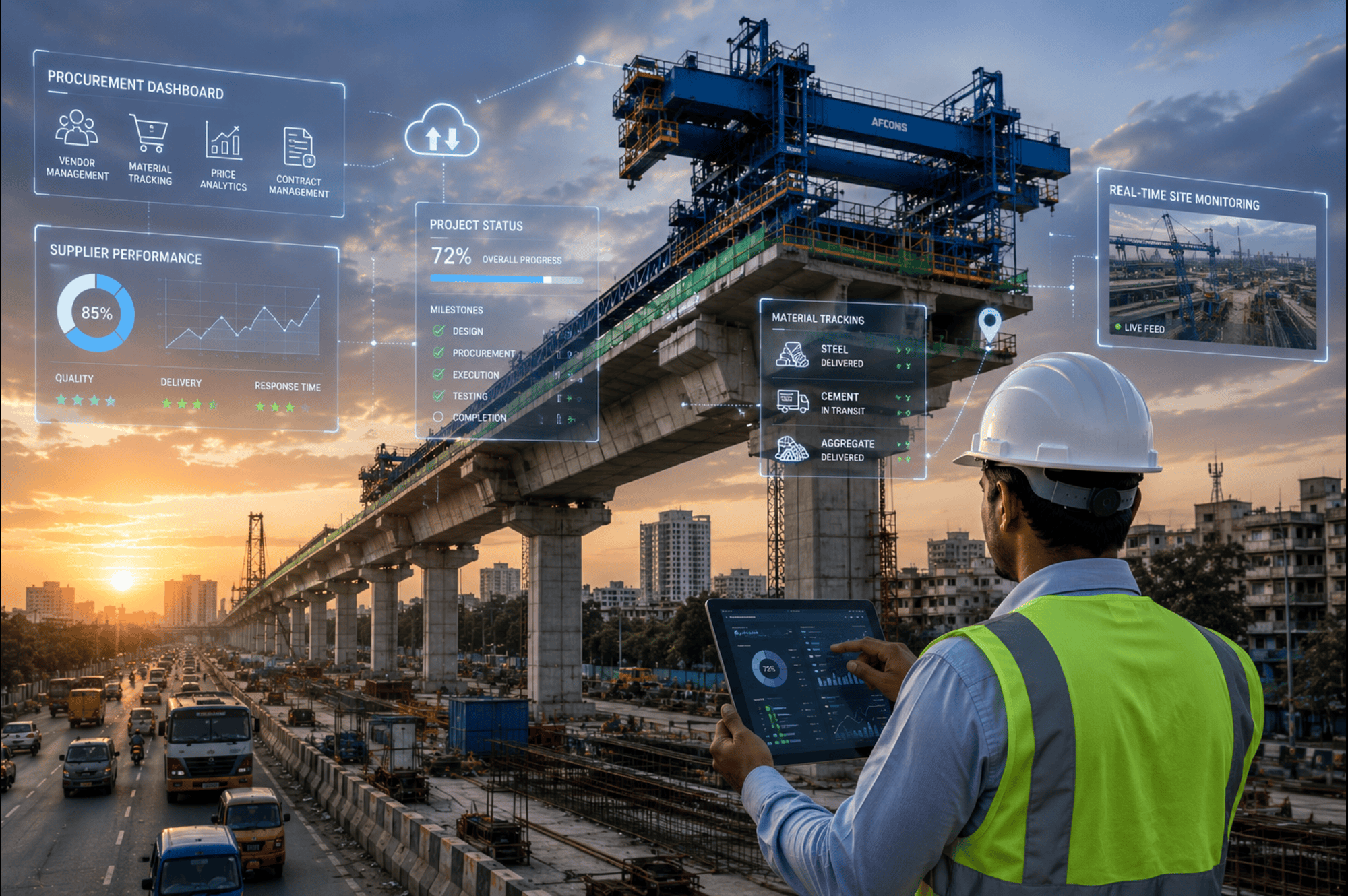
The advantage of a more connected procurement ecosystem is not only speed, but also predictability. Better coordination and real-time visibility help businesses make faster decisions, reduce delays, and improve operational consistency across projects.
As industrial supply chains grow more complex, businesses are increasingly moving toward integrated procurement ecosystems that combine sourcing, fulfillment coordination, financing support, and execution visibility within a more connected operating framework. Across sectors such as Solar EPC, MEP services, AMC operations, and contract manufacturing, the focus is gradually shifting from simply identifying suppliers to managing the entire execution workflow more efficiently. The objective is no longer limited to connecting buyers and vendors, but to improving coordination, reducing delays, strengthening fulfillment reliability, and creating greater visibility across the procurement lifecycle from order placement to project delivery.
Visibility is becoming as important as pricing
For years, procurement decisions were driven primarily by cost optimisation, with businesses focused heavily on negotiating lower prices to protect margins. However, that approach is gradually evolving as companies begin to realise that the lowest-cost supplier does not always deliver the highest operational efficiency.
In today’s execution-driven environment, procurement delays can have a cascading impact across entire projects. A delayed shipment can disrupt manpower deployment, idle equipment, affect project sequencing, and push back delivery timelines, often resulting in costs that far outweigh the initial savings achieved through aggressive price negotiations.
As a result, businesses are increasingly prioritising supplier reliability, fulfilment visibility, delivery predictability, and execution consistency alongside pricing while making procurement decisions. This is particularly evident in high-stakes infrastructure verticals — Solar EPC projects where module delivery windows are tight, MEP and AMC contracts where service continuity is contractually mandated, and contract manufacturing where schedule adherence is non-negotiable.
Financing is becoming integrated with procurement
Working capital pressure continues to remain one of the largest operational challenges across industrial supply chains. In many cases, the delays are not caused by supplier shortages at all. They are caused by payment cycles that stretch to 90 days, receivable gaps that freeze cash flow, and vendors who simply cannot extend credit to contractors operating in those conditions. The materials exist. The bottleneck is financial.
The response to this challenge is a new model of embedded, transaction-level financing — one where credit is integrated directly into the procurement workflow rather than sitting upstream as a separate approval process. Channel finance partnerships that enable T+1 vendor payouts, for instance, allow vendors to receive payment within 24 hours of order fulfilment, even as the buyer operates on extended credit terms. This decoupling of vendor payment cycles from buyer payment cycles is what restores supply-chain liquidity without requiring either side to absorb the cost of delay.
This integration is helping reduce friction across procurement cycles and allowing businesses to maintain continuity even during periods of working-capital pressure. It is particularly valuable for contractors, EPC companies, mid-sized manufacturers, and infrastructure businesses operating under aggressive project timelines.
Industrial supply chains are becoming more proactive
Historically, industrial supply chains in India have often functioned reactively, where disruptions were addressed only after they began affecting project execution. That model is gradually changing.
Businesses today are placing greater emphasis on planning, coordination, and visibility in order to identify potential disruptions earlier and respond faster before delays escalate into larger operational setbacks.
India’s next industrial growth phase will depend on execution quality
India’s industrial economy is entering a stage where scale alone will not define competitiveness. Execution quality, procurement responsiveness, fulfilment efficiency, and operational reliability are becoming equally important.
Technology is not displacing the relationship-driven nature of this market. It is making those relationships work at scale — by adding verified vendor ecosystems, embedded financing, and real-time procurement intelligence on top of the trust networks that already exist. That combination is what converts committed capital into executed projects.
Platforms built around this philosophy — unifying sourcing, services, financing, and fulfillment across verticals like Solar EPC, MEP bundling, and contract manufacturing — represent the next generation of industrial infrastructure in India. They do not replace the supply chain. The make it reliable enough to carry the ambition of the projects it is meant to support.
As infrastructure investment, manufacturing expansion, warehousing development, industrial
automation, and renewable energy projects continue scaling across India, the invisible friction
buried in the supply chain will remain the real constraint on growth — unless the infrastructure
built to serve procurement finally catches up to the ambition of the projects it is meant to
Support.
Tags