From Aspirations to Assets: Infrastructure at the Heart of Viksit Bharat 2047

by Bhalchandra Murarka, CEO, Choice Consultancy Services
In 2047, India will mark one hundred years of independence. “Viksit Bharat 2047” is more than a slogan; it is a quiet contract with ourselves that by the centenary we will be a genuinely developed nation – prosperous, inclusive, sustainable and globally competitive. The official vision for this Amrit Kaal period, from 2022 to 2047, places infrastructure at the centre of the story: not just more of it, but smarter, greener, more integrated and more people centric.
The vision for Viksit Bharat 2047 is the big picture; the National Infrastructure Pipeline (NIP) is the execution blueprint that backs it up. NIP proposes about ₹111 lakh crore of infrastructure investment in a first of its kind effort where the Union and state governments, along with public agencies and the private sector, work in a coordinated way to build a structured pipeline of social and economic projects, recognising infrastructure as a core growth multiplier. Sectors such as energy, roads, urban infrastructure and railways together account for roughly 70–71% of the planned capital expenditure, an explicit bet that connectivity, power and cities are the main engines of productivity and competitiveness with the Centre implementing about 39% of the pipeline, states around 40% and the private sector about 21%, signaling a deliberately shared responsibility model rather than a purely central push.
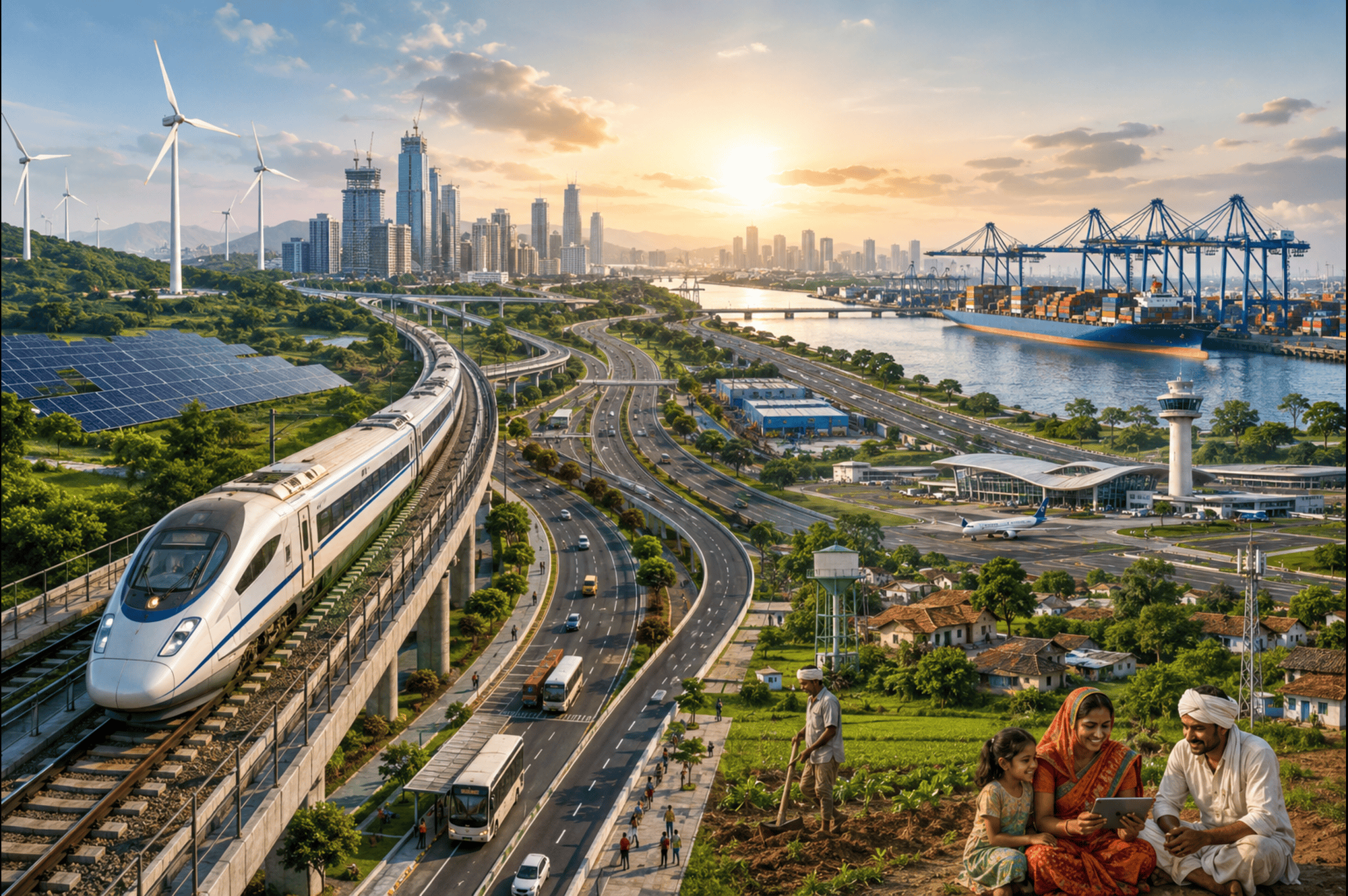
If NIP is the balance sheet, PM Gati Shakti is the operating system. Launched in October 2021, the PM Gati Shakti National Master Plan brings together 16 ministries on a single GIS based platform to plan and monitor infrastructure in an integrated way. It focuses on seven “engines” of growth – roads, railways, ports, waterways, airports, mass transport and logistics infrastructure with the stated aim of seamless multimodal connectivity and lower logistics costs. India’s logistics cost is widely estimated to be in the low to mid teens as a percentage of GDP, significantly higher than in many developed economies, and Gati Shakti is designed to tackle issues such as disjointed planning, missing links and delays in clearances that inflate those costs. Case studies already show how the platform has been used to re align corridors, identify better sites for multimodal logistics parks and avoid duplication across agencies.
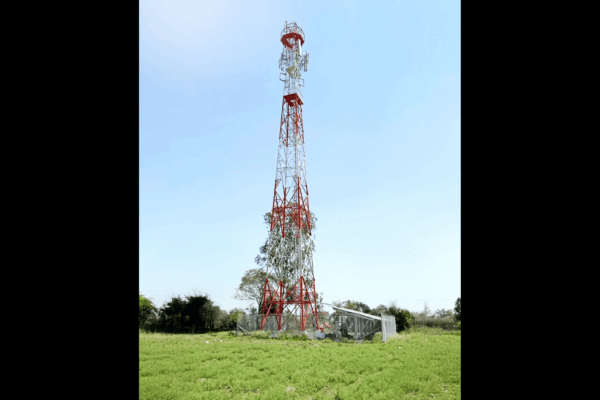
Layered over this physical network is a rapidly expanding digital public infrastructure (DPI) stack. Building on Aadhaar and UPI, recent policy documents talk about DPI for agriculture, health, logistics and skilling; open, interoperable digital rails on which both public and private actors can innovate. The ambition is that a small farmer, a local transporter or a young job seeker should be able to ride the same digital rails as a large corporate: discover services, transact securely, access credit and information, and plug into value chains at far lower frictional cost. Fibre networks, 4G/5G roll outs, cloud and data centres are therefore as central to Viksit Bharat as highways and metros; they are the invisible infrastructure that can make growth more inclusive and more resilient.
Even as cities grab the headlines, Viksit Bharat 2047 will be decided as much in India’s villages, where roughly 63–65% of our people still live and nearly half depend on agriculture for their livelihoods. Over the last two decades, rural infrastructure has quietly deepened through programmes such as PMGSY for all weather village roads, PMAY Gramin for pucca housing, and Jal Jeevan Mission for household tap connections, alongside schools, anganwadis and health facilities that now anchor social services closer to home. Economic Survey updates underline how this combination of roads, housing, drinking water and digital connectivity is already linking rural communities more directly to markets, jobs and public services, improving both incomes and quality of life. The opportunity in the coming decades is to move from basic access to quality—better rural schools and health centres, smart village clusters, and truly “urban grade” services in rural India—so that geography no longer predetermines opportunity.
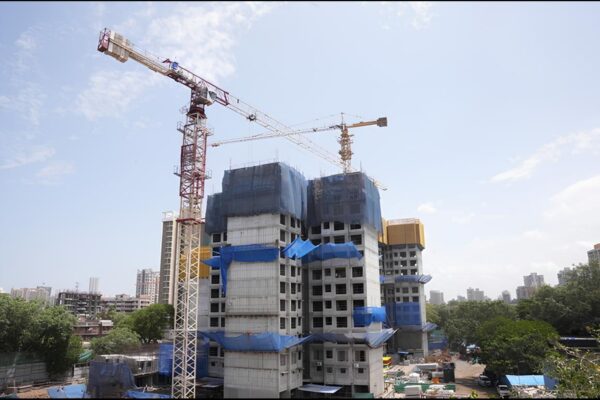
The most visible expression of this transformation will be in India’s cities. Urban infrastructure commands roughly 16-17% of projected NIP capital expenditure, reflecting recognition that water supply, sewerage, solid waste management, public transport, affordable housing and public spaces are not “soft” amenities but core economic infrastructure. Well designed metros and bus systems, non motorised transport networks and transit oriented development can cut congestion and pollution while widening labour market access, especially for women and low income workers. Strengthening municipal finances through better property taxation, user charges and access to municipal bond markets is explicitly flagged by the NIP Task Force as essential for making these investments sustainable. A Viksit Bharat, one might say, will be judged as much by the dignity of life in its tier 2 and tier 3 towns as by the infrastructure of its metros.
Running through all of this is a green thread. About a quarter of NIP investment is expected in the energy sector, where India is targeting large increases in renewable capacity, grid strengthening and more efficient, lower carbon power systems. Maritime plans speak of green ports and hydrogen/ammonia hubs; railways are moving towards greater electrification and semi high speed passenger services; cities are experimenting with electric buses, better building norms and nature based solutions. The Vision 2047 discourse increasingly emphasises that a “developed” India must also be climate resilient and environmentally responsible, not a late industrialising replica of the 20th century West. Infrastructure choices in this decade and the next will lock in emissions and urban forms for generations, which is why the green lens is no longer optional.
The pinch of salt is that the starting point is not easy. NITI Aayog’s Composite Water Management Index highlighted, in 2018, that nearly 600 million Indians already face high to extreme water stress and warned that national water demand could be almost twice available supply by 2030 if current trends continue. The same report noted weak performance by many states on groundwater management, irrigation efficiency and data systems reminding us that infrastructure is not just about building new assets, but managing existing ones better. The NIP Task Force itself points to risks of cost and time overruns, uneven project preparation and the need to deepen bond markets, asset monetisation and development finance institutions if the pipeline is to be fully financed. Analysis of Viksit Bharat also underline structural issues from land acquisition and urban governance to environmental trade offs that will need careful handling.
For leaders across government, business and civil society, the question is no longer whether infrastructure matters to Viksit Bharat 2047, that debate is over. The more important question is whether we can use this infrastructure decade to redesign how India works, lives and competes: can highways be planned as true economic corridors that lift entire regions; can ports and logistics parks become green, digitally enabled gateways into global value chains; can urban infrastructure and digital rails make opportunity feel closer for citizens who have long stood at the margins.
And for each of us, as professionals and as citizens, there is a quieter, personal question inside the national one. When we travel across the India of 2047 by Vande Bharat train, electric bus, coastal ferry or simply walking on a safe, shaded city footpath, will we feel that the infrastructure around us has made our lives not just more efficient, but more dignified, more sustainable and more connected to one another. Or will we look back and realise that we had the plans, the capital and the technology, but did not fully seize the chance to build the Viksit Bharat we promised ourselves.
Tags