Case Study: CRBC Creates a Digital Twin to Develop a Safe Highway within Cambodia’s Floodplains

Bentley Applications Helped Teams Collaborate and Reduce Materials Use, Saving Time and Money
Maintaining Cambodia’s Rapid Development
Following nearly twenty years of conflict, occupation, and turmoil, Cambodia’s constitutional monarchy, established in 1993, has prioritized rebuilding the nation. Ever since, the country’s economy has rapidly grown. To support Cambodia’s rapid development, China Road and Bridge Corporation (CRBC) partnered with the local government to build the first four-lane expressway in the country, connecting Phnom Penh with Sihanoukville. With the success of that project, the two entities moved to further improve Cambodia’s quality of life with a second expressway.
The 138-kilometer Phnom Penh-Bavet Expressway starts from the Third Ring Road in
Phnom Penh and ends in Bavet City, a border city between Cambodia and Vietnam. The toll road includes toll gates, interchanges with existing roads, and service areas. “After the project is completed, it will become the main part of the international corridor connecting Vietnam, Cambodia, Thailand, and Myanmar in Southeast Asia, and play a great role in promoting Cambodia’s national economic development and ASEAN regional interconnection,” said Yulong Liu, chief engineer at CRBC.
Building around Buddhist Temples
CRBC soon realized that road design in Cambodia can be challenging, due in part to the geography and climate. “The terrain along the project is low and flat, and the rainfall in Cambodia is heavy in the rainy season. Because the starting section of the project crosses the river, heavy rain causes the Mekong River to overflow the river channel and form a flood zone,” explained Liu. The first 33 kilometers of the project is within a floodplain, and the rainy season – which can last up to six months – can create a water depth of up to six meters.
The design team also faced cultural considerations. The region is deeply rooted in Buddhism, and over the centuries, followers have built a large number of temples and cultural relics. “The Cambodian owners require that the temples and relics not be moved, which makes it difficult to determine the alignment,” said Liu. Determining the route was further complicated by heavy traffic at the starting point and the need to minimize the number of homes that will be relocated as a result of construction. Both factors make it more difficult to determine the interchanges needed when using traditional design methods.
A Digital Twin Leads the Way
The design team realized that, unlike two-dimensional design, digital design enabled by Bentley software can be used throughout the entire development process to overcome challenges. “With the help of Bentley series software, we can realize digital delivery, solve the problem of inefficient information transmission between design and construction, reduce project cost, and improve project management efficiency,” elaborated Liu. They began by using ProjectWise and iTwin to establish a digital resource management platform and connected data environment, ensuring all information is up-to-date and available to all stakeholders at any time.
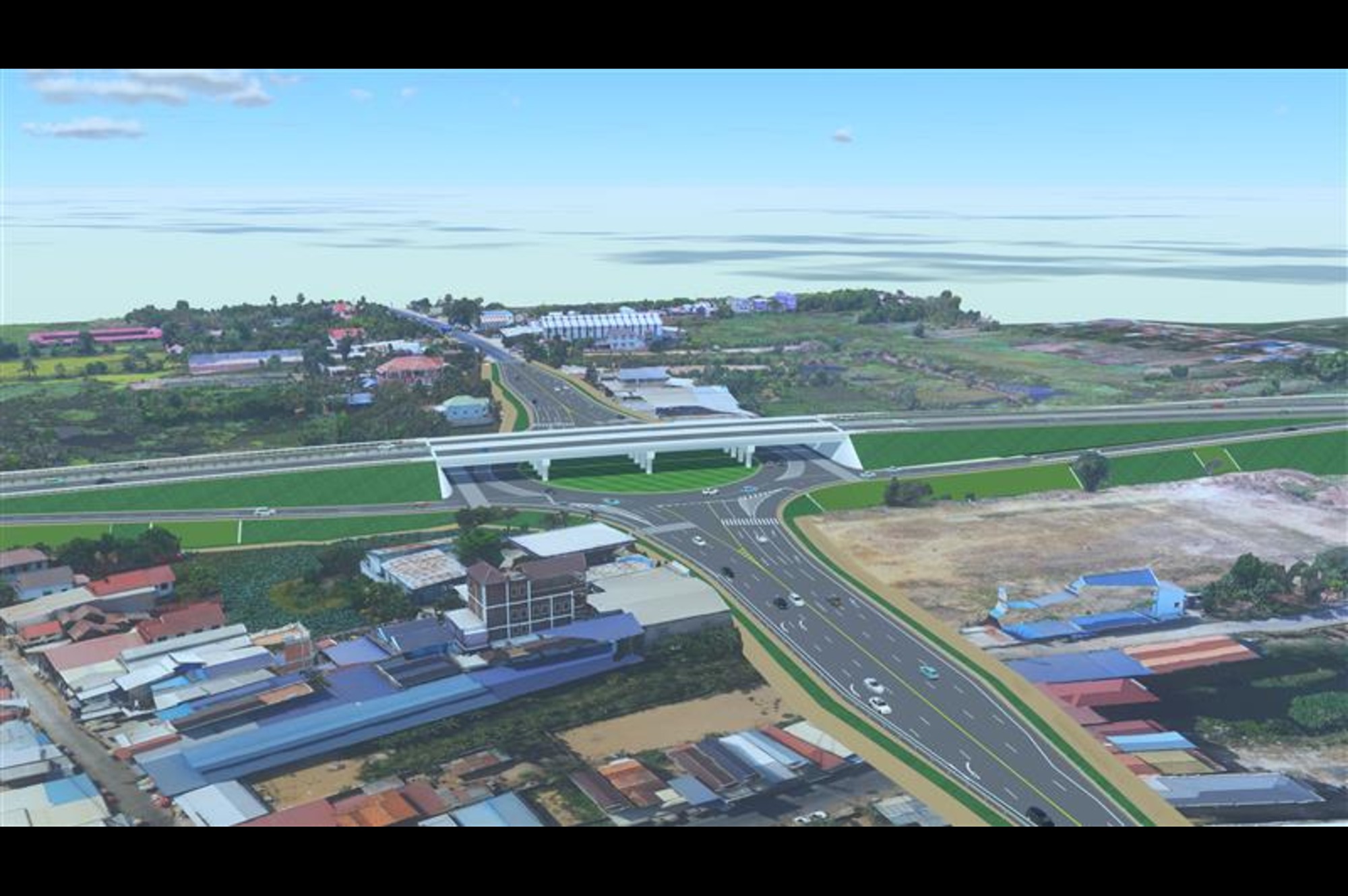
The team then created a model of the project site with iTwin Capture, helping them better visualize the route and determining how to lay it out. “Participants can quickly find out the design problems such as the road encroaching on temples based on the 3D model in the [virtual] environment, and give feedback in time,” said Liu. Using MicroStation, OpenRoads, and OpenBridge – as well as third-party applications, as Bentley applications are open-source and interoperable – they created a digital twin of the highway, including associated facilities. OpenRoads helped them test traffic simulations for different years in the future to pinpoint potential areas of congestion and design intersections that would keep traffic moving. Analysis within the application also helped them to design the road height 0.5 meters above the maximum flood level.
Better Insight with Less Time
By using Bentley applications, all teams and specialists were able to work together on a single, 3D digital twin to improve the efficiency of design and the quality of the road. Using photographic data of the proposed site in the digital twin helped them identify land acquisition boundaries. “Problems can be found in time and design adjustments can be made to reduce the impact on temples, schools, houses, historical sites, graves, and other facilities along the expressway. At the same time, solve the problem of communication with local people in demolition, thus greatly reducing the adverse impact of project construction to surrounding communities,” said Liu. They also used the digital twin to optimize vertical alignment and reduce fill height, lowering earthworks by two million cubic meters and eliminating 142,860 kilometers of truck travel.
Creating a parameterized cross-section template within OpenRoads to examine and test variables and solutions, pressure testing any impact their decisions may have, helped CRBC improve modeling efficiency, reducing modeling time by 50%. Deeper understanding of the digital twin helped the team realize that they could change part of a bridge in the flood zone into a partial subgrade road, eliminating the need for 16,000 tons of concrete and saving a significant amount of money. Overall, digital design shortened the design cycle by 20%, eliminating potential delays to the significant boon for residents and travelers. “The travel time from Prey Veng to Phnom Penh will be shortened from two hours to 20 minutes,” concluded Liu.
Megan Tigue joined Bentley in 2021. She has worked as a product marketing manager for construction management and Bentley Infrastructure Cloud products. Now, she’s channeling her expertise into her current role as an industry marketing manager for roads and highways. With 15 years of experience, Megan is passionate about product and industry marketing, especially activities like creating go-to-market strategies, crafting compelling messaging, empowering sales teams, and accelerating product adoption
Tags