AAC Walls in Extreme Heat: What Gulf Sites Teach EPC Teams

AAC blocks offer significant advantages for construction in hot climates, including thermal insulation, fire resistance and reduced structural loads. However, achieving their full potential depends on proper specification, site planning and installation practices
Autoclaved aerated concrete (AAC) block has become a standard walling material on Gulf projects, and for good reason. It weighs roughly a fifth of normal concrete block, it insulates on its own, and it resists fire for up to four hours. In a Gulf summer, those properties matter.
But the performance written in a datasheet is not automatically the performance delivered on site. We have supplied and installed AAC walls in Qatar since 2007, and most of the problems we see have little to do with the block itself. They come from decisions taken, or not taken, by the project team: at design stage, in the contract, and on the first day of work. For EPC teams planning their first AAC package in a hot climate, five lessons stand out.
The First Course Decides Every Course Above It
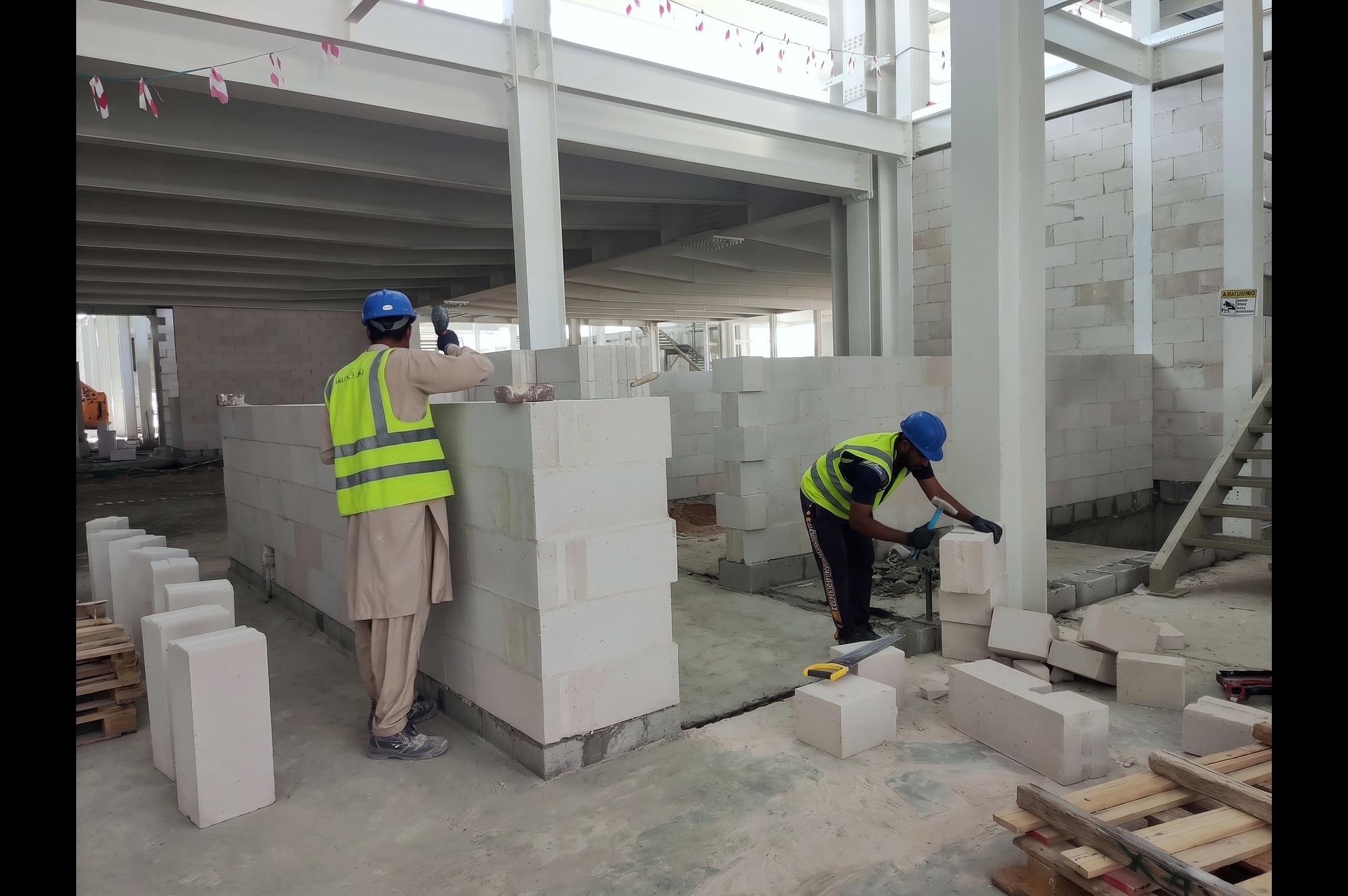
AAC is laid with thin-bed adhesive, in joints of 3 to 5 mm. That is one of its main advantages: less mortar, faster laying and fewer weak lines through the wall. But a thin joint cannot correct an uneven slab. If the first course is not level, every course above it inherits the error, and the mason either grinds blocks or opens the joints, which defeats the purpose of the system.
The answer is simple and it should be written into the method statement. The first course goes down on conventional mortar, which takes up the unevenness of the slab, and it is checked for level along its full length before any thin-bed work begins. Only then does the crew switch to adhesive. On our sites, this check is the first thing we supervise with every new crew. Experienced masons who have spent years with dense block are often the ones most likely to skip it, because with thick mortar joints they never needed to.
Plan The Offloading Before the Truck Arrives
On Gulf sites, dense concrete block is often offloaded with a truck-mounted crane and a clamp that grips the stack from the sides. That does not work for AAC. The block is lighter and its edges are more vulnerable, and a side clamp can crack edges or break blocks inside the pallet. AAC has to be lifted from underneath, by forklift or by forks on a site crane.
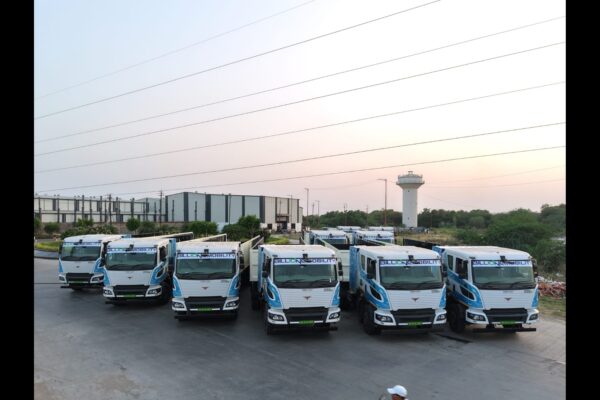
For an EPC team this is a logistics item, not a site detail. The lifting equipment has to be on site when the delivery arrives, and someone has to be responsible for it. In our supply terms, offloading is the main contractor’s responsibility, and we agree it with every client before the first delivery. Even so, a truck waiting for the right machine is one of the most common delays we see. On a congested city site in summer, with deliveries scheduled around heat restrictions on working hours, a lost delivery slot can cost a day.
Control Cracking at the Wall-To-Frame Joint
The most frequent complaint on AAC walls is a fine crack along the line where the blockwork meets a concrete column or beam. The two materials respond differently to heat and load, and in a Gulf summer, with large daily temperature swings on external walls, that difference shows quickly.
The crack is rarely structural, but it is visible, it lets moisture reach the render, and it generates snag lists at handover. Prevention costs very little. Our practice is to fix a strip of mesh over every wall-to-frame junction before plastering, lapping about 10 cm onto each side, using galvanized metal or fibreglass mesh depending on the plaster system. This belongs in the specification and in the inspection checklist, not in the mason’s memory.
Choose The Thickness by the U-Value, Not by Habit
In hot climates, a wall’s thermal performance is not a marketing figure. It decides cooling loads for the life of the building. In Qatar, the requirement for external walls is a U-value of 0.57 W/m²K. A single-layer AAC wall can meet that without an added insulation board, but only at the right thickness.
On our thermal table, a 200 mm AAC wall gives about 0.58 W/m²K, just above the limit. A 250 mm wall gives about 0.48, comfortably inside it. That 50 mm decides whether the external wall complies on its own or needs an extra insulation layer, with the cost, programme time and extra interface details that come with it. Too often, wall thickness is copied from a previous project or chosen for floor area. In a hot climate, it should be chosen at design stage from the thermal requirement, then held through value engineering.
Know Where Lightweight Block Is the Wrong Choice
AAC is a strong solution, but not a universal one. Walls that will stay wet, such as those in permanently damp areas or in contact with retained ground, need another solution or specific detailing and engineering. AAC can be used in load-bearing walls on low-rise buildings, but only in higher-strength block and with structural design behind it, not because a partition block happened to be available on site. Long or tall infill walls must stay within the length and area limits of the local specification, or be broken up with stiffeners.
Saying this openly is part of using the material well. In a market where clients compare materials by reputation, one wrong application does more damage than many good ones can repair.
The Short Version
For EPC teams, the lesson from Gulf sites is that AAC performance is decided in the project’s paperwork as much as in the factory. Write the first-course check into the method statement. Put offloading in the contract and the delivery plan. Specify mesh at every wall-to-frame junction. Choose wall thickness from the U-value requirement. And be clear about where the material should not be used. Each of these costs little at the planning stage and a great deal once the walls are up.
Authored by: Eng. Qasem Al Hariri is the owner of ASLAN Contracting & Transportation, a supplier and installer of AAC blocks in Doha. The company has supplied and installed AAC walls on residential and commercial projects across Qatar since 2007.
Tags