AI Meets Green Construction: Can Digital Twins Help Deliver Truly Sustainable Infrastructure?

by P. GopalaKrishnan, Managing Director, SAME, GBCI
India is entering a major phase of infrastructure development, but success will depend on more than how much gets built. It will depend on how efficiently and sustainably those assets perform over decades. According to an industry report, India’s buildings and construction sector already accounts for 38% of primary energy use and 32% of national greenhouse-gas emissions, making performance a critical sustainability challenge. As infrastructure scales, AI-enabled digital twins could help shift green construction from a design ambition to a continuously measured and improved outcome.
From Designing Buildings to Understanding How They Perform
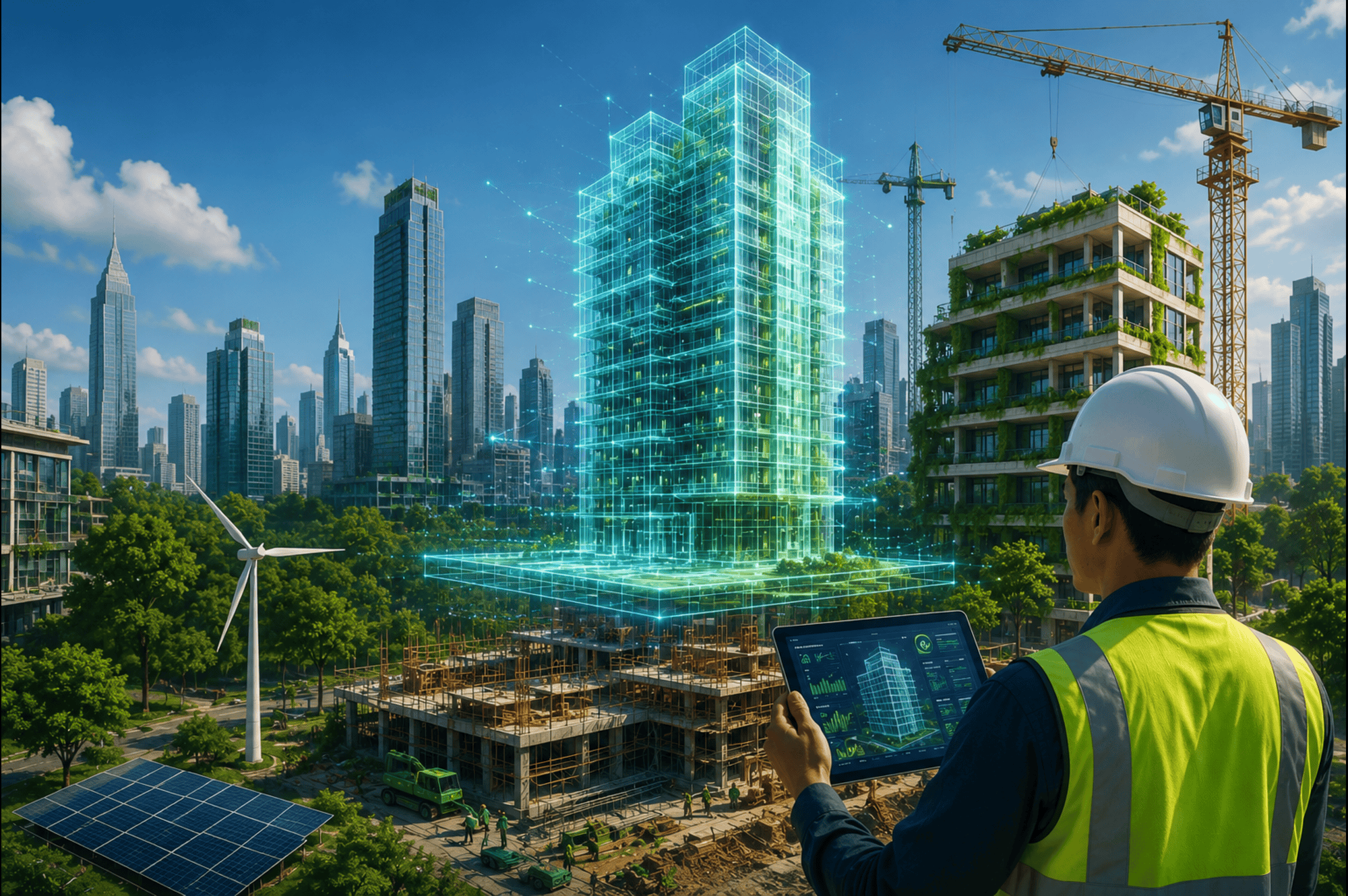
A digital twin is more than a 3D model. It connects a building’s digital representation with data from the physical asset to track how it is designed, built, and how it performs. Because occupancy, water use, equipment efficiency, and weather conditions can all change performance, a building may not deliver what its design intended.
Digital twins help bridge this gap by providing continuous visibility into actual performance. When combined with AI, they can analyse data, identify patterns, predict issues, and compare scenarios—helping teams move beyond asking whether a building meets a sustainability target to understanding why it performs the way it does and how it can improve.
Why This Matters for India’s Next Infrastructure Cycle
The timing is particularly important for India. The country’s building stock is expanding alongside rapid urbanisation, while existing buildings will also require upgrades to improve efficiency and resilience. The scale of infrastructure investment makes even incremental improvements potentially significant.
The Union Budget 2026–27 proposed ₹12.2 lakh crore in public capital expenditure, about 9% higher than the previous year’s budget estimate. India’s experience with smart infrastructure also shows that digital technologies are already moving into mainstream infrastructure planning. Under the Smart Cities Mission, 95% of 8,063 projects had been completed by July 2025, with ₹1.64 lakh crore invested. More than 17,026 km of water-supply networks across 28 cities were being monitored through SCADA systems, demonstrating how connected data is increasingly being used to manage physical infrastructure.
The next step is to connect these capabilities more closely with sustainability outcomes.
From BIM to an AI-enabled Sustainability Engine
Building Information Modelling (BIM) has already changed how project teams create, coordinate, and manage information about buildings. Digital twins can take this further by connecting that information with real-world performance data.
In practical terms, BIM can establish what is intended to be built. Sensors and building systems can show what is actually happening. AI can analyse the difference between the two and help identify opportunities for intervention. This could be applied at multiple stages. During design, teams can compare different building orientations, materials, energy systems, equipment configurations, and operating scenarios. During construction, digital information can help identify coordination issues, improve sequencing, and reduce rework. During operations, continuously updated data can help building teams identify inefficiencies and make adjustments.
Carbon, Water, And Materials: Making Trade-Offs Visible
Carbon, water, energy, and materials are interconnected. A solution that improves one metric can create challenges elsewhere. For instance, efficient cooling may affect water use or embodied carbon, while materials with lower operational impacts can carry different manufacturing footprints.
Digital twins can make these trade-offs visible earlier, enabling teams to compare operational and embodied carbon, energy systems, renewable-energy options, materials, and operating schedules before decisions become costly to change. This is especially important in India, where buildings account for nearly one-third of national greenhouse-gas emissions.
Connected data can also improve water management by identifying leaks, unusual consumption, and inefficient equipment, while better digital information can optimise material quantities, procurement, and construction planning—reducing waste and avoidable rework.
Moving From Reactive Maintenance to Predictive Performance
The operational phase may be where digital twins deliver some of their greatest value. Buildings evolve as equipment ages, occupancy changes, and external conditions shift. Unlike fixed maintenance schedules or reactive repairs, AI-enabled digital twins can support predictive maintenance by identifying performance changes before they lead to failures.
The real value of digital twins is not a guaranteed percentage of energy or water savings, but the ability to continuously generate insights that help teams identify opportunities, optimise performance, and sustain efficiency. And increasingly, sustainability must go beyond efficiency to include resilience—helping buildings anticipate disruptions, adapt to changing conditions and maintain performance over time.
Efficiency Alone Is No Longer Enough
India’s buildings and infrastructure increasingly face heat stress, extreme rainfall, water constraints, power fluctuations, and other climate-related disruptions. Sustainability, therefore, must also mean resilience—the ability to maintain performance under changing conditions.
Digital twins can support this by connecting building systems and helping teams understand these interdependencies. Changes in weather can alter cooling demand, affecting energy use and equipment performance. Similarly, water availability can influence cooling strategies and power disruptions can impact critical operations. By simulating these scenarios, digital twins can help teams anticipate risks, optimise responses, and build resilience into sustainability planning.
The Business Case Cannot Be Ignored
For digital twins to scale, they must address real operational challenges. Sensors, software, data infrastructure, and skilled teams require investment, so adoption should begin with a clear performance problem—whether high energy use, water losses, or equipment downtime.
Digital twins can also make lifecycle costs more visible. A lower upfront cost does not always mean lower overall cost if a system consumes more energy, requires frequent replacement, or causes operational downtime. The technology should support better decisions, not replace human judgement.
Performance Is Becoming the Product
This shift from design intent to measured performance is also reflected in the evolution of LEED. LEED v5 places greater emphasis on lifecycle performance, with stronger focus on decarbonisation, quality of life, resilience and performance monitoring across design, construction and operations. For project teams, digital twins can support this shift by connecting BIM, building systems and operational data to create a clearer picture of how an asset performs over time.
The Indian market is moving in the same direction. In 2025, India ranked second globally outside the US in LEED-certified space, with 16.1 million sq. m. across 611 certified projects. The growth of LEED Operations and Maintenance certifications also points to a greater focus on how buildings perform after completion. As sustainability moves from certification intent to operational proof, digital twins can play an important role in helping owners continuously measure, verify and improve performance.
Building The Digital Layer Alongside the Physical One
India has an opportunity to advance digitalisation and sustainability together. For new buildings, data centres, transport networks and industrial infrastructure, structured asset information and sustainability metrics can be built into projects from the outset. For existing assets, digital tools can establish performance baselines and identify high-value retrofit opportunities.
This will require interoperable data, consistent standards, cybersecurity, strong governance, and the skills to turn data into action. Most importantly, digital twins must remain tied to measurable sustainability outcomes—not become technology projects without a clear purpose.
The Future of Green Construction Is Continuous
Can digital twins help deliver truly sustainable infrastructure? Yes—but not simply because a digital replica exists. Their value lies in enabling better decisions during design, greater visibility during construction, continuous measurement in operations and faster intervention when performance declines.
The opportunity is significant in India. As mentioned earlier, buildings account for 38% of annual primary energy use and 32% of national greenhouse-gas emissions. Even incremental improvements in how buildings and infrastructure are designed, operated, and maintained can compound over decades.
The next generation of green buildings will need to be more than efficient at completion. They will need to learn, adapt, and continuously improve. AI-enabled digital twins can help make that possible by turning sustainability from a static ambition into a measurable, continuously improving lifecycle outcome.
Tags