Off the Critical Path: How Lightweight AAC Wall Panels Are Compressing India’s Project Timelines

India is building faster than at almost any point in its history. Metros, airports, data centres, industrial facilities, massive warehouses, and mass housing are frequently executed in parallel. For the EPC contractors and project developers delivering these assets, the binding constraint is rarely ambition or capital. It is time.
Every infrastructure project runs against a schedule, and that schedule collides with unforgiving site realities: labour availability, weather windows, material logistics, and the domino effect of dependencies where one trade must finish before the next begins. Schedule slippage is expensive, leading to liquidated damages, financing costs on stalled capital, and the heavy opportunity cost of an asset that isn’t generating revenue.
Surprisingly, one of the biggest levers for keeping a project on schedule sits in a place teams rarely think to look: the walling.
The Hidden Drag of Conventional Walling
Clay-brick masonry is an age-old building method, but on a modern infrastructure schedule, it acts as a quiet bottleneck. It is a wet, sequential, labour-intensive process. Bricks are laid one by one, set in mortar, cured, and then plastered. Each step is gated by the one before it. The work depends on water, favourable weather, and skilled masons who are increasingly difficult to source at the pace large projects demand. On a tight programme, traditional walling inevitably drifts onto the critical path.
Then there is the issue of weight. Red clay brick is dense, typically weighing around 1,800–2,000 kg per cubic metre. A heavy wall imposes a heavy dead load, which cascades downward through the building, requiring a heavier structural frame, extensive reinforcement, and larger, deeper foundations. In a country where much of the landmass falls within higher seismic zones, that extra mass increases the inertial forces a structure must be designed to resist under IS 1893. In short, the choice of walling quietly drives up structural costs long before the first occupant arrives.
The Shift to Lightweight AAC Wall Panels
This is where Autoclaved Aerated Concrete (AAC) wall panels are changing the equation. Rather than a simple product swap, they represent an entirely different way of sequencing construction.
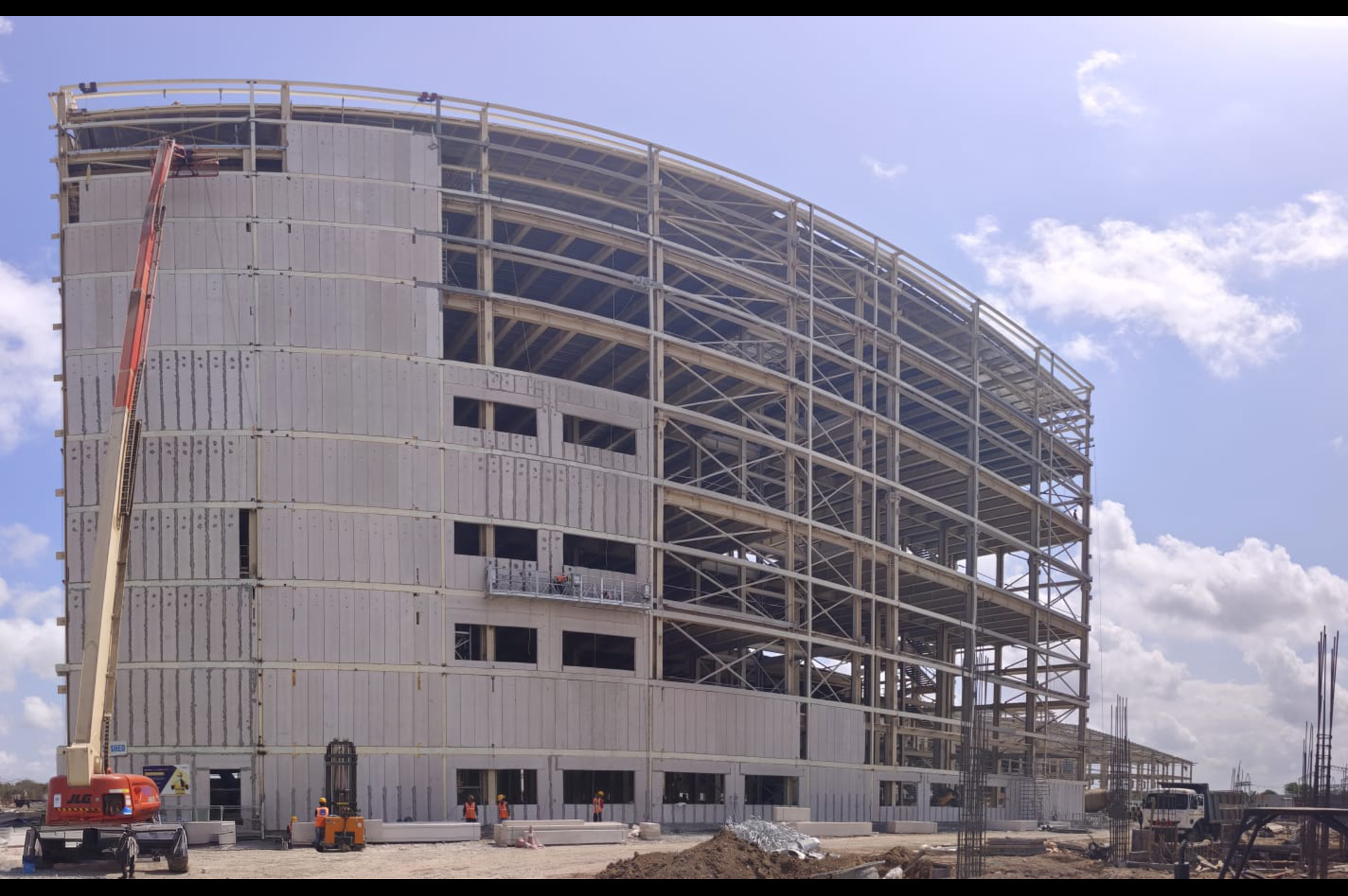
Large-format, full height, reinforced AAC wall panels replace dozens of individually laid bricks with a single component. They are installed dry and fixed into place in a fraction of the time, moving walling completely off the critical path.
The operational and financial advantages of this shift are striking:
• Massive Dead Load Reduction: AAC panels have a dry density of roughly 550–650 kg/m³, about one-third the density of clay brick for the same wall area. Lighter walls enable a lighter superstructure, allowing for leaner framing and smaller foundation designs. For large-span infrastructure, this substantially lowers steel, concrete, and foundation costs, while reducing seismic demand on the frame.
• Superior Thermal Performance: AAC’s thermal conductivity is around 0.16 W/m·K, compared to roughly 0.81 W/m·K for solid clay brick, making it nearly five times more insulating. The microscopic air pores that make AAC lightweight also act as a powerful thermal barrier.
• Rapid Adoption in Modern Assets: Energy-intensive and rapid-turnaround sectors are leading the adoption of this technology:
o Data Centres & Cold Storage Warehouses: The high thermal insulation translates into lower heat ingress, drastically reduced HVAC/cooling loads, and massive operational savings accumulated over the asset’s lifespan.
o Industrial Facilities & Logistics Parks: Large-format panels allow rapid enclosure of expansive spaces, allowing developers to achieve weather-tightness and begin interior fit-outs weeks or months ahead of traditional schedules.
• Speed and Predictability: Dry, panelised installation requires minimal curing time and brings almost zero water to the job site.
Factory-made components mean fewer trades stacking up, reduced material wastage, and highly consistent quality that is not dependent on individual mason availability. Off-site manufacturing also de-risks the project from the two variables that derail schedules most: adverse weather and skilled-labour shortages.
From Material Choice to Schedule Decision
Read together, these properties reframe the fundamental nature of walling. It stops being a line item chosen purely on per-square-foot material cost and becomes a strategic decision impacting the project timeline and the total cost of ownership.
• A lighter wall buys structural economy.
• A faster wall buys schedule certainty.
• A highly insulated wall buys decades of lower operating costs.
• A factory-made wall buys predictability, the scarcest commodity on large-scale Indian projects.
For EPC firms working toward aggressive handover deadlines and developers measuring success by time-to-revenue, this combination is impossible to ignore.
Building the Supply Side
Realising these gains at scale requires a robust manufacturing base capable of delivering consistent, code-compliant components in the volumes demanded by modern infrastructure. Magicrete has aligned its business model with this shift, manufacturing large-format AAC wall panels engineered specifically for Indian conditions, building codes, and seismic realities.
“The conversation has shifted from the per-square-foot price to the lifetime cost of the building envelope.,” notes Sourabh Bansal, MD, Magicrete. Today, developers are asking: ‘How does this wall impact my project timeline, structural steel tonnage, and thirty-year cooling bills?’ When viewed through that lens, AAC wall panels aren’t just an alternative, they are the only logical default.”
As India’s infrastructure pipeline grows denser and delivery timelines tighten further, the projects that cross the finish line first will be those that recognise the wall for what it truly is: not a finishing detail, but a schedule decision sitting squarely on the critical path.
Tags