Dispute Resolution Mechanisms in National Highways Authority of India Contracts

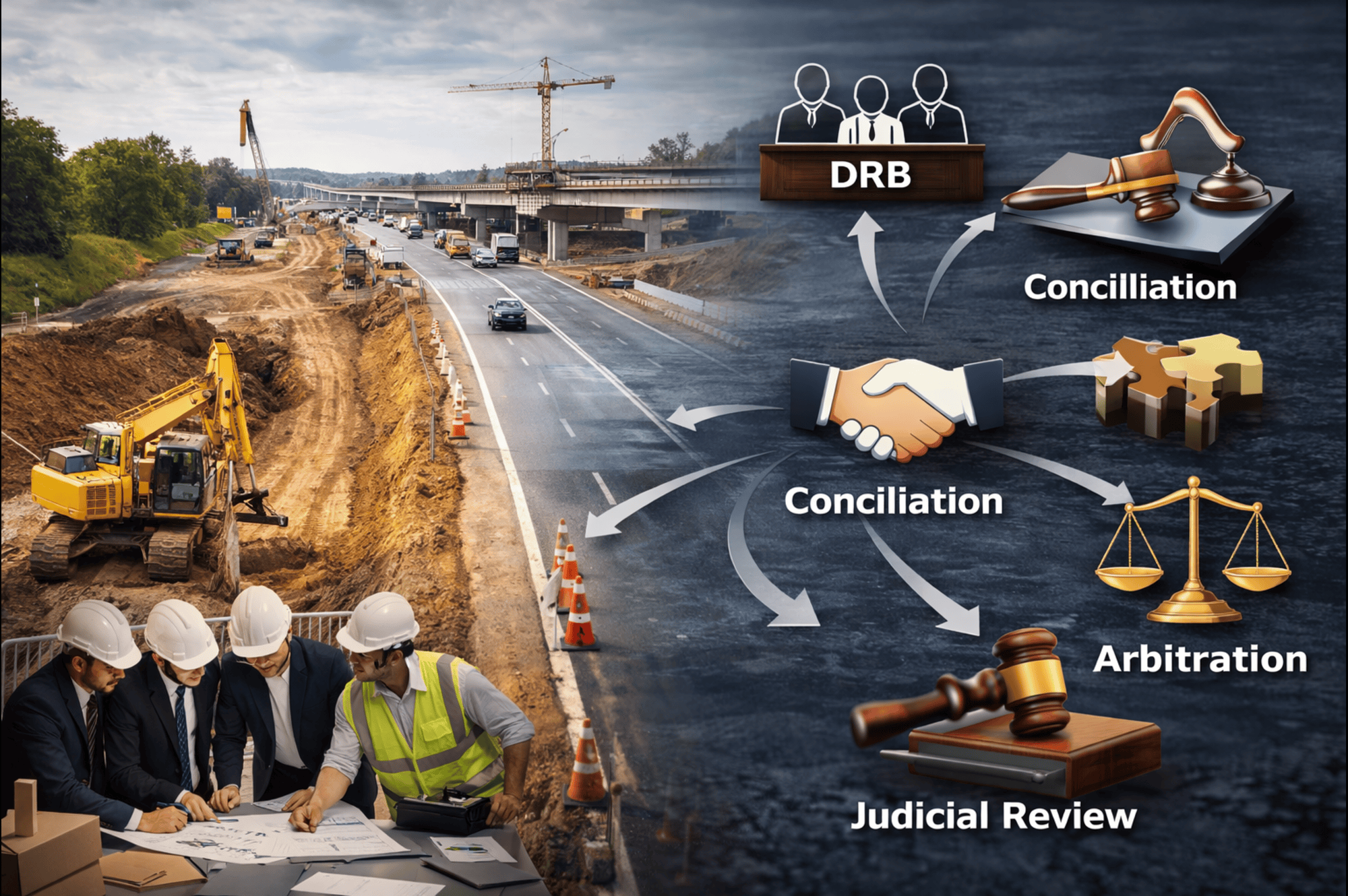
India’s highway expansion, led by the National Highways Authority of India (NHAI), has created complex EPC, BOT, and Hybrid Annuity contracts that often lead to disputes. A structured multi-tier resolution framework – spanning engineers, dispute boards, conciliation, and arbitration under the Arbitration and Conciliation Act, 1996 – aims to resolve conflicts efficiently while limiting judicial intervention
Infrastructure development in India, especially in the highway sector, has seen exponential growth over the past two decades. At the core of this revolution is the National Highways Authority of India, which undertakes massive projects with intricate contractual agreements such as EPC, BOT, and Hybrid Annuity Model contracts. Given the technical, financial, and time-related complexities of such contracts, there is a high possibility of disputes occurring in NHAI contracts. As such, a multi-tier dispute resolution mechanism is incorporated in NHAI contracts, which includes both contractual and alternative forms of dispute resolution.
Nature of Disputes in NHAI Contracts: Disputes in NHAI contracts arise from various issues, such as: Delay in executing the project, Variation in the scope of work, Payment and escalation of costs, Land acquisition and force majeure, Termination of contracts and compensation. Such disputes carry high stakes and require specialized forms of dispute resolution mechanisms. As such, NHAI contracts incorporate a specialized mechanism of resolving disputes, with a framework of resolving such issues in accordance with international standards, such as FIDIC.
Multi-Tier Dispute Resolution Framework
Engineer/Authority Level Determination: The primary mechanism of resolving disputes in NHAI contracts is by the decision of the Independent Engineer in EPC and Hybrid Annuity Model contracts or Authority Engineer, with regard to disputes over issues such as: Measurement of work, Certification of payments, Determination of delays. However, this mechanism is often criticized, owing to a lack of independence, as the Engineer is appointed by NHAI and is therefore biased towards them.
Dispute Resolution Board (DRB): NHAI’s agreements often incorporate a provision for a Dispute Resolution Board (DRB). The DRB is an intermediate form of dispute resolution that: Comprises experts in both technical and legal fields, Offers recommendations or decisions on disputes, Strives for rapid resolution on a project-by-project basis. In Somdatt Builders NCC-NEC (JV) v. NHAI, the dispute was first referred to the DRB, which granted relief to the contractor before the dispute proceeded to arbitration. The DRB process is significant as it minimizes the escalation of disputes and maintains project continuity.
Conciliation Mechanism (Post-2017 Reform): In an effort to settle the rising arbitration claims, NHAI has established a formal conciliation process since 2017, with modifications through the formulation of Standard Operating Procedures (SOPs). Important features: Formalized conciliation committees, Stressing amicable dispute resolution, Minimizing litigation burden. This process has been frequently utilized for resolving high-value claims and indicates a policy shift towards non-adversarial dispute resolution.
Arbitration: Arbitration is the final form of dispute resolution in NHAI’s agreements. The agreements incorporate arbitration provisions under the Arbitration and Conciliation Act, 1996.
Important Characteristics:
• Tripartite arbitration panel
• Technical and contractual expertise taken into account
• Compulsory award subject to judicial review
However, arbitration in NHAI disputes has been subject to criticism for delays and high financial implications. A recent case illustrates the extent of these disputes, wherein the arbitral tribunal directed NHAI to make significant compensation payments for project delays and cost escalation claims.
Judicial Intervention and Supervisory Role
While arbitration is designed to minimize court intervention, Indian courts have an important supervisory role to play in accordance with sections 34 and 37 of the arbitration act.
Limited Scope of Judicial Review: The Supreme Court has been emphasizing minimal intervention in arbitral awards involving NHAI contracts.
(a) Ssangyong Engineering & Construction Co. Ltd. v. NHAI (2019) 15 SCC 131
The Supreme Court has explained the scope of “public policy” under Section 34 of the Act.
(b) Somdatt Builders – NCC – NEC (JV) v. NHAI, 2025 INSC 113
The Supreme Court has reiterated that the court must use “great restraint” in reviewing the arbitral award.
(c) NHAI v. Hindustan Construction Co. Ltd.
The Supreme Court has reaffirmed that interpretation of contractual provisions is within the domain of the arbitral tribunal.
Enforcement and Appeals
• Section 34: Challenge to arbitral award
• Section 37: Appeal against orders under Section 34
In Somdatt Builders, the Supreme Court has held that appellate courts under Section 37 must not re-assess contractual interpretation.
Invocation of Arbitration Clause: The Courts have also clarified various aspects of invoking arbitration.
Consulting Engineers Group Ltd. v. NHAI (Delhi HC, 2022). The Delhi High Court has held that a member of a JV cannot invoke arbitration on his own unless authorized.
Alternative Forums: Lok Adalat and Settlement: Apart from the formal process of arbitration, disputes relating to compensation and land acquisition are often resolved through Lok Adalat: Speedy resolution, Cost-effective settlement, Reduced judicial burden. Recent instances have demonstrated the effectiveness of settling highway disputes relating to compensation through these platforms. This highlights the increased dependence on ADR methods.
V. Challenges in NHAI Dispute Resolution
Despite the robust system in place, there are many challenges to be addressed:
Procedural Complexity: The tiered system results in delay rather than efficiency, especially when disputes are referred sequentially to higher levels.
Delay in Arbitration: Arbitration, though designed to be time-bound, may take years to resolve in the case of high-stake disputes.
Enforcement Problems: Even in the case of an award, enforcement may be disputed due to the frequent practice of challenging under Sections 34 and 37.
Allegation of Bias in Initial Stages: The involvement of the Independent Engineer may be viewed suspiciously in the initial stages due to contractual obligations to the authority.
Emerging Trends and Reforms
Recent trends indicate an increased dependence on conciliation and settlement methods. The judicial approach now emphasizes minimal interference. There is also an increased focus on strengthening arbitration. The NHAI’s conciliation process is a significant step in the direction of incorporating an alternative dispute resolution system to reduce litigation and settle disputes in a timely manner.
Conclusion
The dispute resolution system in NHAI’s construction contracts maintains an excellent balance between contractual freedom, technical determination, and judicial review. The increasing dependence on conciliation and ADR methods highlights the practical shift towards efficiency and cost-effectiveness. The judicial decisions in Ssangyong Engineering, Somdatt Builders, and Hindustan Construction Company have been significant in establishing the independence of arbitral tribunals and limiting judicial review.
In the ever-changing paradigm of infrastructure laws, dispute resolution in NHAI contracts is not only a legal imperative but also a vital aspect to ensure the timely completion of projects and maintain investor sentiment in the Indian highway infrastructure industry.
Shraddha Sharma has experience of more than a decade in litigation and arbitration in infrastructure & commercial disputes. She advises developers, contractors, and public authorities on contract structuring, risk management, and dispute avoidance.
Tags