The Rise of Design & Build Models: Why Integrated Delivery Is Reshaping the Built Environment

by Sammeer Pakvasa, Managing Director & CEO, Eleganz Interiors
Across the construction and interior fit-out industry, the expectations placed on projects have changed significantly over the past decade. Organisations today are no longer simply looking for spaces that meet technical specifications. They expect environments that support productivity, reflect brand identity, enable collaboration, and adapt to rapidly evolving business needs.
At the same time, projects are expected to be delivered faster, within tighter budgets, and with greater accountability across quality and timelines.
In response to these changing expectations, the Design & Build delivery model has steadily gained prominence across commercial construction, corporate workplaces, healthcare environments, and large-scale infrastructure projects. What was once seen as an alternative project structure is now increasingly becoming the preferred approach for organisations seeking greater certainty and efficiency in project execution.
Moving Beyond Fragmented Project Delivery
Traditionally, many construction projects followed a fragmented delivery approach where design consultants, contractors, vendors, and project managers operated as separate entities. While this structure worked in earlier phases of the industry, it often resulted in coordination gaps, communication delays, and accountability challenges.
Design decisions made at early stages did not always consider construction feasibility, material lead times, or cost implications. Similarly, execution teams frequently encountered design constraints that required rework or redesign during the construction phase.
This fragmentation often led to project delays, cost overruns, and compromised efficiency, particularly in complex commercial environments where timelines are critical.
The Design & Build model addresses this challenge by bringing strategy, design, engineering, procurement, and execution under a single delivery framework. Instead of operating in silos, all stakeholders collaborate from the earliest stages of the project lifecycle, creating a unified approach to problem-solving and decision-making.
Integration Creates Certainty
One of the most significant advantages of the Design & Build model is the alignment it creates between design intent and execution reality.
When designers and execution teams work together from the beginning, they are able to anticipate constraints, optimise materials, streamline construction methodologies, and make more informed decisions about cost and timelines.
This integrated approach reduces the likelihood of mid-project redesigns and ensures that design concepts translate seamlessly into built environments.
For clients, this translates into greater predictability, faster delivery cycles, and clearer accountability. Instead of managing multiple consultants and contractors, organisations work with a single integrated partner responsible for the entire delivery process.
In large-scale corporate, BFSI, and commercial projects, this clarity of responsibility is increasingly becoming a critical factor in project planning.
The Growing Complexity of Workspaces
The shift towards Design & Build is also closely linked to the evolving nature of workplaces themselves.
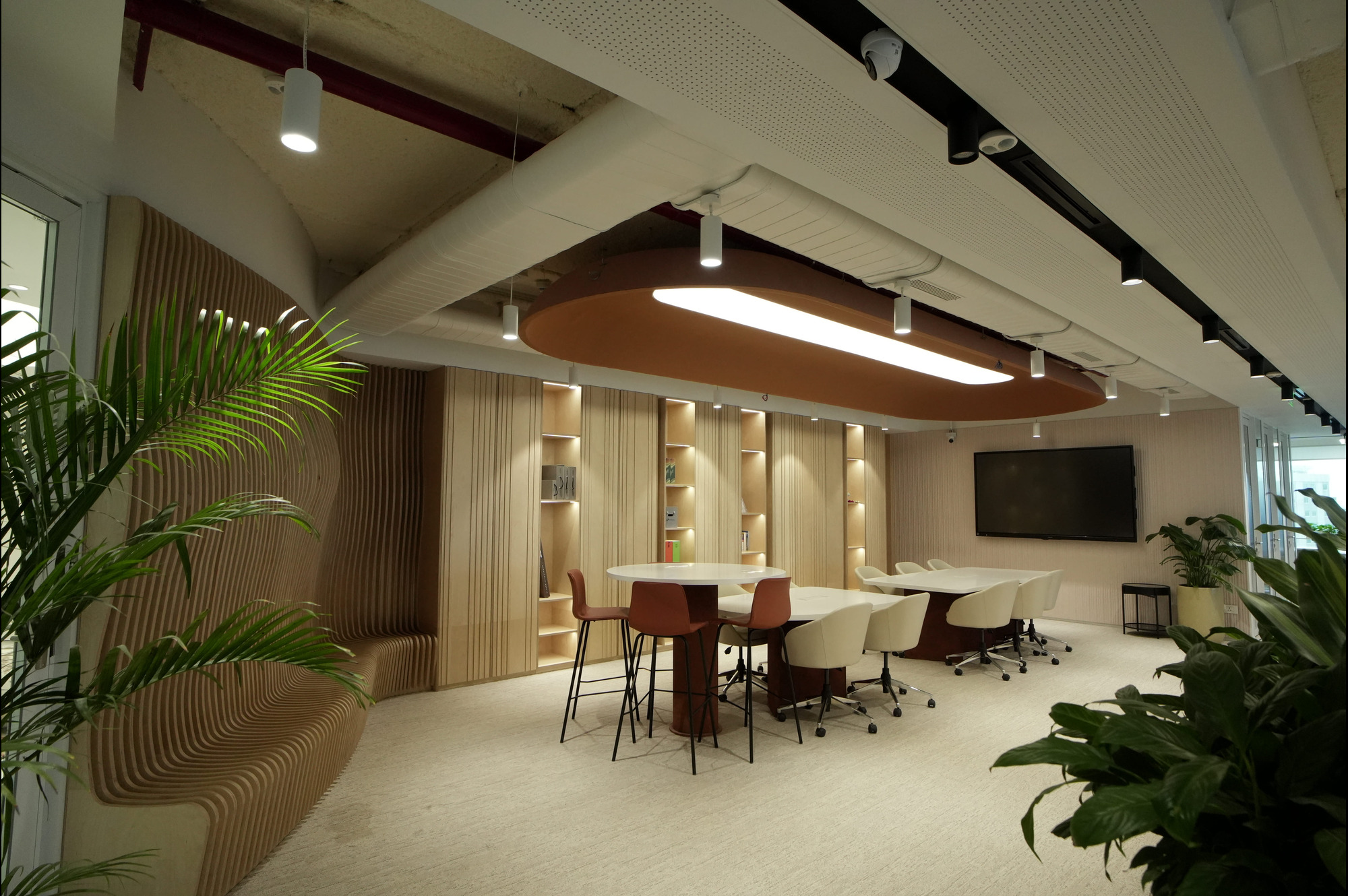
Modern work environments are no longer static office layouts. They are dynamic ecosystems that incorporate collaboration zones, technology-enabled meeting spaces, wellness areas, and adaptable workstations designed for hybrid work models.
Delivering such environments requires close coordination between design teams, engineering specialists, technology consultants, and construction experts.
Under a fragmented delivery structure, integrating these disciplines can become difficult. However, within a Design & Build framework, these elements are considered simultaneously, allowing teams to design spaces that are both aesthetically compelling and technically viable.
This approach is particularly valuable when projects involve advanced infrastructure such as smart workplace technologies, integrated AV systems, or sustainability-driven building requirements.
Speed as a Competitive Advantage
In today’s business environment, speed is often as important as design quality.
Organisations launching new offices, innovation centres, or commercial facilities are operating within highly competitive markets. Delays in project completion can directly impact business operations, employee productivity, and market opportunities.
The Design & Build model enables faster project timelines by allowing design and execution processes to run in parallel rather than sequentially.
Early collaboration also enables procurement strategies, material selection, and construction planning to begin sooner, significantly reducing overall project timelines.
For clients, this means spaces can be operational faster while maintaining high standards of quality and design integrity.
Technology Is Accelerating Integration
The rise of integrated delivery models has also been supported by advances in digital design and construction technologies.
Tools such as Building Information Modelling (BIM), 3D visualisation, virtual walkthroughs, and AI-assisted design workflows allow teams to collaborate more effectively and identify potential challenges before construction begins.
These technologies enable clients to experience and refine their spaces during the design stage itself, reducing uncertainty and enabling faster decision-making.
By combining digital tools with integrated project teams, organisations are able to minimise risk while maintaining precision in execution.
A Shift Towards Accountability
Another important factor driving the adoption of Design & Build models is the growing emphasis on accountability within project delivery.
Clients today expect transparency in timelines, cost management, and quality standards. Integrated delivery models create a clear line of responsibility, ensuring that both design intent and construction outcomes are managed within a single framework.
This accountability strengthens client confidence and helps organisations maintain consistent standards across projects.
As the construction and interiors industry continues to evolve, the Design & Build model is likely to become even more prominent. Increasing project complexity, the need for faster delivery cycles, and the integration of technology and sustainability considerations all require a more collaborative and coordinated approach to project execution.
For organisations developing modern workplaces and commercial environments, integrated delivery is no longer simply an operational choice. It is a strategic approach that enables better alignment between vision, execution, and long-term performance.
Ultimately, the success of any built environment depends not only on how it looks, but on how effectively it supports the people and organisations it is designed for. The Design & Build model provides the structure and collaboration needed to ensure that spaces deliver on both fronts.
Tags