Case Study: Colin Buchanan Supports Economic Stimulus and Urban Development Projects in Downtown Madrid

Using LEGION to Perform Pedestrian Simulation Analysis Ensures Safe, Efficient, and Sustainable Mobility, Reducing the Need for Vehicle Transport
by Prathamesh Gawde, Senior Product Marketing Manager, Bentley Systems
Supporting Modernization of Madrid
To promote urban regeneration, economic growth, and sustainability, the city of Madrid has initiated several development and modernization works. Some of these projects include the renovation of Real Madrid’s stadium, the upgrade and expansion of the adjacent metro station, and the enhancement of the public space Madrid Nuevo Norte along the corridor of the two buildings. The Santiago Bernabéu Stadium works have been completed and, as a result, the stadium is re-emerging as a modern, multipurpose, state-of-the-art facility, with increased seating capacity by approximately 4,000 for a total of 80,000 spectators.
Following the stadium’s recent inauguration, Madrid authorities approved the renovation of the nearby metro station line 10, which shares the same name as the stadium. The station expansion will accommodate the increased influx of passengers traveling to the LaLiga arena. It will also facilitate public transport for those with reduced mobility with the installation of 12 new lifts and 24 escalators, supporting social sustainability initiatives.
Finally, aligned with the city’s economic and sustainability strategies, Madrid Nuevo Norte is a 311-hectare project aimed at enhancing connectivity and pedestrian accessibility and experiences, transforming the area into an innovative urban environment centered on people.
Transport planning and sustainable mobility consultancy Colin Buchanan Consultores (Buchanan) was retained to support Madrid with these three urban regeneration initiatives and the city’s radical shift in mobility strategies by performing predictive analysis and pedestrian simulation to test how designs would perform in terms of people movement and evacuation schemes. “We have developed a unique approach to pedestrian planning projects in urban spaces using Bentley’s pedestrian simulation software LEGION,” said Enrique Huertas, CEO and founder of Buchanan.
Accessibility, Mobility, and Data Integration
Given the short 50-meter distance connecting the stadium and its serving metro station, the ambitious goal to increase station capacity by threefold, and the vast expanse of unused land at Nuevo Norte, each project site from the outset proved complex in nature. The sheer size and scope of the projects presented challenges assessing pedestrian and passenger accessibility and mobility for each of the design concepts. “Never before was a pedestrian simulation analysis performed on a major LaLiga stadium in Spain [nor] used to enhance the user experience of a public space in such a large-scale development as [Nuevo] Norte, placing pedestrian mobility at the core of the design instead of the private vehicle,” said Huertas.
It was clear to Buchanan that a pedestrian digital twin model was crucial, as pressure increased for real-time informed decisions on the performance of the design schemes for each of the three interlinked projects. However, “the data available for the project was of varied nature and origins, and very difficult to articulate in a homogeneous way by all the different actors in charge of the design,” said Huertas. Buchanan realized that the existing pedestrian simulation applications based on social forces models would not provide the level of accuracy required for these schemes. The team needed to eliminate bottlenecks, optimize people flow, identify potential mobility issues prior to construction, and clearly convey to architects, engineers, and urban designers that they must consider pedestrian movement as part of their designs. Therefore, Buchanan sought a collaborative and comprehensive pedestrian modeling and simulation application.
Leveraging LEGION for Pedestrian Simulation
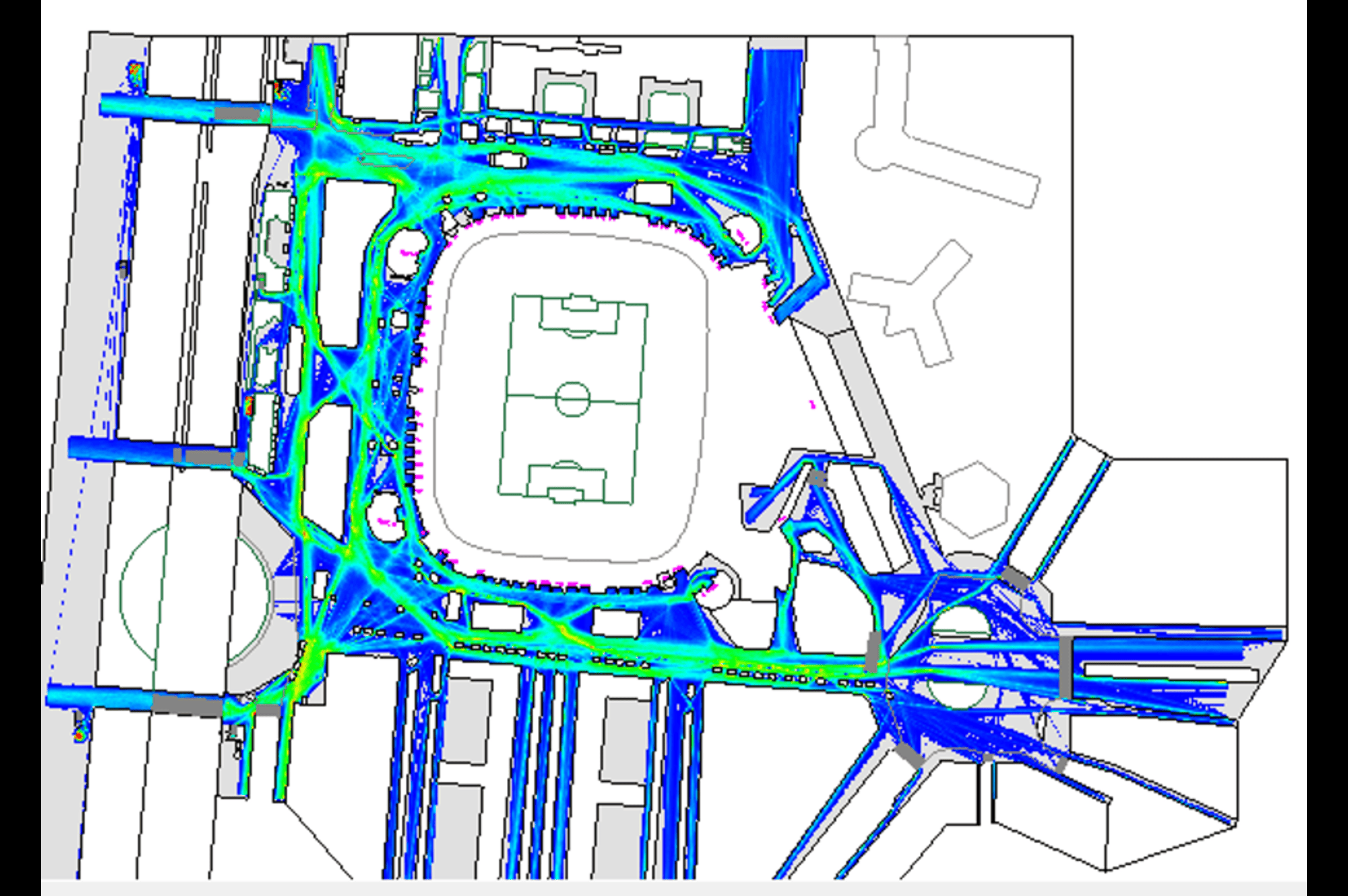
“We decided that LEGION was the most suited [application], and we convinced all three clients — Real Madrid, Madrid Metro, and Madrid Nuevo Norte developers — to use it,” said Huertas. By combining their experience in pedestrian planning for buildings and open space with their extensive knowledge of LEGION, Buchanan presented the clients with the most reliable analysis models for real-time decision making throughout planning, design, and operation stages of each of the projects. Using LEGION, they built digital twins to virtually simulate spectator, passenger, and pedestrian flows, enabling all stakeholders to evaluate and ensure safe mobility and accessibility within the new structures and development.
During the design of the Santiago Bernabéu Stadium, they used the LEGION digital twin to compare the old stadium with proposed designs for the new venue, as well as recommend solutions that would maximize corridor capacity, resolve circulation issues, minimize risks of crushing, and optimize management of the predicted spectator flows. As the stadium was to remain open and host matches throughout construction, Buchanan also helped in simulating temporary pedestrian flows during these works. “We assisted Real Madrid with the production of LEGION simulation models on all phases of the construction stage, advising them how the pedestrian flows would be affected by the site plant and restricted areas,” said Huertas.
Similarly for the metro station, Buchanan used LEGION to create a digital twin model of the existing station to assess how the new station design would perform in terms of managing all the passenger flows predicted for the station, especially on match days. “We were able to advise the operator, Madrid Metro, on the problems that could potentially occur with the new design of the station, recommending mitigation measures derived from the LEGION pedestrian simulation outputs,” said Huertas.
Finally, for the Nuevo Norte scheme along the corridor of the stadium and metro station, Buchanan demonstrated how pedestrian simulation can be used to design large community spaces centered on pedestrian use. Using Bentley’s application, they assessed the dynamic flow analysis of the public area to ensure that pedestrians are placed at the center of the new development, reducing the dependence on cars.
Digital Twins Set Benchmark for Sustainable Urban Regeneration
Using LEGION, Buchanan modeled more than 80,000 football spectators in the Santiago Bernabéu Stadium during ingress, egress, and in the event of emergency where they needed to evacuate the premises in a short period of time. For the metro station, they were able to increase the capacity by three times with their digital twin analysis and simulation. “Finally, with the [Nuevo] Norte next to the stadium, we have been able to reduce the deviation of pedestrian routes along the initial corridor by more than 30%, reducing the need for car usage and enabling walking and cycling across the entire site — all with LEGION simulation,” said Huertas. Working in Bentley’s digital twin and simulation environment not only helped Buchanan ensured safe and efficient mobility on all three projects, it also enhanced the public transport experience and created more pedestrian lines for people to move around a large community area. Both these results reduce the reliance on motor vehicles, thereby decreasing carbon emissions and positively impacting environmental and social sustainability.
Moreover, as placing pedestrians and sustainable mobility at the forefront of a public space in traditionally car-centric cities is gaining importance by the hour, Madrid is serving as a model. “LEGION has enabled us to demonstrate this in the [Nuevo] Norte scheme, as, for the first time, decision-makers are able to see how pedestrian citizens are able to take a positive user experience from using a site that was supposedly designed for them,” said Huertas. Not only will these projects economically, socially, and environmentally benefit the city of Madrid, but their development also offers technological advances that will increase the quality of service, optimize the user experience, and improve efficiency and maintenance. For all these reasons, Madrid’s modernization efforts are set to become a benchmark for urban regeneration and sustainability worldwide.
Tags
Related Posts