When a Budget Becomes a Destiny

by Tejasvi Sharma, Editor-in-Chief, EPC World
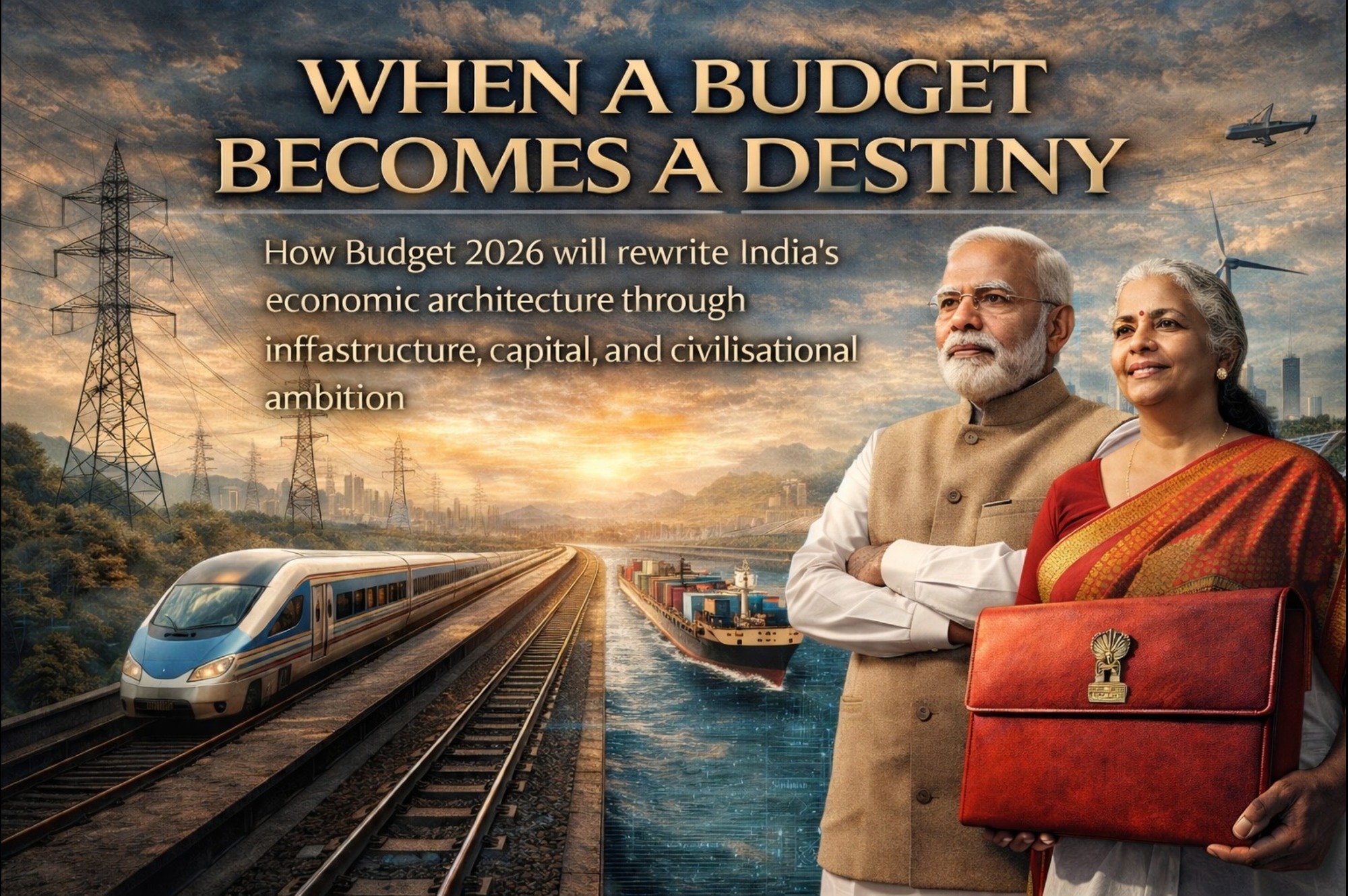
How Budget 2026 will rewrite India’s economic architecture through infrastructure, capital, and civilisational ambition
From public capex and logistics corridors to energy grids and urban resilience, India’s fiscal strategy is no longer about spending – it is about statecraft. Viksit Bharat 2047 begins with a blueprint, not a balance sheet.
As the Union Budget 2026 approaches, India stands at a rare historical confluence where aspiration, capacity, and capital are no longer misaligned. The fiscal discourse is no longer about incremental allocations; it is about civilisational engineering. Infrastructure today is not merely a sector – it is the grammar of governance, the syntax through which economic intent is translated into spatial reality. Roads, rail, power, ports, digital networks, water systems, and urban mobility have become the primary instruments of statecraft.
The Viksit Bharat 2047 vision has redefined the budgetary imagination. Public finance is no longer framed as expenditure but as productive capital deployment, where every rupee invested must generate velocity – of goods, people, data, energy, and opportunity. The state is repositioning itself not as a contractor, but as a platform builder, enabling private capital, institutional finance, and global investors to co-create national assets.
At the heart of Budget 2026 expectations lies public capital investment (capex) as the macroeconomic stabiliser. India has crossed the psychological threshold where infrastructure spending is seen as anti-cyclical ballast rather than fiscal burden. High capex is now treated as a growth multiplier, crowding in private investment, strengthening EPC balance sheets, formalising employment, and accelerating supply-chain integration. National frameworks such as the National Infrastructure Pipeline, PM Gati Shakti, logistics master planning, and mission-mode sectoral programmes have transformed planning from departmental silos into systems orchestration.
The next phase of economic policy is clearly shifting from asset creation to asset productivity. Logistics corridors will no longer be measured merely in kilometres but in cost compression, time efficiency, and reliability indices. The ambition of reducing logistics costs to 8–9% of GDP is not a technical target – it is a geopolitical strategy, positioning India as a competitive manufacturing and export platform. Multi-modal logistics parks, Dedicated Freight Corridors, port-led industrial clusters, inland waterways, and coastal shipping are converging into a continental trade architecture, where infrastructure itself becomes India’s comparative advantage.
Urban essentials are also moving to the centre of fiscal strategy. Water security, waste management, affordable housing, metro systems, drainage networks, and climate resilience are no longer municipal responsibilities – they are macroeconomic stability variables. Smart cities are giving way to resilient cities, where flood management, heat mitigation, decentralised energy, circular waste systems, and digital service delivery define liveability. Budget 2026 is expected to institutionalise this transition by embedding climate adaptation, resilience financing, and sustainability metrics into urban development policy.
Energy policy remains the spinal column of economic strategy. Transmission expansion, renewable evacuation, green hydrogen corridors, storage ecosystems, and grid digitalisation are not environmental narratives – they are industrial policy in disguise. Power is no longer an input; it is a sovereign enabler of manufacturing, data centres, electric mobility, AI infrastructure, and urban growth. The grid itself is evolving into a strategic national asset, as vital as highways or ports.
Simultaneously, digital public infrastructure (DPI) is beginning to fuse with physical infrastructure. Digital twins, BIM platforms, AI-driven asset management, smart grids, and predictive maintenance systems are transforming EPC into cyber-physical engineering. Budgetary discourse is shifting subtly from steel and cement to algorithms, analytics, and automation, where infrastructure is designed not only to stand, but to think, learn, and optimise.
Financial architecture is also undergoing quiet but profound reform. Infrastructure financing is transitioning from short-term bank exposure to long-duration institutional capital – pension funds, insurance pools, sovereign funds, green bonds, infrastructure investment trusts, and asset monetisation frameworks. India is moving toward a capital recycling economy, where mature assets fund new ones without fiscal overstretch, creating a self-reinforcing investment cycle.
What Indian Infrastructure Expects from the Finance Minister
From the perspective of India’s infrastructure ecosystem – EPC contractors, developers, financiers, OEMs, consultants, and institutional investors – the expectations from the Hon’ble Finance Minister in Budget 2026 are now clear and strategic, not transactional.
First, the sector expects capex continuity with predictability. Not just higher allocations, but multi-year visibility, rolling project pipelines, and funding certainty that allows long-term planning, equipment investment, and skill development.
Second, infrastructure expects policy stability and regulatory clarity. Faster approvals, harmonised land acquisition frameworks, time-bound clearances, and dispute-resolution mechanisms that reduce litigation risk and unlock stalled capital.
Third, the industry looks for deep financing reforms – credit enhancement mechanisms, blended finance structures, viability gap funding modernisation, green finance taxonomies, and long-tenure debt instruments that align project life cycles with capital structures.
Fourth, there is a strong expectation of logistics-first budgeting – where corridors, nodes, ports, rail, roads, and warehouses are treated as one integrated economic system, not as fragmented departments.
Fifth, the sector seeks urban infrastructure as a fiscal priority, not residual spending – dedicated urban infra bonds, municipal finance reforms, climate-resilient city funding, and transit-oriented development frameworks.
Sixth, infrastructure expects energy storage and grid investments to be treated as strategic national security assets, with accelerated funding for pumped storage, transmission corridors, and RE evacuation networks.
Seventh, the ecosystem looks for PPP 2.0 frameworks – balanced risk-sharing, bankable concession models, and transparent monetisation structures that attract sovereign and pension capital.
And finally, the industry expects the budget to recognise infrastructure not merely as construction, but as economic architecture – the foundation of productivity, inclusion, competitiveness, and resilience.
The philosophical shift is now unmistakable: infrastructure is no longer a physical deliverable; it is a national operating system. It governs mobility, productivity, inclusion, resilience, and sovereignty. In this framework, Budget 2026 is not merely a financial document – it is a strategic manuscript, scripting how India moves, trades, consumes, builds, and competes.
Viksit Bharat 2047 is not a slogan – it is a systems doctrine. It demands infrastructure that is scalable, sustainable, digitally integrated, financially viable, and socially equitable. It requires cities that function as economic engines, grids that function as climate buffers, and logistics networks that function as trade multipliers.
As India approaches this fiscal moment, the question is no longer whether infrastructure will remain central to economic strategy – it is whether the nation can now elevate infrastructure from construction to cognition, from projects to platforms, from assets to ecosystems.
Budget 2026 will not be remembered for line items. It will be remembered for direction.
Because when a nation aligns its fiscal policy with its civilisational vision, infrastructure ceases to be expenditure – it becomes destiny in motion.
Tags
Related Posts