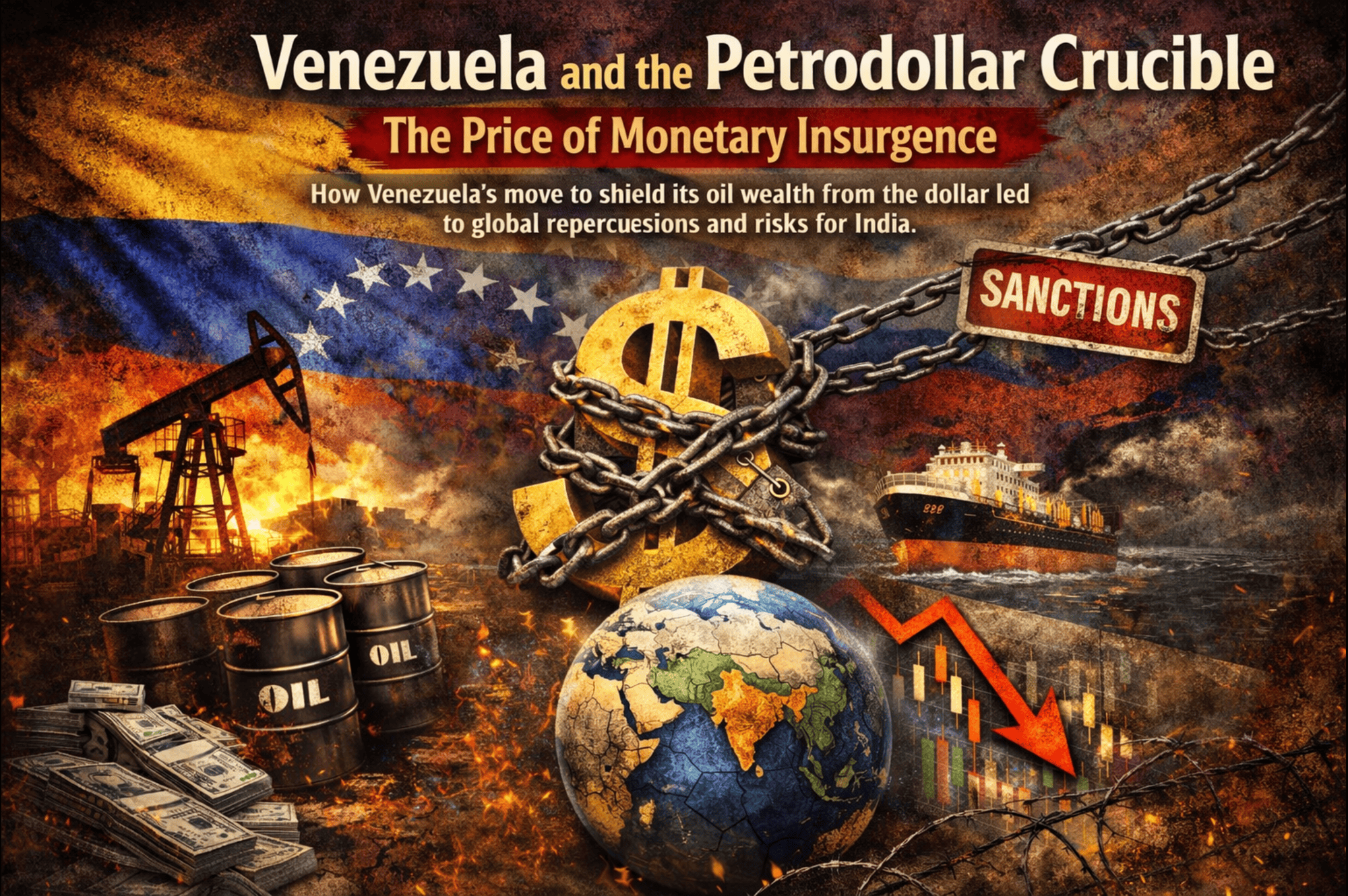
Venezuela and the Petrodollar Crucible: The Price of Monetary Insurgence

by Tejasvi Sharma, Chief Editor, EPC World Media Group
An economic pariahdom engineered through sanctions and stratagems — was Venezuela targeted for shielding its petroleum sovereignty from the petrodollar’s centripetal dominion? Global reverberations, diplomatic realignments, and India’s looming energy-infrastructure vulnerabilities
The lexicon of war has mutated. The age of conventional invasion has ceded primacy to an era of geo-economic siegecraft, where sanctions eclipse soldiers and credit blockades supersede cruise missiles. Within this arena, Venezuela has stood besieged—not by kinetic combat, but by a sophisticated campaign of financial ostracization, diplomatic delegitimization, and monetary coercion. To apprehend the logic of Venezuela’s targeting, one must first decode the unspoken scaffolding of global energy finance: the petrodollar system—a fiscal lattice wherein crude oil, the world’s most indispensable commodity, is transacted in U.S. dollars, perpetuating unparalleled American monetary hegemony.
The Petrodollar Edifice: A System Above Sovereignty
Instituted in the 1970s through an informal entente between the United States and Saudi Arabia, the petrodollar system evolved into the global reserve currency engine, ensuring that oil-exporting nations recycled their dollar earnings into U.S. treasury instruments, cementing the dollar’s supremacy. The system is not merely transactional—it is existential to American economic omnipotence. It confers the U.S. unfettered control over global liquidity, sanctions leverage over dissidents, and a coercive advantage in energy geopolitics. When oil becomes currency, currency becomes power—and power seldom tolerates insurgence.
Venezuela’s Defiance: The Crime Was Not Oil, But the Currency of Oil
Venezuela is endowed with the largest proven oil reserves on Earth. Yet, abundance alone does not provoke retribution; defiance does. Under Hugo Chávez, and later Nicolás Maduro, Venezuela began probing alternatives to the dollar for oil settlements. These included:
• Yuan-based oil trade agreements with China
• Energy-for-infrastructure barter mechanisms
• The introduction of “Petro,” a cryptocurrency ostensibly backed by oil reserves
Although Petro faltered operationally, its symbolism was incendiary: a nation attempting to repatriate control over oil revenue away from dollar dependence. This was construed not as economic experimentation, but as monetary mutiny.
The U.S. retaliated not with open warfare, but with economic asphyxiation:
• Freezing Venezuela’s foreign assets
• Expelling it from dollar-based banking rails
• Crippling its oil export monetization channels
The attack was not territorial—it was systemic, targeting Venezuela’s ability to transact, borrow, or legitimize itself within the global energy economy.
Global Reactions: A Theatre of Strategic Calculus
United States and NATO Allies
They framed sanctions under a moral patina: restoration of democracy, anti-corruption mandates, and human rights advocacy. Yet beneath this rhetoric lay a clear message: the petrodollar is non-negotiable, and alternatives will be throttled.
China
China absorbed Venezuelan crude under long-term supply contracts, settled energy imports in yuan, and extended infrastructure financing despite Western sanctions. Beijing’s reaction was not sympathetic—it was strategic: securing influence in Latin America, ensuring energy security, and promoting BRICS-aligned currency multipolarism.
Russia
Moscow vociferously condemned Western sanctions, expanded defense cooperation, and positioned Venezuela as a victim of American economic imperialism. This too was strategy—bolstering its anti-dollar energy diplomacy axis.
BRICS Bloc
While India, Brazil, and South Africa issued rhetorical support for multipolar trade, they avoided explicit confrontation. Their reaction was pragmatic hedging, not alliance-defiance.
United Nations
The UN espoused its perennial creed: dialogue, diplomacy, and peaceful resolution, refusing to anoint blame.
This global choreography revealed a cardinal truth: nations did not react to Venezuela—they reacted to the petrodollar’s fragility being exposed.
India’s Vector: Energy, Infrastructure, and the Shadow of Currency Fragmentation
India was not a combatant in Venezuela’s crisis, but it is a collateral stakeholder in the system the crisis imperiled.
Energy Vulnerability
India imports >85% of its crude oil, all traditionally settled in dollars. Any systemic erosion of the petrodollar would mean:
• Higher transaction friction
• Pricing volatility
• Pressure to adopt alternative settlement currencies
Infrastructure Cost Sensitivity
India’s marquee programs—PM Gati Shakti, Bharatmala highways, port expansion, airports (NMIA, Guwahati, etc), and 500 GW renewable energy targets—are energy-intensive. If oil prices spike or dollar liquidity constricts, India will see:
• Escalating EPC project costs
• Higher logistics and aviation fuel inflation
• Reduced competitiveness of infrastructure bonds
• Investor hesitancy in manufacturing FDI
Strategic Response: Rupee Energy Diplomacy
India has already begun experimenting with:
• Rupee oil settlement with Russia
• Local currency energy trade with UAE
The Venezuela episode will accelerate this necessity, compelling India to expand rupee-based energy diplomacy without overtly provoking the dollar system.
World Implications for India: Near Future Scenarios
1. Inflationary Oil Shock
Sanctions on oil nations or market fragmentation could spike crude prices, raising costs across transport, manufacturing, construction, and airport operations.
2. Currency Diversification Pressure
India may need to:
• Expand rupee settlement agreements
• Hedge energy imports through non-dollar trade pacts
• Strengthen forex buffers against oil volatility
3. Impact on FDI
Stable currency markets attract capital. India’s ability to de-risk energy currency exposure will influence manufacturing FDI, infra bonds, and investor confidence.
4. Infrastructure Sector Strain
Higher energy costs will affect:
• HAM model road developers
• Airports
• Ports and logistics
• Construction material pricing
Epilogue: The Lesson is Larger Than Venezuela
Venezuela was not attacked for possessing oil, but for attempting to protect oil revenue from dollar dominion, inadvertently exposing the fragility of the petrodollar world order. The global reactions were less moral and more strategic, each nation choreographing influence while India observed the structural risks now poised to encroach upon its own energy-infrastructure ecosystem.
For India, the crisis is a cautionary prelude. In a world where currency is weaponized and oil is the fulcrum of global power, India must pursue strategic autonomy through local currency diplomacy, hedged infrastructure financing, and inflation-resilient energy strategy—a geopolitical ballet more intricate than war, but no less precarious.
Tags
Related Posts