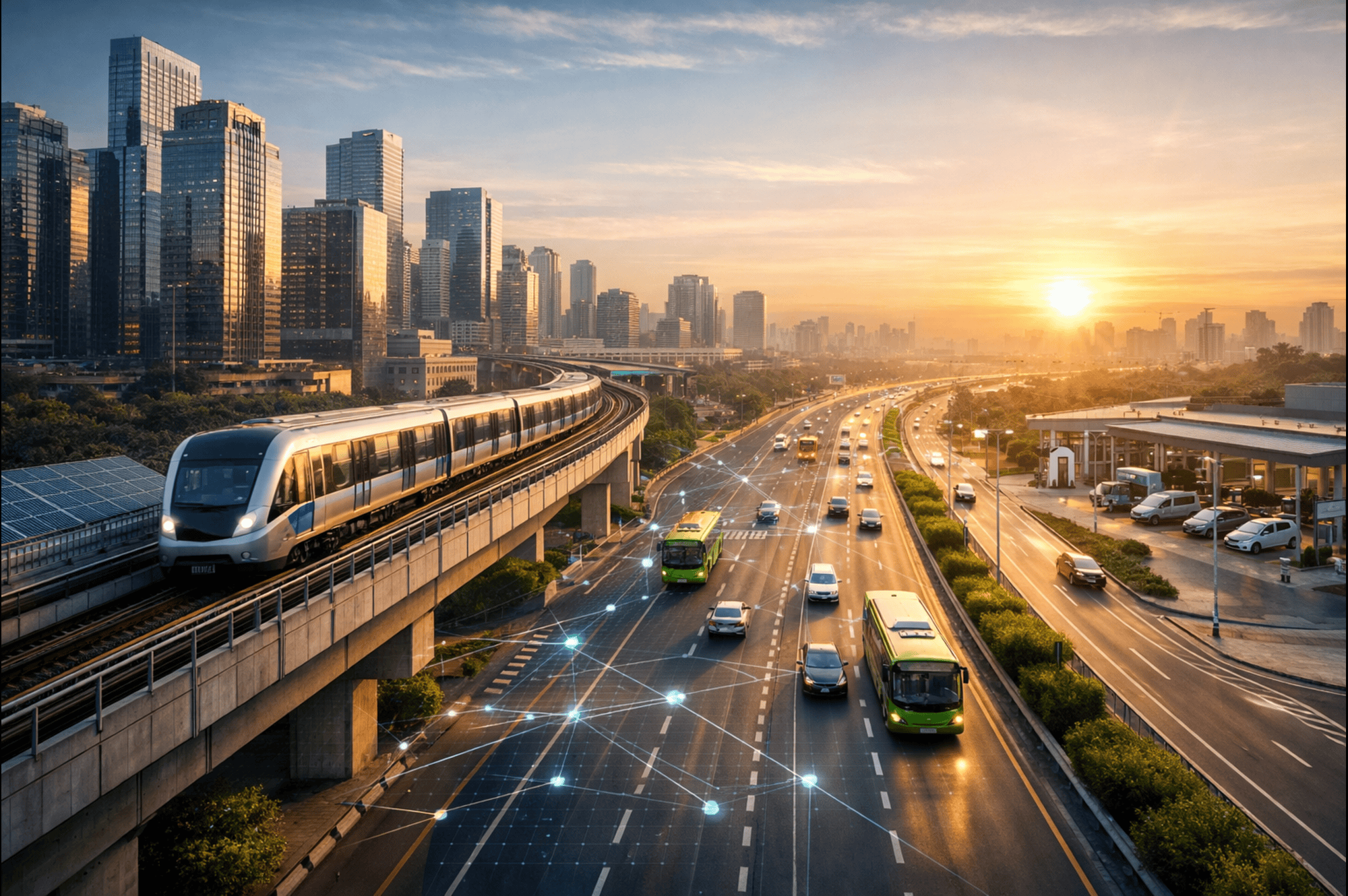
Urban Mobility: Steering India’s Urban Dynamics

As India’s cities surge ahead as engines of growth, visionary leadership is shaping urban dynamics and accelerating the nation’s momentum—redefining infrastructure, governance, and economic opportunity for a more connected, competitive future. In this compelling cover story, Tejasvi Sharma, Editor-in-Chief, explores how such transformative leadership is reshaping India’s urban landscape and driving a stronger, more competitive tomorrow
India’s cities are growing at a breath-taking pace, transforming into hubs of commerce, innovation, and opportunity. At the heart of this transformation lies urban mobility—the invisible network that keeps economic activity in motion. Efficient transport systems reduce travel time, lower logistics costs, improve workforce participation, and connect markets seamlessly. As urban centers contribute an increasing share to the nation’s GDP, the relationship between urban development and mobility has become deeply intertwined, shaping productivity, competitiveness, and quality of life.
The Urban Development and Mobility Nexus reflects more than infrastructure planning; it represents a strategic vision for sustainable growth. From integrated public transport and transit-oriented development to digital traffic management and green mobility solutions, the way cities design movement determines their economic resilience. When mobility is inclusive, affordable, and environmentally responsible, it not only accelerates business growth but also strengthens social equity. In India’s journey toward becoming a global economic powerhouse, smart urban mobility stands as a cornerstone of progress.
At the policy helm of India’s urban transformation stands the Ministry of Housing and Urban Affairs, which has steadily repositioned mobility as a catalyst for economic acceleration. By framing transport as an integrated component of urban planning rather than a standalone utility, the Ministry has encouraged cities to adopt comprehensive mobility plans, transit-oriented development models, and sustainable transport benchmarks. National initiatives such as the Smart Cities Mission and AMRUT have reinforced this direction, linking infrastructure funding with measurable improvements in connectivity, efficiency, and environmental performance.
Equally significant is the Ministry’s role as an enabler of institutional reform and innovation. Through standardized urban transport guidelines, viability gap funding, and support for metro rail, bus rapid transit, and electric mobility projects, it has strengthened the financial and technical capacity of states and urban local bodies. By fostering collaboration between government agencies, private stakeholders, and technology providers, the Ministry is shaping a mobility ecosystem that is not only modern and multimodal but also inclusive and resilient—ensuring that India’s urban growth story remains economically dynamic and globally competitive.
Transformative Leadership Driving India’s Urban Mobility Renaissance
“Great leadership is not about commanding change—it is about enabling transformation with vision, integrity, and decisive action.”
This philosophy resonates strongly with the leadership approach of Shri Manohar Lal, Union Minister of Housing and Urban Affairs, whose tenure has brought renewed momentum to India’s urban mobility mission. With a focus on disciplined governance and time-bound implementation, he has strengthened the strategic alignment between urban infrastructure expansion and economic growth. Recognizing that mobility forms the backbone of productive cities, his leadership has emphasized accelerating approvals, streamlining inter-ministerial coordination, and ensuring that projects move from blueprint to reality without bureaucratic inertia.
A defining feature of his stewardship has been the expansion and modernization of metro rail systems across both established metropolitan centers and rapidly growing Tier II cities. By prioritizing multimodal integration—linking metro corridors with city buses, suburban rail networks, and last-mile connectivity—he has advanced the vision of seamless urban transit. Integrated ticketing systems, digital fare platforms, and commuter-friendly infrastructure upgrades have enhanced accessibility while improving operational efficiency. These initiatives directly contribute to reducing congestion, saving travel time, and boosting economic productivity.
Sustainability has been another cornerstone of his agenda. Under his guidance, the Ministry has intensified efforts to expand electric bus fleets, strengthen charging infrastructure, and promote clean mobility solutions. The scaling up of Intelligent Transport Systems (ITS), GPS-enabled public transport tracking, and centralized command-and-control centers reflects a decisive move toward data-driven urban transport governance. Such measures not only improve commuter convenience but also support environmental goals by reducing emissions and enhancing air quality in densely populated cities.
Shri Khattar has also championed transit-oriented development (TOD) to ensure that mobility infrastructure catalyses holistic urban growth. By encouraging compact, mixed-use development along transit corridors, the Ministry has worked to maximize infrastructure returns while fostering vibrant, walkable communities. Innovative financing frameworks, enhanced public-private partnerships, and structured funding models have further enabled cities to undertake ambitious mobility projects while maintaining fiscal prudence.
Through this multi-layered strategy—combining infrastructure expansion, digital modernization, environmental sustainability, and institutional reform—his leadership reflects a clear understanding that mobility is central to India’s urban and economic future. The result is a more integrated, resilient, and forward-looking urban transport ecosystem, designed not only to meet present demands but to power the nation’s long-term growth trajectory.
Setting Benchmarks
The Ministry’s key initiatives in urban mobility reflect a calibrated strategy that blends infrastructure expansion with financial innovation and industrial policy. At the forefront is the Smart Cities Mission, which integrates mobility planning with digital governance, intelligent traffic systems, and data-driven infrastructure management. By embedding transport modernization within broader urban transformation plans, the Mission has enabled cities to deploy integrated command-and-control centers, smart signalling systems, and technology-enabled public transport solutions.
Complementing this effort is the AMRUT, which has strengthened foundational urban infrastructure, ensuring that mobility advancements are supported by improved civic services and planned urban expansion. The Ministry’s sustained backing of metro rail projects across major and emerging cities has significantly expanded mass transit capacity, easing congestion while improving economic connectivity. Simultaneously, the scaled deployment of electric buses and the promotion of clean mobility frameworks have accelerated India’s transition toward environmentally responsible public transport systems.
Another such initiative that grabs attention in the forefront is the PM-eBus Sewa scheme, conceived to significantly augment city bus services through large-scale induction of electric buses. Designed to improve operational efficiency while reducing urban emissions, the scheme strengthens public transport capacity in high-demand cities. Complementing this is the introduction of the Payment Security Mechanism (PSM) for e-bus operators—an institutional framework that safeguards timely payments, lowers financial risk for private operators, and enhances long-term investor confidence in electric mobility projects.
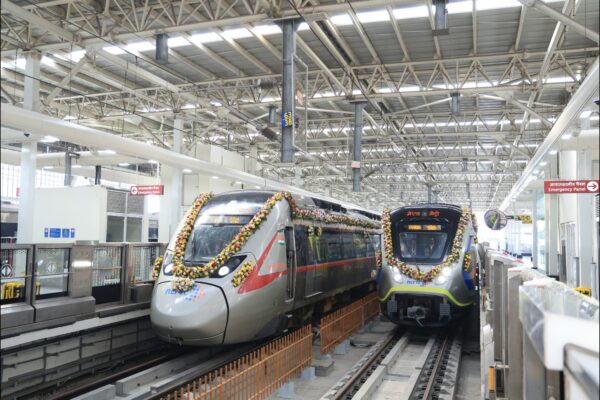
Beyond fleet electrification, the Ministry’s city-level allocations for projects such as the expansion of Pune Metro, the East–West corridor of Lucknow Metro, and the commissioning of the Regional Rapid Transit System by National Capital Region Transport Corporation underscore a broader commitment to sustained infrastructure creation. These allocations are not merely fiscal provisions—they serve as powerful signals to markets, original equipment manufacturers (OEMs), and engineering, procurement, and construction (EPC) firms that India’s urban mobility pipeline is durable, structured, and investment-ready. Such predictability encourages capital deployment, technological partnerships, and long-term capacity building across the ecosystem.
Further reinforcing this transformation is the synergy between the FAME II incentive framework and the Make in India localization agenda. By leveraging the procurement scale of the Ministry of Housing and Urban Affairs, the government is catalyzing domestic manufacturing of electric buses, advanced battery systems, and intelligent transport technologies. This convergence of civil infrastructure, electro-mobility, and digital innovation is fostering a national mobility-industrial complex—where urban transport development fuels industrial growth, technological sophistication, and employment generation.
Together, these initiatives represent a cohesive and forward-looking mobility strategy—positioning India’s cities not only as centers of movement, but as engines of sustainable economic transformation.
Integrating Intelligent Mobility
As India advances into a new era of urban transformation, the emphasis is progressively shifting from infrastructure expansion to intelligence integration. The Ministry of Housing and Urban Affairs has demonstrated a clear commitment to embedding technology, analytics, and system integration into the core of urban transport planning. The future of mobility will be defined not merely by kilometres of metro rail laid or buses deployed, but by AI-enabled headway optimization, predictive maintenance systems, corridor-level digital twins, and grid-responsive electric charging depots. Through policy guidance and digital governance frameworks, the Ministry is encouraging cities to transition from static capacity creation to adaptive, data-driven service delivery.
Centralized command-and-control centres established under urban transformation programs are evolving into mobility intelligence hubs—capable of monitoring traffic flows, optimizing signal timings, and integrating multimodal data streams in real time. The Ministry’s push for interoperable ticketing systems, integrated urban transport policies, and digital mobility platforms reflects a structural shift toward seamless commuter experience. These initiatives underscore a broader vision: mobility networks that are responsive, efficient, and resilient to future urban pressures.
A key dimension of this forward-looking strategy lies in regional integration. Inspired by the implementation of high-speed corridors by the National Capital Region Transport Corporation, the Ministry has articulated the expansion of RRTS-like systems beyond the National Capital Region. This signals a transformative shift—from city-centric transit to region-wide mobility grids that connect economic clusters across districts and states. By dissolving municipal silos and enabling fluid labour movement, such systems can reshape urban geography into interconnected labour-market regions.
This vision positions mobility as economic architecture rather than standalone infrastructure. Through sustained investments, technological integration, and long-term policy commitment, the Ministry is laying the groundwork for a decade where intelligence-driven, regionally networked transport systems power productivity, reduce spatial inequalities, and redefine how India’s urban economy organizes itself for growth.
Persistent Gaps
Despite unprecedented investment and policy momentum, critical structural gaps continue to challenge the effectiveness of urban mobility systems. Many cities still struggle with inadequate last-mile connectivity—metros and high-capacity corridors often operate without seamless feeder services, safe pedestrian pathways, or reliable micro-mobility options, leaving transit networks functionally incomplete. The commuter’s journey, therefore, remains fragmented rather than truly end-to-end.
Equally concerning is institutional fragmentation. Overlapping mandates among multiple agencies dilute accountability, slowing decision-making and weakening coordinated planning. Added to this is municipal fiscal fragility—without dedicated Urban Transport Funds and predictable revenue mechanisms, sustaining operational excellence becomes difficult. The revival of Unified Metropolitan Transport Authorities (UMTAs) and the establishment of ring-fenced urban transport funds in progressive states are thus not administrative formalities, but essential reforms to restore coherence, financial stability, and long-term efficiency to India’s mobility ecosystem.
Towards a Cohesive Mobility Future
While structural gaps persist, the direction of reform signals confidence rather than constraint. The Ministry of Housing and Urban Affairs has acknowledged these systemic challenges and is steadily working to address them through institutional strengthening, integrated planning frameworks, and financial innovation. Efforts to revive Unified Metropolitan Transport Authorities (UMTAs), promote dedicated Urban Transport Funds, and institutionalize multimodal planning standards reflect a conscious move toward governance coherence and long-term sustainability.
Under the leadership of Shri Manohar Lal Khattar, the vision extends beyond correcting deficits—it aspires to reimagine mobility as a unifying economic force. By prioritizing last-mile connectivity, reinforcing fiscal mechanisms, and fostering collaboration across agencies, the Ministry is laying the groundwork for resilient and accountable urban transport systems. The emphasis on technology integration, regional connectivity, and industrial synergy further demonstrates a commitment to overcoming fragmentation through structured, future-ready reforms.
In this evolving landscape, mobility is no longer viewed as a standalone service but as a catalyst for inclusive development, productivity, and regional balance. With decisive leadership and a clear strategic roadmap, India’s urban mobility framework is poised not only to bridge existing gaps but to surpass them—driving cities toward smarter governance, stronger economies, and a more connected national future.
Tags