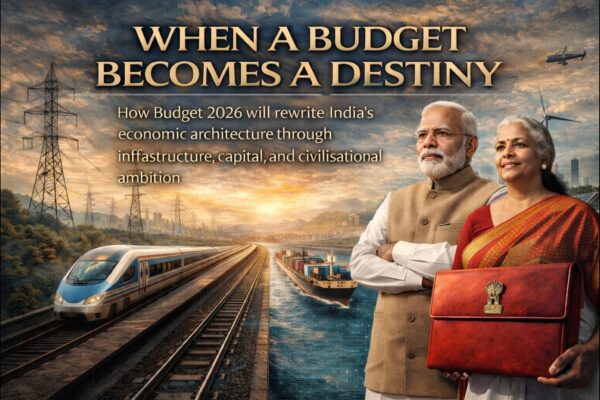

The Great Indian Infra Gold Rush: Why Trillions in Private Capital are Rewriting the Nation’s Growth Story

by Tejasvi Sharma, Editor-in-Chief, EPC World
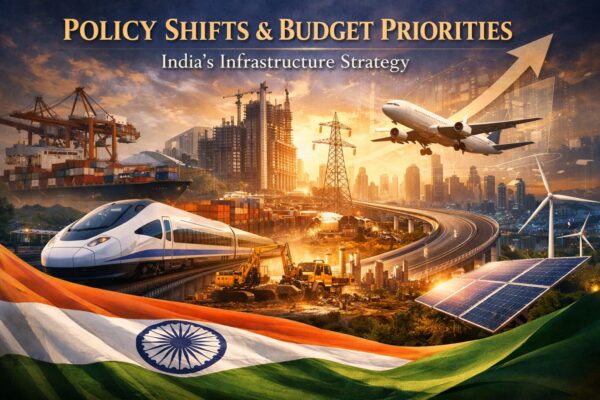
India is in the throes of a tectonic reconfiguration – an infrastructural renaissance that is no longer confined to the asphalt arteries of highways or the steel sinews of railways. A more variegated, capital-hungry, and technologically inflected opportunity set is unfurling across digital infrastructure, renewable energy, ports, logistics, urban utilities, and industrial corridors. What was once the exclusive preserve of public capex has matured into a sophisticated investment ecosystem, luring global sovereign funds, pension pools, infrastructure funds, and strategic corporates into a long-horizon wager on India’s growth.
At the heart of this metamorphosis lies a simple arithmetic: India’s ascent to a $5–7 trillion economy is mathematically impossible without an exponential expansion in infrastructure investment. The National Infrastructure Pipeline (NIP), PM Gati Shakti, asset monetisation frameworks, and the deepening architecture of PPPs and InvITs have together recalibrated the risk-return calculus. The result is a widening aperture for private capital participation in India’s infrastructure market—beyond highways into renewable energy, digital infrastructure, data centres, ports, airports, logistics parks, water, waste-to-energy, and EV charging networks.
From Roads to Routers: The New Geography of Infrastructure Capital
The canonical image of Indian infrastructure – toll roads and EPC contracts – has yielded to a more polymorphic reality. Digital infrastructure has emerged as a frontline asset class. Data centres, fibre backbones, 5G densification, cloud interconnects, and edge computing nodes are fast becoming the invisible scaffolding of India’s digital public goods architecture. As UPI-scale transactionality converges with AI-driven compute demand, the data centre economy is attracting patient capital seeking annuity-like yields anchored in long-term hyperscaler contracts.
Parallelly, renewable energy investment in India has graduated from a capacity-addition narrative to a systems transition thesis. Solar and wind are now being complemented by grid-scale energy storage, green hydrogen, offshore wind, pumped hydro, and hybrid RE-RE-storage projects. The opportunity is no longer episodic; it is infrastructural in the deepest sense – transmission corridors, green energy corridors, and smart grids that render electrons as tradable as commodities. For investors, the appeal lies in contracted cash flows, sovereign offtake guarantees, and the optionality embedded in the hydrogen economy as India positions itself as a manufacturing and export hub.
Then there are ports and logistics, the maritime and terrestrial gateways of trade competitiveness. India’s coastline, long under-leveraged, is being reimagined through port-led development, multimodal logistics parks, coastal shipping, and hinterland connectivity. Private terminal operators, logistics platform companies, and warehousing majors are orchestrating an asset-heavy expansion that collapses dwell times and logistics costs – an efficiency dividend that translates directly into margin accretion for Indian manufacturing. The confluence of ports, industrial corridors, and freight rail under PM Gati Shakti is turning connectivity into a balance-sheet asset.
The Architecture of Investability: PPPs, InvITs, and Asset Recycling
The renaissance in infrastructure investment opportunities in India is not merely thematic; it is institutional. Public–Private Partnerships (PPPs) have matured from concession-heavy experiments to risk-calibrated collaborations with refined dispute resolution, model concession agreements, and viability gap funding. Infrastructure Investment Trusts (InvITs) and REITs have unlocked secondary market liquidity, enabling developers to recycle capital while offering yield-seeking investors access to de-risked operating assets. Asset monetisation pipelines – across highways, transmission lines, and airports—have converted brownfield stability into greenfield growth capital.
Crucially, the ecosystem is learning to price risk with greater sobriety. Long-duration capital is increasingly underwriting not just construction risk but lifecycle performance risk, ESG compliance, and resilience metrics. The era of reckless bidding is giving way to disciplined underwriting, covenant-lite financing structures, and blended finance instruments that crowd in development finance institutions alongside private equity and infrastructure funds.
Urban India: The Next Frontier of Bankable Assets
India’s cities – congested, under-served, yet irrepressibly aspirational – represent a colossal investable frontier. Urban infrastructure investment in mass transit, water and wastewater, waste-to-energy, district cooling, affordable housing, and smart city platforms is transitioning from municipal grant-dependence to project-financed, user-charge backed models. As municipal finance reforms deepen and credit enhancements proliferate, urban utilities are inching toward bankability. The prize is not merely financial; it is civilisational -unlocking productivity by civilising urban metabolism.
The EV charging ecosystem, too, is quietly accreting scale. What began as pilot corridors is evolving into networked charging infrastructure integrated with renewable energy and grid services. For investors, the EV stack offers a portfolio of asset types – fast chargers, battery swapping, fleet depots – each with distinct utilisation curves and monetisation pathways.
The ESG Inflection: Capital with a Conscience
The narrative of infrastructure investment in India is now inextricable from ESG and climate resilience. Green bonds, sustainability-linked loans, and blended finance vehicles are channelling capital into climate-smart infrastructure – flood-resilient urban drainage, coastal protection, resilient power grids, and low-carbon mobility. Investors are underwriting not just IRR but impact-adjusted returns, cognisant that resilience is the new alpha in an era of climatic volatility.
Risks, Realism, and the Long View
To be sure, the opportunity set is not frictionless. Land acquisition complexities, regulatory latency, counterparty risk, and contractual sanctity remain perennial anxieties. Yet, the arc of reform – digitised approvals, single-window clearances, dispute resolution mechanisms, and model frameworks – has begun to compress uncertainty. What distinguishes this moment is not the absence of risk, but the presence of credible pathways to mitigate it.
India’s infrastructure market today offers something rare: scale without saturation, growth without demographic fragility, and returns without terminal obsolescence. The canvas is continental, the pipeline is multi-decadal, and the political economy of infrastructure has acquired a reformist cadence. For private capital – domestic and global – the wager on India is no longer speculative; it is structural.
The Closing Thesis: Infrastructure as India’s New Asset Class
The great Indian infrastructure story is being rewritten as a multi-asset, multi-decade investment opportunity – from highways to hyperscale data centres, from solar parks to smart ports, from transmission corridors to urban utilities. As private capital migrates beyond conventional roads into digital infrastructure, renewable energy, and ports, India is not merely building assets; it is constructing the economic grammar of its future.
In this epochal realignment, infrastructure is no longer a fiscal line item. It is India’s new asset class – a compounding engine of productivity, competitiveness, and sovereign capability. Those who recognise the inflection early will not merely finance India’s growth; they will co-author it.
Tags
Related Posts