
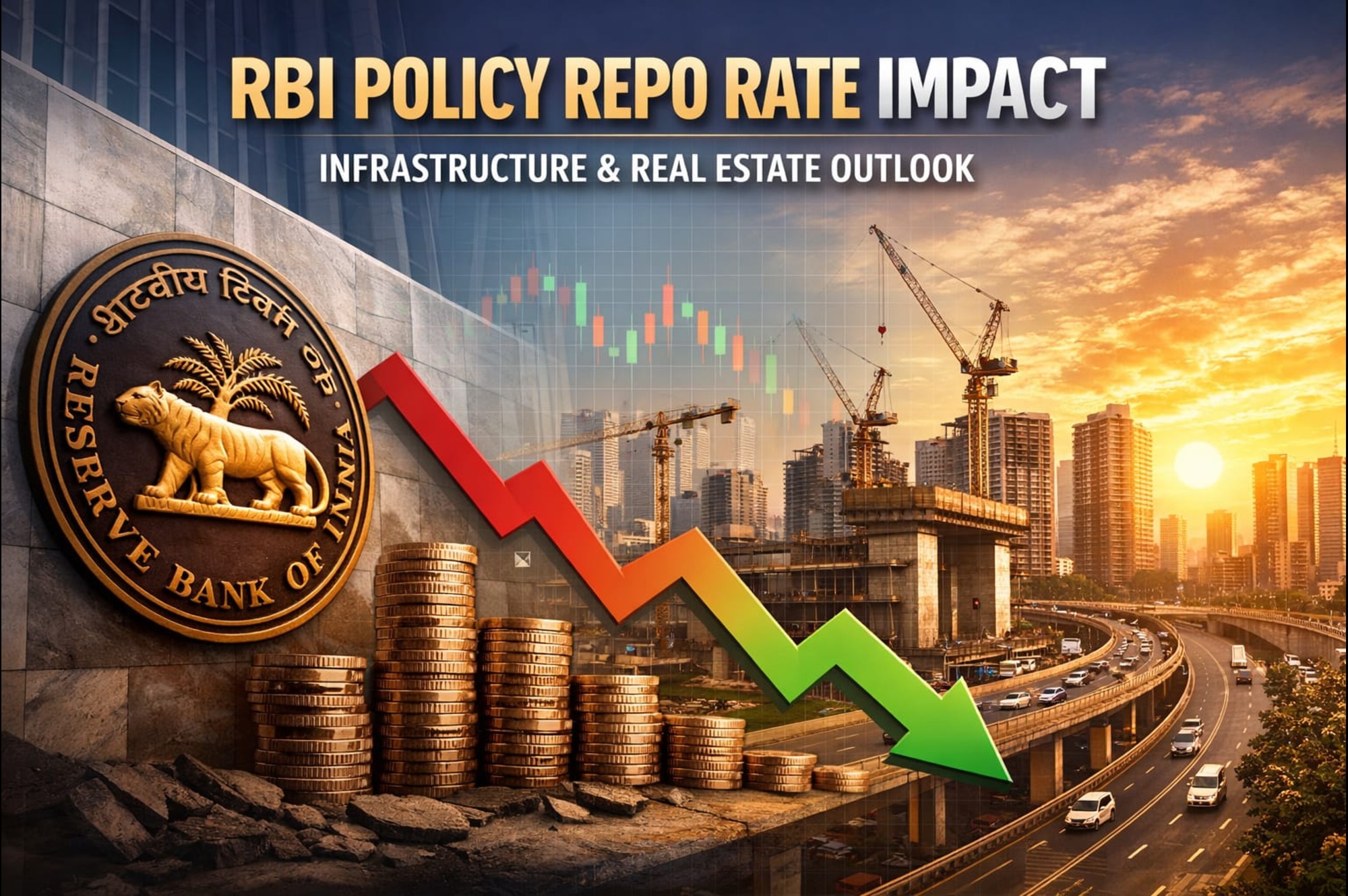
RBI Policy Repo Rate: The Monetary Lever Shaping India’s Infrastructure and Real Estate Trajectory

by Tejasvi Sharma, Editor-in-Chief, EPC World
In the intricate architecture of a nation’s economic framework, few instruments wield as immediate and far-reaching an influence as the policy repo rate determined by the Reserve Bank of India. Often perceived as a technical lever within the domain of monetary policy, the repo rate is, in reality, a decisive force that shapes liquidity, investment appetite, and ultimately, the pace of infrastructure creation and real estate expansion across India.
At its core, the repo rate represents the interest rate at which the central bank lends short-term funds to commercial banks. A calibrated adjustment in this rate transmits through the financial system, influencing borrowing costs, credit availability, and capital allocation. In an economy such as India—where infrastructure development is capital-intensive and real estate is deeply credit-dependent—the implications of repo rate movements are both immediate and structural.
The Repo Rate as a Catalyst of Capital Flow
Infrastructure, by its very nature, demands long-gestation capital. Highways, metro systems, ports, renewable energy parks, and urban infrastructure projects are underpinned by financing structures that rely heavily on debt. A reduction in the repo rate translates into lower lending rates, thereby easing the cost of capital for EPC contractors, developers, and project financiers. This, in turn, enhances project viability and accelerates financial closures.
Conversely, a tightening cycle—marked by repo rate hikes—introduces friction into the system. Borrowing becomes more expensive, internal rates of return (IRR) are compressed, and marginal projects are deferred or shelved. In such an environment, only projects with robust financial structuring and strong balance sheets move forward, leading to a selective, rather than expansive, growth trajectory.
For India, which is currently navigating an ambitious infrastructure pipeline under initiatives such as the National Infrastructure Pipeline (NIP) and Gati Shakti, the repo rate assumes a strategic dimension. A stable or accommodative rate regime not only sustains investor confidence but also enables the government and private sector to maintain momentum in execution.
Transmission to the Real Estate Ecosystem
The real estate sector operates at the intersection of consumer sentiment and credit accessibility. Homebuyers are acutely sensitive to interest rate movements, as even a marginal increase in home loan rates can significantly alter affordability. When the repo rate is reduced, banks typically lower lending rates, thereby stimulating demand in residential real estate.
This demand-side stimulus has a cascading effect. Increased sales velocity improves developer cash flows, enabling them to accelerate construction, reduce inventory overhang, and reinvest in new projects. In metropolitan markets such as Mumbai, Delhi NCR, and Bengaluru, where ticket sizes are substantial, the elasticity of demand to interest rate changes is particularly pronounced.
On the supply side, developers benefit from reduced borrowing costs for project financing. Lower interest outflows improve project economics, allowing for better pricing strategies and enhanced margins. In contrast, a high-interest-rate regime constrains both demand and supply, leading to slower absorption, increased holding costs, and cautious project launches.
Balancing Inflation and Growth
The central bank’s challenge lies in balancing inflation control with growth imperatives. While a lower repo rate stimulates economic activity, it can also fuel inflationary pressures. Conversely, higher rates curb inflation but may dampen investment and consumption.
For the infrastructure sector, which operates on long investment cycles, policy stability is often more critical than the absolute level of interest rates. Predictability in monetary policy enables stakeholders to plan financing structures, hedge risks, and align execution timelines with greater certainty.
Implications for EPC Players and Contractors
For EPC contractors and specialist firms operating in segments such as waterproofing, structural engineering, and construction technologies, the repo rate indirectly influences project flow and payment cycles. A buoyant infrastructure and real estate market translates into higher project volumes, faster decision-making, and improved liquidity across the value chain.
However, in a tightening cycle, contractors often face delayed payments, stretched working capital, and increased financing costs. This underscores the importance of financial discipline, efficient cost management, and strategic client selection in navigating varying interest rate environments.
The Road Ahead: A Strategic Perspective
As India aspires to become a $5 trillion economy, infrastructure and real estate will remain the twin engines of growth. The repo rate, in this context, is not merely a monetary tool but a strategic enabler that can accelerate or moderate this growth trajectory.
A calibrated, forward-looking approach by the central bank—aligned with macroeconomic realities—will be instrumental in sustaining momentum. For industry stakeholders, the imperative is to remain agile, financially resilient, and strategically aligned with policy signals.
Conclusion
The policy repo rate is, in essence, the pulse of India’s economic rhythm. Its movements reverberate through the corridors of finance, construction, and urban development, shaping the contours of the nation’s built environment. For the infrastructure and real estate sectors, understanding and anticipating these shifts is not just prudent—it is indispensable.
In the evolving narrative of India’s growth story, the interplay between monetary policy and physical infrastructure will continue to define both pace and direction. And at the heart of this interplay lies the repo rate—subtle in mechanism, yet profound in impact.
Tags