India–USA Trade Deal: Strategic Convergence or Asymmetric Compromise?

by Tejasvi Sharma, Editor-in-Chief, EPC World
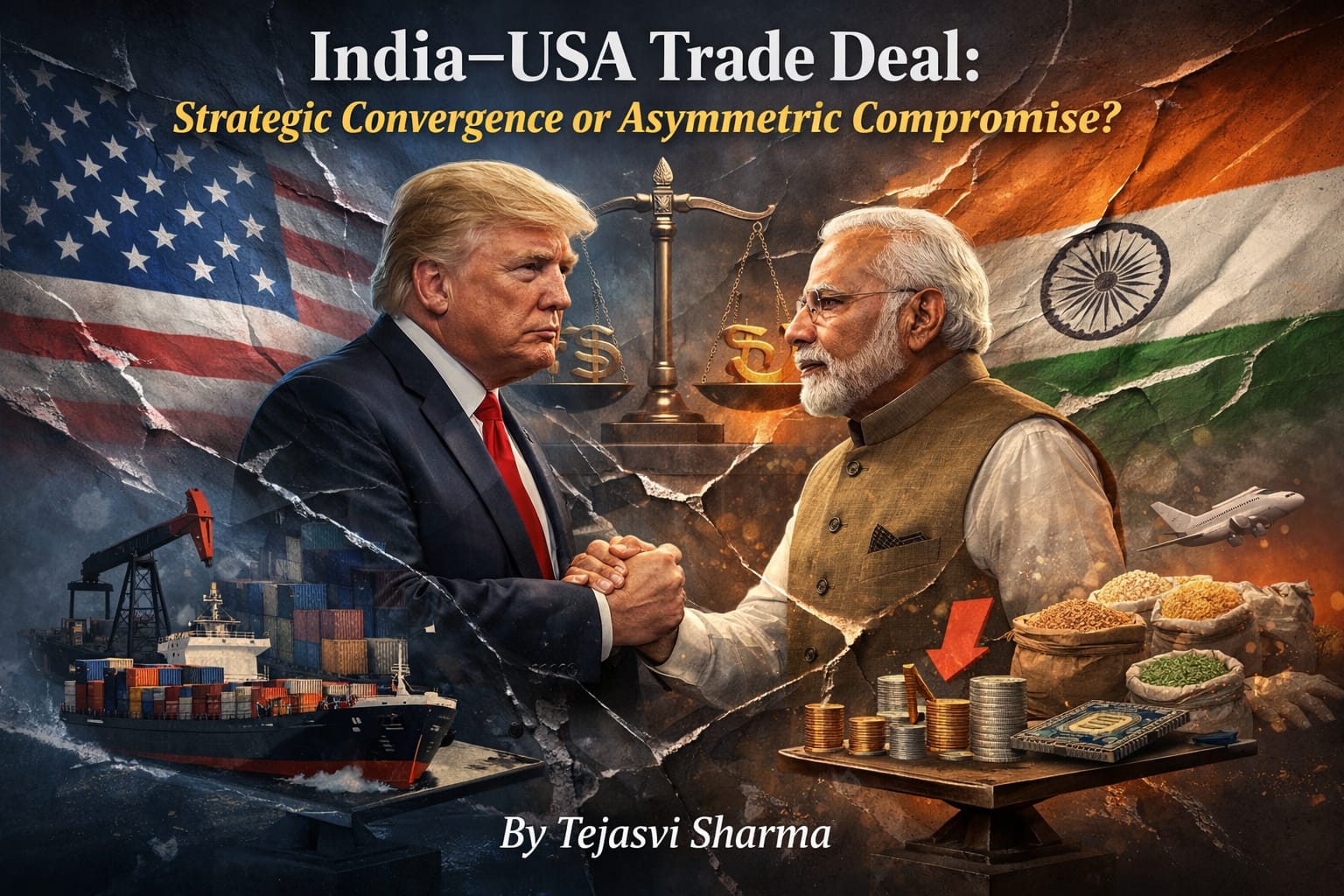
As India and the United States move closer to a recalibrated trade arrangement under a renewed Donald Trump presidency, the debate has sharpened from cautious optimism to uneasy introspection. What began as a discussion on market access and tariff rationalisation has evolved into a far more consequential question: is the emerging India–USA trade deal a marker of strategic convergence between two major democracies, or does it reflect an asymmetric compromise driven by coercive leverage?
At the centre of this debate lies a striking tariff asymmetry. President Trump has announced a reduction of US tariffs on Indian goods to 18 per cent, positioning it as a major concession. Simultaneously, he has publicly asserted that the United States expects zero tariffs from India on American exports – an expectation that has triggered political, economic, and strategic alarm bells in New Delhi. The optics, and perhaps the substance, matter.
The Strategic Promise of the Deal
From a purely economic standpoint, India does stand to gain substantially. The United States remains India’s largest export destination, and even a partial reduction in tariffs can significantly enhance the competitiveness of Indian goods across pharmaceuticals, textiles, engineering goods, auto components, gems and jewellery, and electronics. For India’s services economy—particularly IT, global capability centres, and professional services – greater regulatory predictability and visa facilitation could unlock a new growth cycle amid global slowdown concerns.
More structurally, the deal aligns with a once-in-a-generation realignment of global supply chains. As multinational corporations pursue a “China+1” or “China+many” strategy, India has positioned itself as a democratic, scalable, and geopolitically reliable manufacturing base. A preferential trade framework with the US could accelerate foreign direct investment into semiconductors, defence manufacturing, clean energy equipment, and advanced electronics – complementing India’s Production-Linked Incentive (PLI) schemes and its broader Make in India agenda.
Technology collaboration is another pillar of promise. Artificial intelligence, critical minerals, space technologies, defence platforms, and quantum computing are no longer peripheral sectors; they are the commanding heights of 21st-century power. Enhanced trade-linked technology access could compress India’s learning curve and deepen its role in strategic value chains. In parallel, closer energy cooperation – particularly in LNG, renewables, green hydrogen, and climate finance – offers India a pathway to energy security amid volatile global markets.
In geopolitical terms, a deeper trade partnership with Washington strengthens India’s leverage in global negotiations, from the WTO to bilateral talks with Europe, the UK, and Indo-Pacific partners. Trade, in this sense, becomes an instrument of statecraft rather than mere commerce.
The Tariff Flashpoint: 18 Per Cent vs Zero
Yet it is precisely here that the unease begins. President Trump’s framing of the tariff outcome has been unapologetically transactional. The reduction of US tariffs to 18 per cent has been presented not as mutual liberalisation, but as a concession extracted through pressure – following a phase where Indian goods faced sharply elevated duties. In return, the expectation of zero tariffs from India represents a far steeper and more immediate concession than India has historically offered even in comprehensive free trade agreements.
This asymmetry raises a fundamental question: if trade is reciprocal, why does one side retain an 18 per cent tariff wall while the other is expected to dismantle its barriers entirely?
Critics argue that this dynamic resembles negotiation under duress rather than strategic partnership. The sequencing matters. Elevated tariffs were imposed first, followed by partial relief contingent on broader Indian concessions – not only on trade, but on energy sourcing, regulatory norms, and strategic alignment. Such a pattern risks setting a precedent where economic pressure becomes a routine tool of diplomacy.
What India Risks Losing
The most immediate risk is policy autonomy. Zero-tariff access for US goods could constrain India’s ability to nurture domestic industry, particularly in capital-intensive sectors where American firms enjoy overwhelming scale and technological advantage. Intellectual property regimes, government procurement rules, and digital trade disciplines may further narrow India’s regulatory space at a stage when its industrial base is still maturing.
Agriculture remains a political and economic red line. Any dilution of protections – especially involving subsidised US farm produce or sensitive segments like dairy and genetically modified crops – could have destabilising consequences for livelihoods and food security. Similarly, India’s MSME sector, the backbone of employment, may struggle to compete without calibrated safeguards and transition periods.
Digital sovereignty presents another fault line. India views data as a strategic resource underpinning its fintech revolution, digital public infrastructure, and national security architecture. US opposition to data localisation and platform regulation places these priorities under pressure. A trade deal that weakens India’s control over its digital ecosystem could have consequences far beyond commerce.
There is also the macroeconomic risk of widening trade imbalances. Greater openness without commensurate export competitiveness in high-technology and capital goods could deepen deficits, making India more import-dependent in precisely the sectors it seeks to indigenise.
Finally, there is the geopolitical cost. India’s foreign policy has long rested on strategic autonomy—engaging all major powers without becoming beholden to any. If trade concessions become linked to alignment on third-country relationships or energy choices, that autonomy risks erosion.
Has India Surrendered?
To frame the issue bluntly: India has not “surrendered” in the literal sense, but it is undeniably negotiating from a position shaped by external pressure. The danger lies not in compromise – every trade deal involves one – but in normalising asymmetry as the price of access.
The India–USA trade deal should be judged not by headline tariff cuts, but by its architecture: phased liberalisation, protection of sensitive sectors, enforceable technology-transfer provisions, and clear red lines on sovereignty. Trade policy is industrial policy by other means, and industrial policy is national strategy in economic form.
In an era defined by geo-economics, the true test of this deal will not be how quickly it is signed, but how intelligently it is structured—and whether India can secure growth, resilience, and strategic independence without trading one for the other.
Tags
Related Posts