Deccan Gold Reports Encouraging Nickel-Copper-PGE Exploration Results in Chhattisgarh

Deccan Gold Mines has reported an encouraging milestone at its Bhalukona Nickel-Copper-Platinum Group Elements (Ni-Cu-PGE) project in Chhattisgarh, with preliminary geological modelling of exploration drilling data indicating the potential for over 4 million tonnes of mineralisation grading approximately 0.24% nickel equivalent (Ni_Eq).
Significantly, the preliminary estimates cover only near-surface mineralisation across approximately 300–350 metres of the 1.3-km mineralised corridor identified at Bhalukona. They do not account for potential repetitions of the mineralised sequence indicated by drone magnetic and induced polarisation (IP) surveys, suggesting further exploration potential across the project area.
The modelling represents an important step in understanding the scale and geological characteristics of the Bhalukona deposit. The estimated nickel-equivalent grade is based on the weighted contribution of nickel, copper, platinum, and palladium mineralisation.
Commenting on the development, Dr. Hanuma Prasad Modali, Managing Director, Deccan Gold Mines, said, “India’s critical-minerals ambitions will ultimately be determined not just by the resources we know we possess, but by our ability to discover, evaluate and responsibly develop them. Bhalukona is an encouraging milestone in our effort to unlock India’s domestic critical-mineral potential. The preliminary modelling points to a promising nickel-copper-PGE system, with the current estimates covering only a fraction of the identified mineralised corridor. India’s resource security will depend on our ability to discover and responsibly develop strategic mineral resources at home. Our focus is to advance Bhalukona through science-led exploration, technical rigour, and long-term commitment, contributing to a stronger domestic mining ecosystem and more resilient critical-mineral supply chains.”
Systematic Exploration Establishes a Promising Geological Footprint
Deccan Gold was among the early companies to receive a nickel exploration licence in India, with the Government of Chhattisgarh executing the Bhalukona–Jamnidih Composite Licence in favour of the Company on April 1, 2025.
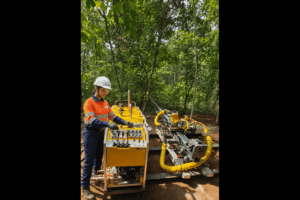
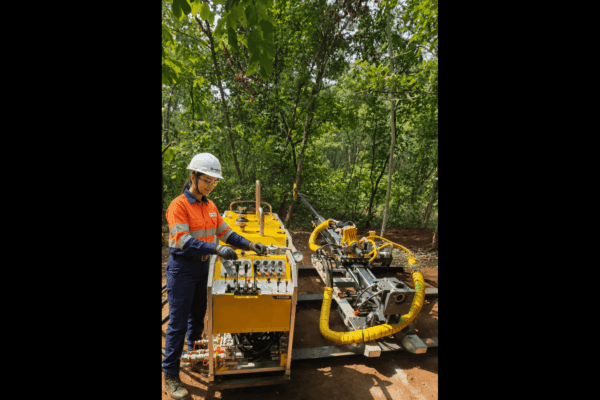
Covering approximately 30 sq. km in Basana Tehsil, Mahasamund District, Chhattisgarh, the project has undergone a staged exploration programme over the past 19 months. The programme has included drone magnetic and LiDAR surveys, deep IP surveys, electrical resistivity tomography, geological mapping, rock-chip and channel sampling, and bulk sampling for beneficiation studies. Since March 2026, the Company has also undertaken a diamond-core drilling programme comprising 15 drill holes totalling 2,773 metres.
The exploration work has identified a layered mafic-ultramafic geological formation hosting nickel-copper-PGE sulphide mineralisation. Drilling has established a mineralised corridor more than 100 metres wide, extending approximately 1.3 km in length and to depths exceeding 200 metres.
The mineralisation includes disseminated as well as heavy-to-massive sulphide occurrences, with the principal sulphide minerals identified as pyrrhotite, pentlandite and chalcopyrite. These are associated with nickel and copper mineralisation, alongside palladium and localised platinum occurrences.
Further Exploration to Assess the Full Potential
The preliminary geological interpretation provides a strategic direction for the Company’s next phase of exploration. The current model covers only approximately 25% of the identified mineralised corridor and does not include potential repetitions of the mineralised sequence suggested by geophysical surveys.
The Company will continue to evaluate the geological data and use the results of its exploration programme to guide further work and assess the extent and continuity of the mineralised system.
The figures represent preliminary exploration-stage interpretations and do not constitute a defined mineral resource or mineral reserve. Further exploration, geological evaluation, and technical assessment will be required to establish the scale, continuity, and economic potential of the mineralisation.