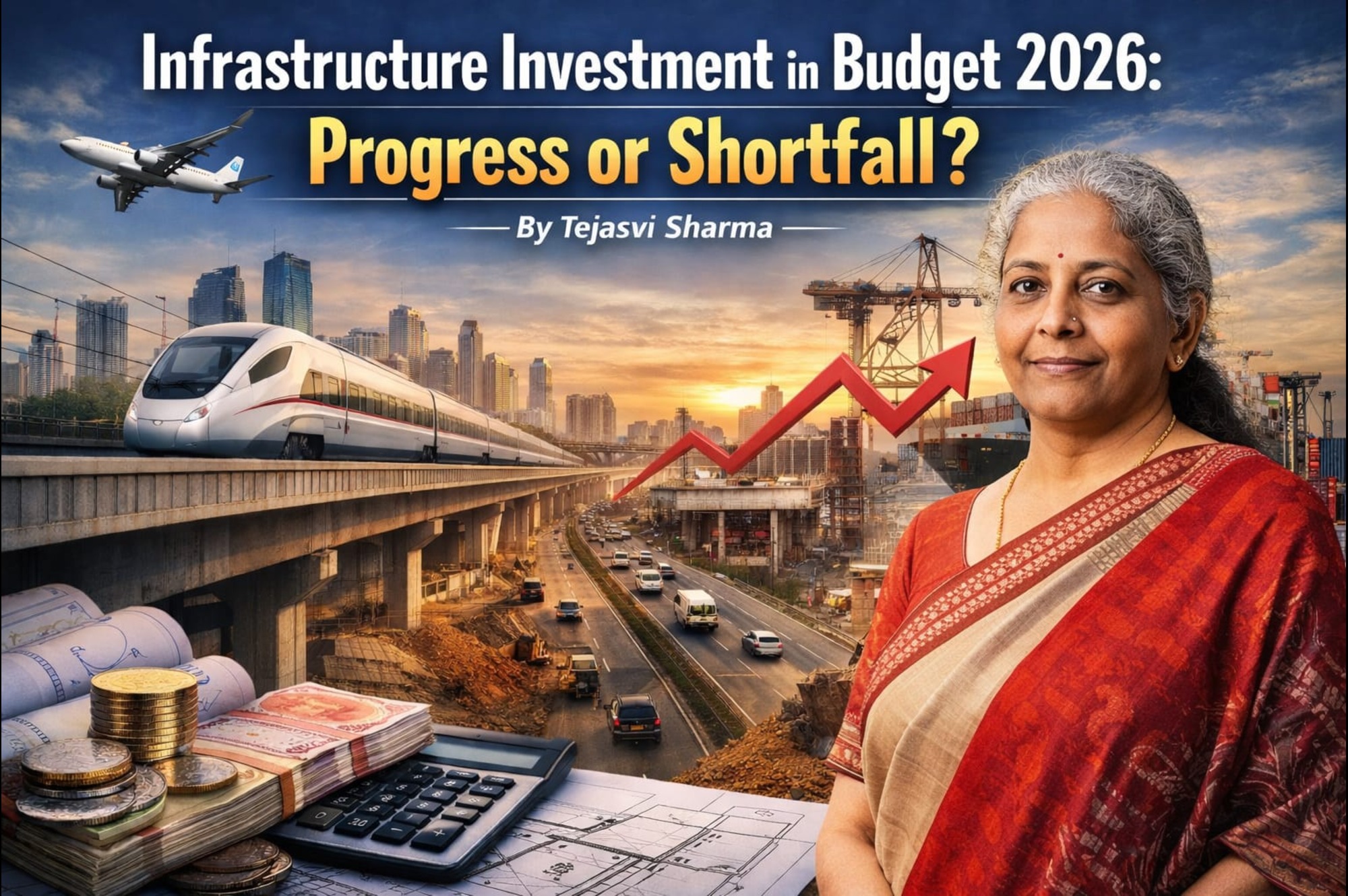
Budget 2026 and the Politics of Asphalt, Steel, and Credibility

by Tejasvi Sharma, Editor-in-Chief, EPC World
India’s Union Budget for FY2026–27 has once again chosen a familiar, almost doctrinal leitmotif: public capital expenditure (capex) as the sovereign’s most persuasive instrument of macroeconomic choreography—a lever to crowd in private investment, compress logistics friction, and render “Viksit Bharat 2047” less a slogan than a construction schedule. The headline number is unambiguous: public capex is proposed at ₹12.2 lakh crore, up from ₹11.2 lakh crore in the Budget Estimates (BE) of FY2025–26.
Yet, budgets are not merely arithmetic; they are intentions with paperwork. And the more incisive question is not whether the allocation is large—by any historical yardstick it is—but whether it is sufficient, given last year’s execution constraints, state-level absorption capacity, and the widening ambition of India’s infrastructure narrative (green logistics, multimodal corridors, urban clustering, resilient assets, and future-ready mobility).
The Comparison that Matters: Allocation versus Absorption
On paper, the year-on-year step-up from ₹11.2 lakh crore to ₹12.2 lakh crore is a clear signal of continuity: the Centre is unwilling to relinquish the capex-led growth paradigm even as it pursues fiscal consolidation (with the fiscal deficit in BE 2026–27 stated at 4.3% of GDP).
However, last year’s story carries an inconvenient footnote: revised estimates (RE) indicate capex undershooting. The Centre’s public capex for FY2025–26 is reported at ₹10.95 lakh crore (RE) versus ₹11.21 lakh crore (BE)—a slippage that is not catastrophic, but is directionally revealing.
In the same vein, capital grants to states for asset creation (a crucial pipeline for roads, water supply, schools, hospitals, irrigation—i.e., the “everyday infrastructure” that converts budgets into lived experience) reportedly fell sharply in RE to about ₹3.08 lakh crore, from ₹4.27 lakh crore allocated earlier.
This is the crux: India does not merely need higher allocations; it needs higher throughput—faster DPR finalisation, tendering velocity, dispute minimisation, land acquisition de-risking, and contractor cashflow hygiene. In the absence of that administrative kinetic energy, even a monumental capex figure becomes a rhetorical monolith—grand, impressive, and partially inert.
Where Budget 2026 Is Trying to Be “Future-Ready”
Budget 2026–27 does not present infrastructure as a monolithic “roads-and-bridges” ledger; it frames it as a systems problem: logistics efficiency, modal shifts, and economic clustering.
Among the more consequential proposals:
- Seven high-speed rail corridors positioned as “growth connectors” (inter-city mobility as productivity infrastructure, not merely passenger convenience).
- A new Dedicated Freight Corridor (Dankuni to Surat) and the operationalisation of 20 new National Waterways over five years—an explicit attempt to rebalance India’s freight economy away from the tyranny of truck-dependent logistics.
- A Coastal Cargo Promotion Scheme designed to incentivise modal shift and raise inland/coastal shipping share over the long arc to 2047—aligned with “green logistics” and lower-carbon freight intensity.
- A proposed Infrastructure Risk Guarantee Fund, offering partial credit guarantees to lenders—arguably one of the most market-literate interventions in the package, because it targets the quiet villain of Indian infrastructure: construction-phase risk and the resulting risk-premium spiral.
- The conceptual move toward City Economic Regions (CERs)—with ₹5,000 crore per CER over five years—suggesting that urban infrastructure will increasingly be judged by agglomeration dividends: productivity density, transit accessibility, and service-sector scalability.
If one were to summarise the Budget’s infrastructure doctrine in trending keywords, it would read like a strategic brief: PM Gati Shakti, multimodal connectivity, logistics efficiency, urban transformation, capex push, PPP revival, asset monetisation (REITs/InVITs), climate resilience, and future-ready infrastructure.
Is the Allocation Sufficient?
Numerically, it is substantial. Structurally, it is necessary. Practically, it is conditionally sufficient.
It is necessary because India’s growth aspirations cannot be sustained on consumption sentiment alone; they require productive capacity—ports that clear faster, rail that hauls cheaper, cities that commute smoother, and power systems that remain stable while decarbonising.
The Budget’s emphasis on freight corridors, waterways, and risk guarantees reflects an understanding that the next tranche of competitiveness will be earned in logistics latency and cost-of-doing-business compression, not in rhetorical exuberance.
But it is only sufficient if three execution realities improve:
- State capacity and disbursement discipline: last year’s RE compression in capital grants to states signals that planning bandwidth and project readiness are not uniformly mature.
- Contract enforcement and dispute minimisation: India’s infra engine is often throttled not by money, but by arbitration drag, scope creep, and payment gridlocks—capital locked in claims is capital not building assets.
- Private capital crowd-in: the Budget’s risk guarantee architecture is promising, but it must translate into lower financing spreads and faster financial closures.
So, Budget 2026’s infrastructure allocation is best read as a credibility wager: the Centre is betting that bigger capex, smarter risk-sharing, and multimodal intent will produce a compounding dividend. The wager can be won—but not by money alone. In India’s infrastructure theatre, the true differentiator is not the size of the script; it is the discipline of the stagecraft.
Tags
Related Posts