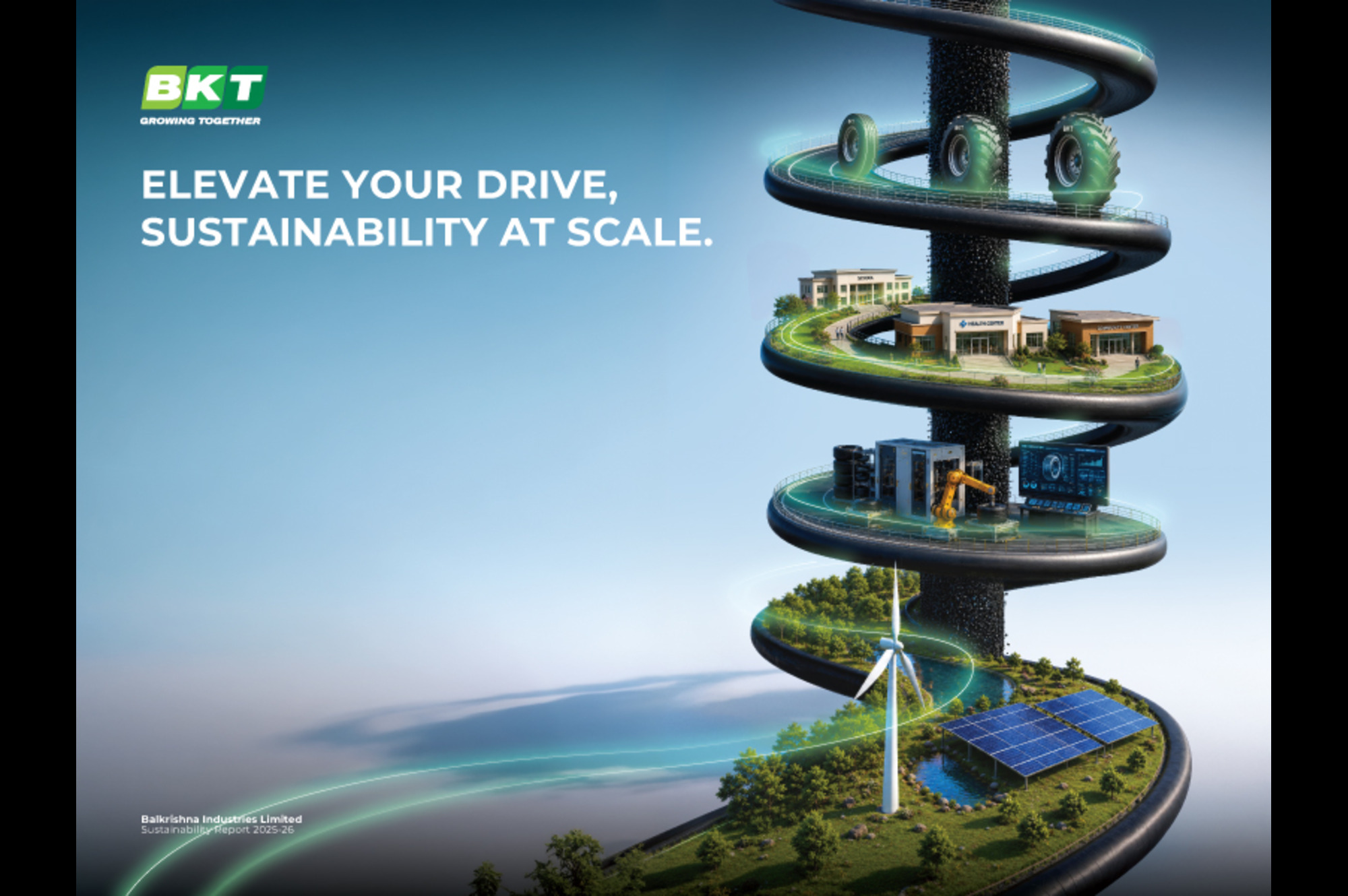
BKT’s 2025-26 Sustainability Report Highlights Innovation, Governance and Responsible Industrial Growth

An industrial growth strategy increasingly focused on responsible resource management, technological innovation, and long-term value creation. This is the vision that emerges from the new 2025-26 Sustainability Report by Balkrishna Industries (BKT), one of the world’s leading Off-Highway tire manufacturers.
The report entitled Elevate your drive, sustainability at scale illustrates how BKT is integrating environmental, social, and governance criteria in an increasingly structured manner into its industrial and strategic decisions—from product design to plant management, and in its relationships with suppliers, employees, and communities.
The document marks a significant evolution in the company’s sustainability journey, introducing for the first time a Double Materiality Assessment—an analysis that evaluates the impacts of the corporate activities on the environment and society, as well as the risks and opportunities that sustainability factors present for the business.
The analysis, developed through stakeholder engagement and integrated into strategic and risk management processes, represents a further step toward a governance model focused on performance measurement, transparency, and long-term value creation.
“BKT’s international growth entails ever-greater responsibilities toward our customers, partners, and the communities in which we operate,” stated Rajiv Poddar, Joint Managing Director, BKT. “The new Sustainability Report reflects our commitment to supporting this growth through a solid industrial strategy, in which innovation, responsibility, and the ability to create long-term value are the guiding principles behind our decisions.”
Innovation and Sustainability: From Research to The Product Life-Cycle
A key aspect that emerges from the new report is the role of research and development in the evolution of BKT’s sustainability strategy.
|
During the two-year periods 2024–25 and 2025–26, the company conducted life cycle assessments (LCA) on six products that are representative of its industrial operations, covering different tire categories and carbon black.
The assessments, which were developed in accordance with the international ISO 14040 and ISO 14044 standards and independently verified by external parties, enable the analysis of environmental impacts across the several stages of the product life-cycles, providing useful information to guide future design choices, the use of raw materials, and production processes.
This approach reflects BKT’s commitment to strengthening the relationship between technical performance, industrial quality, and resource efficiency through increasingly structured analytical tools.
Decarbonization: Measurable Goals and Investments in Energy Transition
From a climate perspective, BKT has formally committed to achieving Net Zero for Scope 1 and Scope 2 emissions by 2050 through a decarbonization roadmap that includes energy efficiency measures, an increase in renewable energy sources, and the transition to new fuels used in production processes.
As part of its interim targets, the company aims to achieve a reduction of 25 % within the intensity of Scope 1 and 2 emissions per metric ton of production by 2030, compared to the 2023–24 fiscal year.
In 2025–26, Scope 1 and Scope 2 emission intensity fell from 1.58 to 1.56 tCO₂e per metric ton produced. During the same period, energy efficiency initiatives and the use of renewable energy sources resulted in the avoidance of approximately 10,654 metric tons of CO₂ equivalent.
Another significant achievement relates to the energy consumption from renewable sources and biomass, which amounted to 74,945 GJ, i.e. a 107 % increase compared to the previous fiscal year.
The proportion of renewable electricity in total electricity purchased rose to 10.33 %, as part of a plan to reach 20 % by 2030.
“Managing climate risks requires a rigorous approach based on data, measurable objectives, and increasing integration across different business functions,” commented Dr. Anurrag Khandelwal, General Manager – ESG at BKT. “Our efforts focus on strengthening monitoring systems, improving process efficiency, and assessing environmental impacts, so that industrial decisions are supported by increasingly comprehensive and reliable information.”
Resource Efficiency, Safety, And Social Responsibility
Water management is another key area of BKT’s strategy, particularly in the light of production facilities that are located in areas subject to water stress.
During the 2025–26 fiscal year, the company recovered and fed back over 1.05 million kiloliters of treated wastewater into its production processes, thus continuing the expansion of its Zero Liquid Discharge (ZLD) systems. These systems are already operational at the Bhuj and Waluj production plants, while implementation is still underway at the Bhiwadi and Chopanki facilities.
In terms of circular economy, 94.7 % of the generated waste was either recycled or reused, avoiding disposal in landfills.
The company’s focus on people is reflected in the results achieved in the areas of safety, training, and inclusion. Throughout the year, BKT recorded zero fatalities, zero lost-time accidents, and zero reportable accidents among employees and workers.
These achievements were complemented by over 340,000 hours of training and a 35 % increase in the number of permanent women employees compared to the previous year.
The commitment to communities also takes shape in investments amounting to 42.64 crore INR—equivalent to 426.4 million rupees—allocated to Corporate Social Responsibility initiatives in the areas of education, health, food security, rural development, and environmental protection.
Transparency And Independent Assessments
The strengthening of governance and measurement processes is also reflected in the external ESG assessments.
In fiscal year 2025–26, BKT achieved an EcoVadis Score of 70, compared to 57 in the previous year, and an S&P Global ESG Score of 58, compared to the previous score of 53.
The Sustainability Report also includes information that has been independently verified by Bureau Veritas (India) Private Limited, in accordance with the AA1000AS Version 3, Type 2, High Assurance standard.
These tools help enhance the transparency of information and the comparability of corporate performance in an international context where customers, industry partners, and stakeholders place increasing importance on the quality of governance systems and the reliability of ESG information.
“For BKT, resilience and sustainability are part of the same industrial vision,” stated Arvind Poddar, Chairman and Managing Director, BKT. “Our ambition is to build an increasingly sound organization, which is able of combining growth, quality, and innovation with responsible resource management. We strongly believe that long-term competitiveness is based on our capability to continuously improve our products, industrial processes, and the standards that guide our operations.”
Through its 2025–26 Sustainability Report, BKT thus continues to strengthen an industrial model in which sustainability becomes a concrete criterion for management and development, supported by measurable objectives, technological investments, and increasingly structured level of governance.