
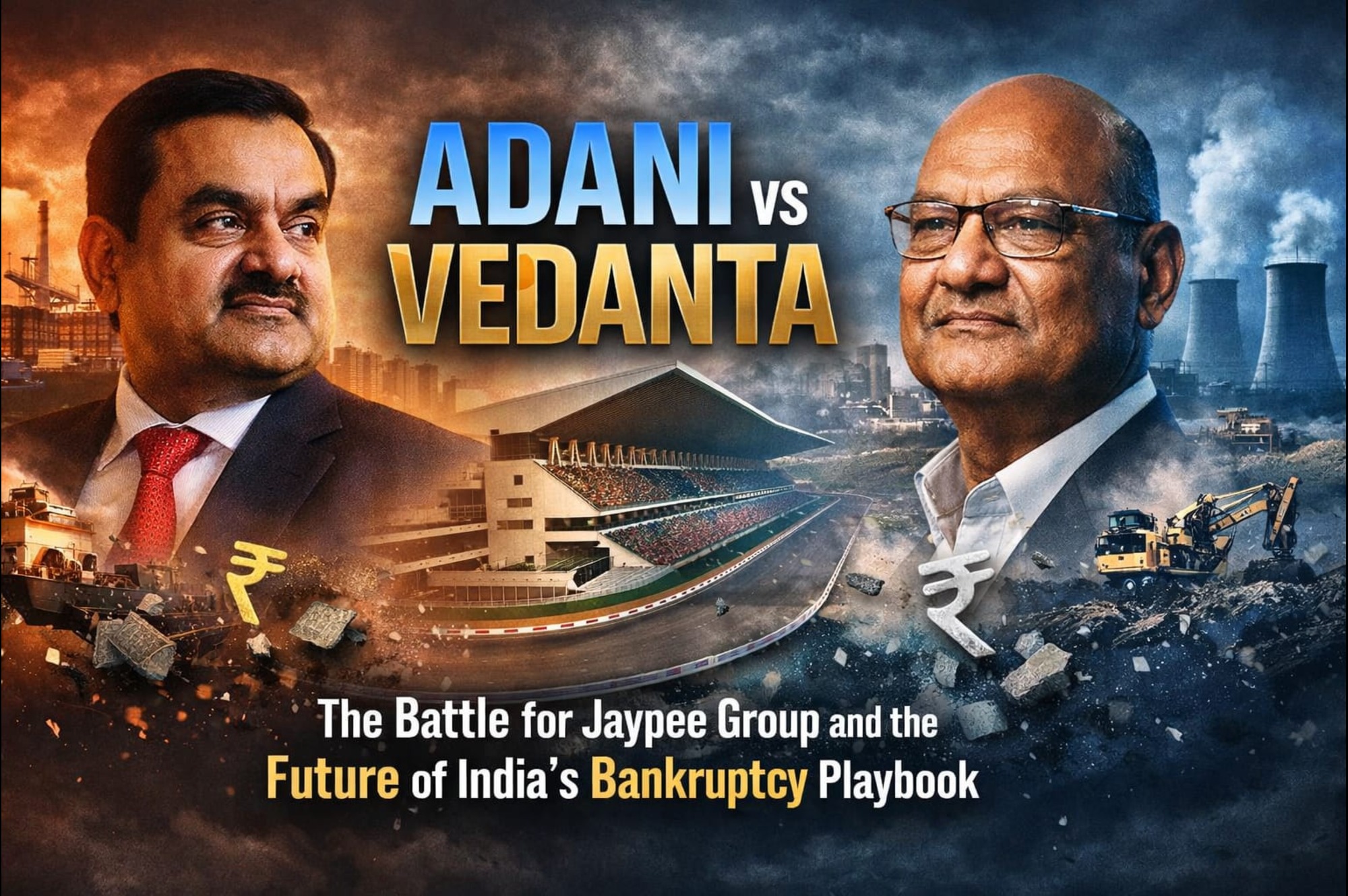
Adani vs Vedanta: The High-Stakes Battle for Jaypee Group That Could Redefine India’s Bankruptcy Playbook

by Tejasvi Sharma, Editor-in-Chief, EPC World
A Corporate Battle Beyond Numbers
India’s infrastructure sector is witnessing one of its most intense corporate confrontations in recent years. The fight between the Adani Group and the Vedanta Group to acquire the distressed assets of the Jaypee Group has evolved into far more than a bankruptcy resolution.
It is now a defining test of how India evaluates value, risk, and credibility in large-scale insolvency cases.
From Infrastructure Titan to Insolvency Case
There was a time when Jaypee Group represented the scale and ambition of India’s infrastructure boom. With expressways, cement plants, real estate developments, and the iconic Buddh International Circuit under its portfolio, it stood as a symbol of integrated infrastructure growth.
However, aggressive expansion funded by heavy debt eventually led to financial distress. By the time Jaiprakash Associates Ltd. entered insolvency proceedings, creditor claims had crossed ₹57,000 crore.
Yet, despite its financial collapse, Jaypee remained asset-rich—making it one of the most sought-after distressed opportunities in India.
Why Jaypee Still Matters
Even in distress, Jaypee offers a rare combination of strategic assets:
- Cement plants aligned with India’s infrastructure growth
- Prime land banks in high-potential urban corridors
- Power and industrial assets
- Hospitality and commercial developments
- Buddh International Circuit, a unique global-standard asset
For large conglomerates, this is not just acquisition—it is strategic expansion.
Two Bidders, Two Strategies
Adani Group: Building a Larger Ecosystem
Led by Gautam Adani, the Adani Group has built its growth model on integration.
Jaypee fits into multiple verticals:
- Strengthening cement and construction materials
- Expanding real estate and urban infrastructure footprint
- Leveraging land assets for long-term development
- Enhancing infrastructure ecosystem synergies
Adani’s approach is clear: acquire, integrate, and scale.
Vedanta Group: Unlocking Distressed Value
Under Anil Agarwal, Vedanta has historically focused on value-driven acquisitions.
Its strategy for Jaypee:
- Acquire undervalued assets
- Unlock hidden potential
- Optimise long-term returns
- Monetise non-core assets
Vedanta’s bid was widely reported to be higher in overall valuation—making its rejection the centre of controversy.
Why Adani Won the Bid
Despite Vedanta’s higher offer, lenders approved Adani’s resolution plan of approximately ₹14,500 crore.
The key differentiator was not valuation—but structure.
Adani’s bid offered:
- Higher upfront payment
- Faster recovery timeline
- Lower execution risk
- Fewer conditionalities
Vedanta’s proposal, although financially stronger on paper, involved payments spread over a longer period.
Key Insight
In insolvency, certainty often outweighs valuation.
For lenders fatigued by delays, faster recovery becomes more valuable than higher long-term returns.
The Legal Battle Intensifies
The story did not end with creditor approval.
Vedanta has challenged the decision, escalating the matter to the National Company Law Tribunal (NCLT).
Its arguments include:
- Its revised bid offered significantly higher value
- The evaluation process lacked transparency
- The principles of value maximisation were not upheld
Meanwhile, Adani is defending its position based on:
- Strong creditor backing
- Compliance with insolvency procedures
- Execution certainty
This has transformed the deal into one of the most closely watched corporate legal battles in India.
What This Means for India’s Insolvency Framework
The Jaypee case raises critical questions:
- Should the highest bidder always win?
- Or should execution certainty and speed take priority?
- How should lenders balance risk vs reward?
India’s Insolvency and Bankruptcy Code (IBC) is designed to maximise value—but this case highlights how “value” can be interpreted differently.
Market Perspective: Opportunity vs Risk
For Adani Group
- Strategic expansion across infrastructure and real estate
- Strong synergy potential
- But integration complexity and legal overhang
For Vedanta Group
- Aggressive capital deployment strategy
- Demonstrates acquisition appetite
- Raises questions on capital allocation discipline
Markets are watching not just the outcome—but the process.
A Turning Point for Corporate India
The Jaypee battle reflects a broader shift:
From leveraged expansion to disciplined, integrated growth
- Old model: Rapid diversification funded by debt
- New model: Strategic acquisitions with execution focus
Adani represents the new-age integrated infrastructure platform.
Vedanta represents opportunistic value-driven expansion.
Both are relevant—but only one will prevail in this case.
Conclusion: Defining Victory in Modern Capitalism
The battle for Jaypee is not just about acquiring assets.
It is about redefining how India measures success in distressed acquisitions.
- Is victory the highest bid?
- Or the most executable plan?
As the case unfolds in court, one thing is already clear:
India’s next phase of infrastructure capitalism will be shaped not just by capital—but by credibility, speed, and the ability to deliver.
EPC World Insight
For the EPC and infrastructure ecosystem, this case will influence:
- Future bidding strategies
- Structuring of resolution plans
- Lender decision frameworks
- Investor confidence in insolvency processes
Because in today’s infrastructure economy:
Owning assets is important.
But convincing stakeholders that you can transform them—that is power.
Tags
Related Posts